Bangladesh's proposed $2.8 billion Padma Barrage aims to mitigate dry-season water scarcity and offset India's Farakka Barrage diversions. As the 1996 Ganges Treaty nears its 2026 expiration, the mega-project raises Indian flood concerns, highlighting the urgent need for basin-wide hydro-diplomacy.
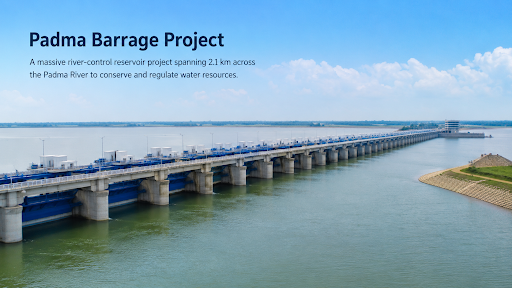
Bangladesh approves the $2.8 billion Padma Barrage project to mitigate dry-season water scarcity, ahead of the December 2026 expiration of the 1996 India-Bangladesh Ganges Water Treaty.
Bangladesh constructs the barrage at Pangsha Upazila in the Rajbari district, situated 180 km downstream of India’s Farakka Barrage.
Infrastructure: The 2.1-kilometre-long structure features 78 spillways, 18 undersluice gates, fish passes, and navigation locks.
Storage Capacity: The reservoir holds 2,900 million cubic metres (MCM) of freshwater, extending 165 kilometres upstream.
Financial Outlay: The Bangladesh Delta Plan 2100 allocates Tk 50,443 crore (approx. $5.15 billion) for a seven-year execution timeline.
Hydropower: Integrated plants at the Padma site and Gorai off-take generate 113 Megawatts (MW) of electricity.
Hydrological Network: The river originates at Devprayag as the Ganga, enters Bangladesh at Shibganj as the Padma, and merges with the Jamuna and Meghna rivers before reaching the Bay of Bengal.
Agricultural Dependency: The basin supports 4.6 million hectares of agricultural land, serving as the primary freshwater source for southwestern Bangladesh.
Ecological Role: Freshwater flow maintains the salinity balance of the Sundarbans, protecting the Royal Bengal Tiger habitat and supporting 15 million forest-dependent people.
Sedimentation: The river transports 500 to 700 million tons of sediment annually; reduced dry-season flows accelerate riverbed siltation and flood risks.
1996 Treaty: The 30-year Ganges Water Treaty guarantees 35,000 cusecs of water to each nation in alternating 10-day periods during the dry season.
Joint Rivers Commission (JRC): Established in 1972, the JRC manages 54 transboundary rivers through technical coordination and data exchange.
Farakka Dispute: India operates the Farakka Barrage (commissioned 1975) to divert up to 40,000 cusecs for the Kolkata Port, which Bangladesh cites as a cause for salinity intrusion and groundwater depletion.
Multilateral Need: Experts advocate for including Nepal, which contributes 70% of the Ganges' dry-season flow, into basin management frameworks.
Agricultural Yields: The project irrigates an additional 2.88 million hectares and increases annual rice production by 2.39 million tonnes.
Food Security: Regulated flows support a projected increase of 2.34 million tonnes in annual fish production.
Regional Development: The barrage revives five dead river systems and secures water for the Rooppur Nuclear Power Plant.
Climate Resilience: The reservoir acts as a buffer, storing monsoon bursts to mitigate both flooding and drought.
Geopolitical Anxiety: Bangladesh’s potential reliance on Chinese funding for the project alarms New Delhi, given Beijing’s existing influence in the Brahmaputra and Mekong basins.
Environmental Risks: Mega-dams threaten Hilsa breeding cycles and trap fertile silt, potentially worsening land subsidence in the delta.
Seismic Vulnerability: The Bengal basin faces high seismic risks, raising concerns regarding the structural integrity of the 2,900 MCM reservoir.
Transboundary Governance: India expresses concerns over potential backwater flooding in West Bengal and Bihar and demands joint hydrological modeling.
Benefit-Sharing Model: Both nations should adopt the Sadoff & Grey framework, shifting from volume-based disputes to sharing economic benefits like hydropower and navigation.
Sub-Regional Integration: Policymakers must leverage the BBIN (Bangladesh, Bhutan, India, Nepal) initiative to create an integrated energy and transit grid.
Institutional Reform: Governments should elevate the JRC from an advisory body to a legally binding regulatory authority.
Cooperative Investment: India should consider co-financing the project to dissolve security anxieties and ensure transparent, joint operation.
To secure the Ganges-Padma basin, India and Bangladesh must move beyond zero-sum water sharing and adopt a collaborative, benefit-sharing model before the 1996 treaty expires in 2026.
Source: THEHINDU
|
PRACTICE QUESTION Q. Consider the following statements regarding the Padma Barrage and transboundary rivers:
Which of the statements given above is/are correct? (a) 1 and 2 only (b) 3 only (c) 2 and 3 only (d) 1, 2, and 3 Answer: (b) Explanation: Statement 1 is incorrect: The proposed Padma Barrage is an initiative planned to be constructed downstream of the Farakka Barrage (inside Bangladesh). Its primary objective is to act as a large reservoir to store water for the dry months and to mitigate the effects of the water diverted by India's Farakka Barrage, rather than to control floodwaters entering the country. Statement 2 is incorrect: The 1996 Ganges Water Sharing Treaty does not guarantee a fixed volume of water throughout the year. Instead, it operates on an equitable, need-based sharing formula that fluctuates depending on the seasonal availability of water during the dry season (January to May). Statement 3 is correct: The Indo-Bangladesh Joint Rivers Commission (JRC) was established in 1972 to facilitate cooperation and manage issues concerning the 54 transboundary rivers shared between the two nations. |
The Padma Barrage project is a massive, multi-billion dollar river-control reservoir initiative featuring a 2.1-km-long concrete infrastructure spanning the Rajbari district to systematically harvest, conserve, and regulate water resources.
The project links directly to the Ganga River because it is being constructed across the Padma River, which serves as the principal downstream international distributary of the Ganges after it crosses the border from India into Bangladesh.
The barrage is highly critical for Bangladesh because it impounds 2.9 billion cubic meters of monsoon water to mitigate severe dry-season water scarcity, counter dangerous salinity intrusion in the Sundarbans, and secure vital irrigation for 2.88 million hectares of farmland.
The project carries major implications for India as it acts as a strategic downstream geopolitical counterweight to India's Farakka Barrage, directly impacts bilateral hydropolitics right as the 1996 Ganga Water Sharing Treaty expires in December 2026, and risks introducing complex Chinese engineering partnerships into India's border zone.


© 2026 iasgyan. All right reserved