Social media platforms face increasing automated censorship pressures in India under amended IT Rules and the Sahyog portal. Shrinking safe harbour protections and expedited takedown mandates risk bypassing judicial safeguards, threatening constitutional freedom of speech and expression.
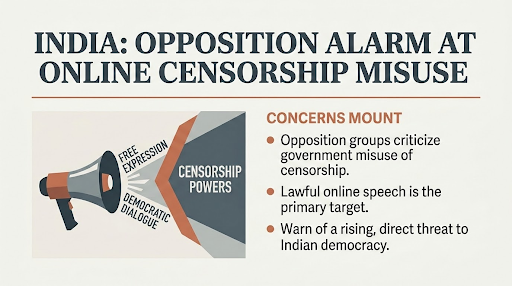
Opposition parties criticised the government for misusing censorship powers against lawful online speech as a rising threat to Indian democracy.
Online censorship refers to government or state interventions that restrict the fundamental right to freedom of speech and expression on digital platforms.
It involves the systematic removal, hiding, or blocking of public access to online information, user accounts, and media outlets.
It also extends to "prior restraint," where content is subjected to verification, labeling, or modification requirements before it is allowed to circulate.
National Security and Sovereignty: Content that threatens the defense, integrity, and sovereignty of India, or impacts friendly relations with foreign states, is subject to blocking orders.
Public Order and Safety: Content that may incite violence, communal disharmony, or disrupt public order is restricted to prevent real-world harm.
Protection of Vulnerable Groups: Strict measures are in place to remove Child Sexual Abuse Material (CSAM) and content that violates the dignity of women, such as non-consensual intimate imagery or "morphed" photos.
Curbing Misinformation: To combat the "persistent spread of fake news" and, more recently, AI-generated deepfakes that could influence elections or damage reputations.
Enforcing Judicial Orders: Platforms must comply with court-mandated takedowns, often related to defamation or copyright infringement.
Recent Policy Shifts
Massive Digital Reach to Manage: India has a massive digital population of over 1 billion internet users, making digital content management a major administrative priority. (Source: PIB)
Decentralized Takedown Authority: Launch of the Sahyog portal empowered district-level police officers and multiple agencies across the country to issue direct content removal demands.
What is the framework for Online Censorship in India?
Constitutional Framework: Freedom of speech is guaranteed under Article 19(1)(a), but the state can impose "reasonable restrictions" under Article 19(2) citing sovereignty, security, public order, decency, or morality.
Section 69A of the IT Act: Grants the government the authority to block public access to online information in the interest of the country's sovereignty, security, or public order.
Section 79 (Safe Harbour) of the IT Act: Provides social media intermediaries immunity from legal liability for third-party content, provided they act as neutral messengers and expeditiously remove unlawful content upon receiving "actual knowledge".
IT Rules 2021 & 2026 Amendments: Mandate social media platforms to deploy "reasonable efforts" and automated tools to prevent the dissemination of unlawful content and Synthetically Generated Information (SGI).
Bypassing Judicial Safeguards: Sahyog portal allows authorities to circumvent the strict procedural safeguards and reviews established for Section 69A blocking orders, bypassing the Supreme Court's standard set in Shreya Singhal.
Automated and Blind Censorship: Due to rapid 3-hour deadlines and fear of liability, platforms deploy automated software to instantly delete flagged content without evaluating user intent, or context like artistic expression or protest.
Privatizing Adjudication: By imposing vague duties like "reasonable efforts," the state shifts the responsibility of content regulation onto private tech corporations, pushing them into the role of private adjudicators and censors.
The "Chilling Effect" on Free Speech: Constant threat of immediate takedowns without a procedural defense creates fear, suppressing lawful speech, investigative journalism, and political dissent, leading to widespread self-censorship.
Lack of Transparency and Accountability: Government does not publish data on takedown actions, resulting in opaque criteria, weak public oversight, and a severe accountability deficit over arbitrary censorship decisions.
Restoring Judicial Safeguards: Adhere to the Shreya Singhal ruling by mandating formal court orders or government notifications for takedowns instead of informal police notices.
Mandatory Transparency: Authorities should publish all blocking orders and takedown requests in a public repository to ensure democratic accountability.
Independent Oversight: Establish independent bodies to audit police requests and review moderation to prevent arbitrary censorship.
Specific Legal Standards: Define ambiguous terms like "reasonable efforts" to avoid over-compliance and ensure regulations are narrowly tailored.
Global Standard Alignment: India should implement international guidelines, like the EU's Digital Services Act, to ensure free expression through independent audits and mandatory judicial reviews.
While managing online harms is essential, India must establish a transparent, rights-based regulatory framework that upholds strict judicial safeguards and protects the constitutional right to free expression in the digital age
Source: THEHINDU
|
PRACTICE QUESTION Q. "The reduction of content takedown timelines to three hours effectively bypasses the 'Actual Knowledge' doctrine established in the Shreya Singhal judgment." Critically analyze. 150 words |
Under Section 79 of the Information Technology Act, 2000, "Safe Harbour" grants digital platforms legal immunity from third-party content liability, provided they act merely as neutral messengers and promptly remove illegal content upon receiving "actual knowledge".
The Supreme Court struck down the vague Section 66A of the IT Act for having a "chilling effect" on free speech and clarified that "actual knowledge" requires a specific court order or formal government notification for content removal .
Launched by the government in 2024, the Sahyog portal empowers thousands of officials, including district-level police, to issue immediate content takedown notices directly to tech companies under Section 79(3)(b).



© 2026 iasgyan. All right reserved