Offshore wind energy presents a highly reliable, high-capacity renewable power source critical for India's 2030 decarbonization targets. Despite an estimated 70 GW potential along the Gujarat and Tamil Nadu coasts, high initial costs and grid constraints stall implementation, requiring robust Viability Gap Funding and targeted policy execution.
Why In News?
The Global Wind Energy Council's (GWEC) Global Offshore Wind Report 2026 warns that 25 GW of ready-to-build projects are stalled by grid and financing delays.
What is Offshore Wind Energy?
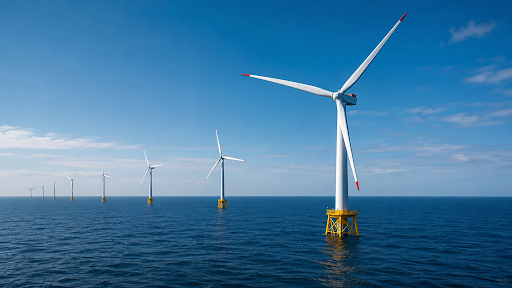
Offshore wind energy involves establishing wind farms in large water bodies, primarily oceans, to harness steady sea breezes for electricity generation.
Developers identify potential offshore wind zones and deploy specialised turbines that convert wind kinetic energy into clean power.
Offshore vs Onshore Wind Energy
Offshore wind offers higher adequacy and reliability and demands lower storage requirements compared to onshore wind and solar projects.
Onshore wind projects frequently face land acquisition bottlenecks, whereas offshore wind circumvents terrestrial land limits but demands specialized vessels and equipment for maintenance.
Working Mechanism
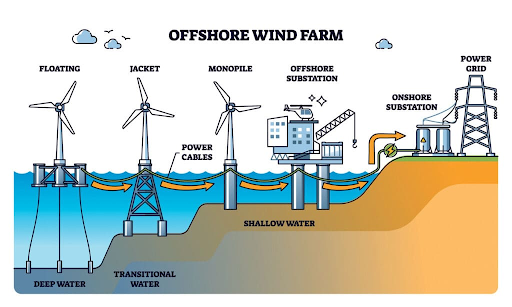
Large-scale turbines withstand harsh sea conditions to capture strong coastal winds.
Operators integrate these projects into the national grid using expensive undersea cabling.
Advanced floating offshore wind platforms utilize complex mooring systems and heavy anchors to operate in deep waters unsuitable for bottom-fixed installations.
Global Offshore Wind Energy Sector
Current Installed Capacity
Leading Countries
Emerging Markets
Advantages of Offshore Wind Energy
Higher Wind Speeds
Oceans experience stronger and more consistent wind profiles, yielding highly predictable electricity generation and better seasonal performance profiles.
Greater Energy Generation
Higher wind speeds directly translate to greater capacity factors. Modern offshore wind turbines utilize massive rotors, with average turbine sizes crossing the 10-megawatt threshold globally, maximizing energy capture per unit.
Reduced Land Acquisition Issues
Land remains a State subject, making onshore land acquisition a severe bottleneck for project developers. Offshore wind completely eliminates onshore land conflicts by utilizing seabed leases managed by the central government.
Lower Visual and Noise Impact
Turbines located deep in uncharted waters prevent acoustic disturbances and visual clutter for local coastal populations, minimizing NIMBY (Not In My Back Yard) resistance.
Offshore Wind Energy in India
National Offshore Wind Energy Policy
The government notified the National Offshore Wind Energy Policy in 2015 to establish a regulatory framework for developing offshore wind zones.
Potential Along Gujarat Coast
Studies identify massive potential off the Gujarat coast. The National Institute of Wind Energy (NIWE) installed LiDAR in 2017 to collect wind resource data.
Potential Along Tamil Nadu Coast
Extensive geotechnical and geophysical studies successfully mapped sites off the Tamil Nadu coast. Authorities installed 4 LiDARs to measure wind resources, backing a 500 MW capacity target for initial phase installations.
Government Targets
India initially targeted 5 GW of offshore wind by 2022 and 30 GW by 2030, but zero operational projects exist to date. Current strategies align with achieving 500 GW of non-fossil fuel capacity by 2030.
Significance for India's Energy Transition
Net-Zero Goals: Exploiting offshore wind is critical to achieving India’s decarbonization targets and transitioning the power system away from thermal reliance.
Energy Security: Scaling offshore wind protects the national economy from global fossil fuel supply chain disruptions and volatile import costs.
Diversification of Renewable Energy Sources: Offshore wind complements the intermittency of solar energy. Its unique seasonality ensures the grid receives a steady, robust baseload power supply.
Challenges Facing Offshore Wind Projects
High Capital Costs
Grid Connectivity Issues
Supply Chain Constraints
Regulatory Delays
Marine Biodiversity Impacts
Fishing Community Concerns
Way Forward
Faster Regulatory Clearances
Governments must treat offshore wind as critical national infrastructure to fast-track permitting, bypass bureaucratic backlogs, and secure grid access.
Domestic Manufacturing Ecosystem
Policymakers must incentivize the manufacturing of offshore wind turbines domestically to boost supply chain resilience and scale up deployment.
Investment Support Mechanisms
The government must optimize the newly approved ₹7,453 crore Viability Gap Funding (VGF) scheme and design bankable Contracts for Difference (CfDs) to lower financial risks for private developers.
Conclusion
Accelerating offshore wind deployment requires resolving critical grid bottlenecks and enhancing financial viability frameworks to secure clean energy transition.
Source: DOWNTOEARTH
|
PRACTICE QUESTION Q. Consider the following statements regarding the Global Offshore Wind Sector: 1. China currently accounts for more than half of the world's total installed offshore wind capacity. 2. Offshore wind energy is characterized by lower capacity factors and higher storage requirements than onshore solar energy. Which of the statements given above is/are correct? A) 1 only B) 2 only C) Both 1 and 2 D) Neither 1 nor 2 Answer: A Explanation: Statement 1 is correct: China currently accounts for more than half of the world's total installed offshore wind capacity. By the end of 2025, China's total offshore wind capacity had reached 48.4 GW, which accounts for 52% of the global offshore wind market. Statement 2 is incorrect: Offshore wind energy typically operates with higher capacity factors (often ranging between 30% to 50%) than onshore solar energy. Due to the stronger, more consistent winds at sea, offshore wind generates more consistent power, leading to lower storage requirements relative to onshore solar power, which naturally fluctuates due to daily and seasonal sunlight variations. |
Offshore wind energy is a clean power source generated by harvesting wind currents over open bodies of water, oceans, using large wind turbines anchored to the seabed or floating on platforms.
Global capacity is surging because marine environments offer vastly stronger, more consistent, and uninterrupted wind speeds than land, allowing massive turbines to generate higher amounts of electricity.
India possesses a massive, untapped estimated potential of 127 gigawatts (GW) of offshore wind capacity concentrated primarily along the coastal corridors of Gujarat and Tamil Nadu.
The main bottlenecks include exorbitant initial capital setup costs, complex marine engineering logistics, rapid equipment corrosion from salty seawater, and lengthy delays in building deep-sea grid transmission infrastructure.


© 2026 iasgyan. All right reserved