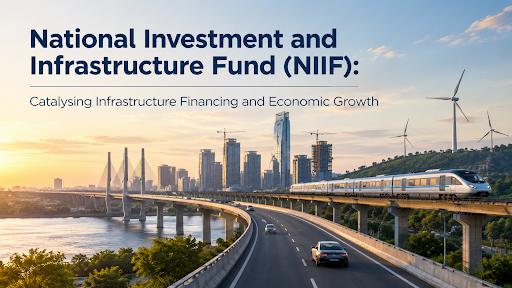
NIIF is India’s sovereign-anchored alternative asset manager established in 2015 to catalyze global capital for infrastructure. Managing over $5 billion across specialized funds, it drives economic growth and solves the infrastructure financing gap. Explore comprehensive UPSC notes on NIIF.
Why In News?
The Union Cabinet approves an additional ₹30,000 crore investment in the National Investment and Infrastructure Fund (NIIF), doubling the government’s total commitment to ₹60,000 crore.
What is NIIF?
NIIF is India's sovereign-anchored alternative asset manager, established to mobilize domestic and international institutional capital into commercially viable greenfield and brownfield infrastructure projects
Origin: The Government of India established NIIF in 2015 as a Category II Alternative Investment Fund (AIF) under SEBI regulations.
Objectives:
Finance infrastructure projects: Maximizes economic impact by investing in both operational and under-construction assets.
Attract long-term investments: Utilizes public capital to secure patient capital from sovereign wealth funds, pension funds, and multilateral banks.
Support economic growth: Generates superior risk-adjusted commercial returns while advancing national priorities like Make in India.
Promote public-private partnerships: Advises central and state governments on new PPP frameworks and asset monetization strategies.
Key Features
Sovereign-Backed Structure: The Government of India maintains a 49% stake as an anchor investor, while global and domestic institutions (e.g., ADIA, Temasek, HDFC, Kotak) hold the remaining 51%. NIIF currently manages over USD 4.9 billion in Assets Under Management (AUM).
Master Fund: Focuses on core infrastructure sectors like transportation and energy.
Fund of Funds (FoF): Invests in third-party private equity funds. It partnered with the UK Government to establish the Green Growth Equity Fund (GGEF), India’s first climate-focused fund.
Strategic Opportunities Fund (SOF): Provides long-term growth equity to high-growth businesses, including a ₹2,100 crore investment in Manipal Hospitals and the acquisition of NIIF Infrastructure Finance Ltd (NIFL).
India-Japan Fund (IJF): A bilateral fund anchored by the Government of India and the Japan Bank for International Cooperation (JBIC) targeting the energy transition and circular economy.
Significance
Infrastructure Development: NIIF deploys capital across 25 diverse entities, covering renewable energy, smart meters, and digital infrastructure.
Private Capital Mobilisation: The fund utilizes a "catalytic capital model," raising ₹40,000 crore in total commitments and returning ₹12,000 crore through profitable exits.
Job Creation: NIIF drives large-scale employment in construction, energy, and logistics, supporting India’s status as a top-five global leader in infrastructure job creation.
Economic Competitiveness: Investments align with flagship schemes including Digital India, PM Gati Shakti, FAME, and PM E-DRIVE.
Strategic Advisory: NIIF provides expertise for the Maritime Development Fund and various PPP frameworks.
Source: MONEYCONTROL
|
PRACTICE QUESTION Q. Consider the following statements regarding the National Investment and Infrastructure Fund (NIIF):
Which of the statements given above is/are correct? A) 1 and 2 only B) 2 only C) 2 and 3 only D) 1, 2, and 3 Answer: BExplanation:Statement 1 is incorrect. The Government of India does not hold a 100% stake in the NIIF. Instead, it holds a 49% stake to provide a sovereign anchor while mobilizing capital from international and domestic institutional investors (who hold the remaining 51%). Statement 2 is correct. The India-Japan Fund (IJF) is indeed a strategic bilateral fund managed by NIIF (specifically NIIF Limited). Established with a corpus of $600 million (funded 49% by the Government of India and 51% by the Japan Bank for International Cooperation), it focuses on investing in environmental sustainability and low-carbon emission strategies. Statement 3 is incorrect. NIIF does not operate entirely as a Master Fund. It manages multiple distinct funds, including a Fund of Funds (FoF), which specifically invests in third-party managed funds (such as private equity and venture capital funds) to access sectoral expertise in areas like green energy, affordable housing, and healthcare. The Master Fund is just one of its investment platforms, primarily focused on direct infrastructure investments. |




© 2026 iasgyan. All right reserved