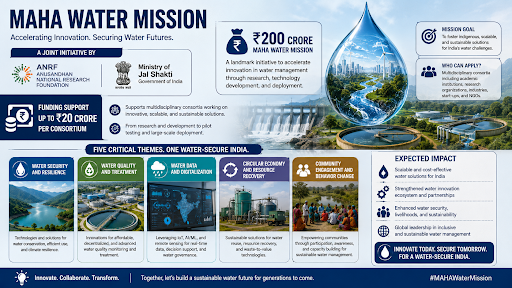
The ₹2000-crore MAHA Water Mission, launched by ANRF and the Ministry of Jal Shakti, aims to accelerate innovation in water management. It funds multidisciplinary consortia up to ₹20 crore to develop scalable technologies across five critical themes,
.
Why In News?
The Ministry of Jal Shakti and the Anusandhan National Research Foundation (ANRF) have jointly launched the ₹200-crore MAHA Water Mission.
About MAHA WATER MISSION
The government launches the Missions for Advancement in High-impact Areas (MAHA) Water Mission to accelerate innovation, research, and entrepreneurship in the water sector.
The Anusandhan National Research Foundation (ANRF) and the Ministry of Jal Shakti (MoJS) jointly run and fund the program.
The mission bridges the gap between fundamental research and field deployment.
It specifically advances technological innovation from Technology Readiness Level (TRL)-2 to TRL-6-7 to solve national water challenges.
Funding and Financial Structure
The mission operates with a total projected outlay of ₹200 crore over a five-year period.
The government awards research grants of up to ₹20 crore per project to selected multidisciplinary consortia.
The program does not support proposals requiring high capital costs.
Consortium Model and Industry Participation
The mission mandates a collaborative consortium approach, bringing together a mix of universities, national laboratories, research organizations, Startups, MSMEs, and industry partners.
Every project must include at least one Startup, MSME, or Industry partner.
The participating industry or startup partner must contribute at least 10% of the total project budget.
The mission features a dedicated Open Call for Proposals specifically targeting Startups and MSMEs for Product and Prototype Development.
Five Priority Themes
Water Resource Assessment and Sustainable Management: Focuses on hydrogeological mapping, aquifer recharge, and solving sea-water intrusion.
Drinking Water: Develops low-cost potable water solutions for piped household supply.
Water Quality and Ecological Health: Explores the water-food-energy nexus and community-led treatment technologies.
Water Use Efficiency and Circular Economy: Creates new technologies for greywater management, industrial waste, and agricultural water use.
Climate Resilience and Adaptation: Uses AI/ML-enabled decision support systems and digital surveillance to manage climate change impacts on water resources.
Digital Integration and Technology Partnerships
The Department of Water Resources partners with the Department of Space/ISRO through an MoU to utilize satellite technologies and geospatial data for precise groundwater mapping and irrigation planning.
The government complements the mission by launching the Jal Sanchay Jan Bhagidari, Citizen Tracking and Reporting (JSJB-CTR) Portal and App.
This digital platform facilitates real-time monitoring and empowers citizens through active public participation.
Significance
The ANRF democratizes research funding by moving opportunities beyond elite premier institutions directly to smaller universities, startups, and grassroot innovators.
The mission strengthens India's long-term water security by driving scalable, localized, and nature/technology-based solutions
Source: DDNEWS
|
PRACTICE QUESTION Q. Consider the following statements regarding the MAHA Water Mission:
Which of the statements given above is/are correct? A) 1 and 2 only B) 2 and 3 only C) 1 and 3 only D) 1, 2, and 3 Answer: B Explanation: Statement 1 is incorrect: The MAHA (Mission for Advancement in High-Impact Areas) Water Mission is a collaborative initiative launched by the Anusandhan National Research Foundation (ANRF) and the Ministry of Jal Shakti. It was not launched in conjunction with the NITI Aayog. Statement 2 is correct: Selected multidisciplinary consortia (which can include universities, national laboratories, startups, MSMEs, and industry partners) can receive financial support of up to ₹20 crore per project. Statement 3 is correct: Participating startups, MSMEs, and industry partners are mandated to contribute at least 10% of the total project budget. |
It is a ₹200-crore national program launched by ANRF and the Ministry of Jal Shakti designed to bridge the gap between fundamental research and field deployment for high-impact water solutions.
Multidisciplinary consortia bringing together Principal Investigators (PIs) from universities, national laboratories, research organizations, startups, MSMEs, and industry partners are eligible to apply.
Selected multidisciplinary consortia can receive substantial funding of up to ₹20 crore per project over the duration of three to five years.

© 2026 iasgyan. All right reserved