The International Big Cat Alliance (IBCA) is an inter-governmental organization headquartered in New Delhi focused on conserving seven big cat species. India will host the first global summit in June 2026 to adopt the historic New Delhi Declaration
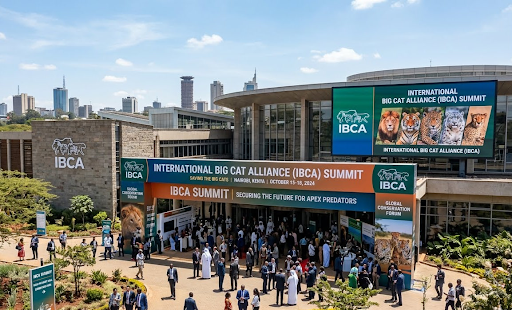
The Union Minister for Environment, Forest and Climate Change launched the website and logo for the inaugural International Big Cat Alliance (IBCA) Summit.
Launch: The IBCA was officially launched by the Indian Prime Minister in 2023, to commemorate the 50th anniversary of Project Tiger.
Current Status: In January 2025, the framework agreement transformed the alliance into a treaty-based international organization and legal entity.
Headquarters: New Delhi, India
Core Objective: Enhance international collaboration to stabilize and increase big cat numbers while combating illegal wildlife trafficking.
Focus Species (The 7 Big Cats) The alliance covers seven major big cats: Tiger, Lion, Leopard, Snow Leopard, Cheetah, Jaguar, and Puma.
Membership & Governance
1st Global Big Cat Summit 2026
Conservation Status of Big Cats
Source: PIB
|
PRACTICE QUESTION Q. Consider the following statements regarding the International Big Cat Alliance (IBCA): 1. It is a treaty-based inter-governmental international organization headquartered in New Delhi 2. The alliance focuses on the conservation of seven big cats, all of which are naturally found in India. 3. The "New Delhi Declaration" is associated with the conservation priorities of the IBCA. Which of the statements given above is/are correct? A) 1 and 2 only B) 2 and 3 only C) 1 and 3 only D) 1, 2, and 3 Answer: C Explanation: Statement 1 is correct: The International Big Cat Alliance (IBCA) officially came into force on 23rd January 2025 as a treaty-based inter-governmental international organization. It is headquartered in New Delhi, India. Statement 2 is incorrect: While the alliance focuses on seven big cats—Tiger, Lion, Leopard, Snow Leopard, Cheetah, Jaguar, and Puma—not all are naturally found in India.
Statement 3 is correct: The New Delhi Declaration on Big Cat Conservation is a framework associated with the IBCA, focusing on global cooperation, landscape-level conservation, and anti-poaching measures. |
The IBCA is a multi-country, multi-agency coalition initiated by India to strengthen global cooperation for the conservation of big cats and their natural habitats, which officially became a treaty-based inter-governmental organization in January 2025.
The alliance focuses on seven big cat species: Tiger, Lion, Leopard, Snow Leopard, Cheetah, Jaguar, and Puma.
The headquarters and Secretariat of the IBCA are located in New Delhi, India, with the Indian government signing the official Headquarters Agreement.




© 2026 iasgyan. All right reserved