India and Ethiopia have upgraded ties to a Strategic Partnership, reflecting Ethiopia’s role as a Horn of Africa gateway and AU hub. New MoUs deepen cooperation, though internal instability and Chinese competition persist. Leveraging BRICS, expanding trade and partnering in new-age sectors will be key to strengthening India’s Africa outreach.

Copyright infringement not intended
Picture Courtesy: NEWSONAIR
Ethiopia and India have signed three memoranda of understanding to enhance cooperation in administrative assistance in customs matters, data centre establishment at the embassy of Ethiopia and cooperation in UN peacekeeping.
Ancient Ties
Civilizational links began during the Aksumite Empire, where Indian merchants traded silk and spices for Ethiopian gold and ivory through the port of Adulis. Kushan-period Indian coins have been excavated in northern Ethiopia.
Colonial Era
Indian soldiers played a critical role in British military expeditions to Ethiopia, including the 1868 mission to free diplomats and the 1941 campaign that ended Italian occupation.
Post-Independence (1948)
|
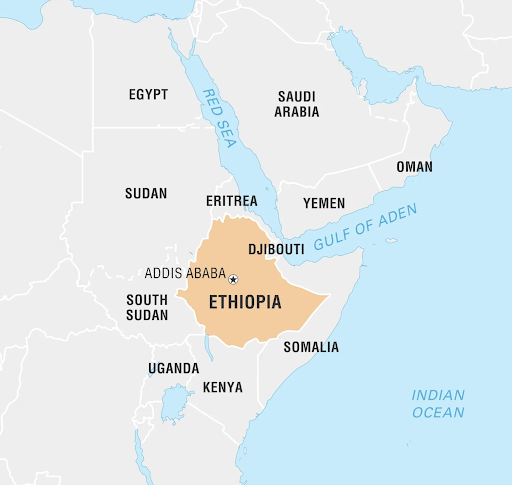
Ethiopia is a landlocked country located in the Horn of Africa, East Africa, bordered by Eritrea, Djibouti, Somalia, Kenya, South Sudan, and Sudan. |
Geostrategic Location
Ethiopia, located in the Horn of Africa, is a stable regional anchor. Its capital, Addis Ababa, hosts the African Union (AU) headquarters, establishing it as Africa's political capital and a key hub for India's diplomacy with the continent.
Growing Economy
Ethiopia, with over 135 million people and a fast-growing economy, presents a major consumer market for Indian trade and investment.
Multilateral Convergence
Ethiopia's BRICS inclusion strengthens its strategic ties with India. Both collaborate on platforms like the G20 (with the AU) to advocate Global South interests.
Gateway to Africa
Strong India-Ethiopia ties offer a dependable partner for expanding India's economic and political influence in Eastern Africa and the continent.

Investment Hub
India is the second largest foreign investor in Ethiopia, with over 650 Indian companies having invested approximately $5 billion. These investments are concentrated in sectors like agriculture, manufacturing, textiles, and pharmaceuticals (Source: PIB).
Trade Partnership
India's total trade with Ethiopia in 2024-2025 was $550.19 million, according to the Department of Commerce. Exports totaled $476.81 million, and imports were $73.38 million.
India's main exports include primary/semi-finished iron and steel, drugs, pharmaceuticals, machinery, instruments, chemicals, paper, plastic, and metal manufactures.
Imports from Ethiopia are primarily pulses, flax yarn, precious/semi-precious stones, vegetables, seeds, leather, and spices.
Development Finance
India has extended over $ 1 billion through concessional Lines of Credit (LoCs) for key infrastructure projects in Ethiopia, including rural electrification and the sugar industry. (Source: MEA).
Capacity Building
India aids Ethiopia's human resource development through the Indian Technical and Economic Cooperation (ITEC) programme and Indian Council for Cultural Relations (ICCR) scholarships, training thousands of Ethiopian officials and students annually.
Education & Technology
ITEC and ICCR scholarships, university linkages, and cooperation in Science & Technology. India supported the Pan-African e-Network project, now upgraded to the e-VidyaBharati and e-ArogyaBharati (e-VBAB) Network.
Defence & Security
Cooperation in UN Peacekeeping training, regular defence dialogues, and capacity building for the Ethiopian defence forces. Both sides collaborate on counter-terrorism efforts.
Health & Pharmaceuticals
India provides grant assistance for medicines and supports the upgradation of healthcare facilities. Indian pharmaceuticals are a major export to Ethiopia.
Agriculture & Food Security
Collaboration in agricultural technology, natural farming, and developing meat and dairy sectors to ensure food security.
Digital Public Infrastructure (DPI)
A new and crucial area of focus, where India can share its expertise from platforms like UPI and Aadhaar to drive Ethiopia's digital transformation.

Trade Imbalance: Trade balance is heavily skewed in India's favour. Ethiopia's export basket is dominated by primary agricultural commodities with low value-addition.
Regional Instability: Internal political challenges and conflicts in the Horn of Africa impact the overall stability and investment climate.
Economic Bottlenecks: A severe foreign exchange (forex) crisis in Ethiopia hampers Indian businesses' ability to repatriate profits and import raw materials.
Fiscal Constraints: Ethiopia’s ongoing debt restructuring and post-conflict economic strain limit its capacity for large-scale industrial or defense projects.
Geographical Barriers: As a landlocked nation, Ethiopia faces high transaction costs due to logistics inefficiencies and reliance on neighboring ports like Djibouti.
Regulatory Hurdles: Indian investors frequently cite inconsistent taxation, complex regulatory approvals, and a lack of policy transparency as major deterrents.
Geopolitical Competition: India faces stiff competition from major powers like China and Gulf nations, which possess greater financial "deep pockets" for regional influence.
Diversify Trade: India should assist Ethiopia in diversifying its export basket, focusing on value-added products like processed foods, finished leather, and textiles.
Improve Investment Climate: Establishing a more streamlined and predictable regulatory environment in Ethiopia will attract further Indian FDI.
Financial Innovation: Implement Local Currency Settlement (LCS) mechanisms to bypass Ethiopia’s forex crisis and facilitate smoother trade and profit repatriation.
Infrastructure & Logistics: Invest in joint logistics ventures and utilize the African Continental Free Trade Area (AfCFTA) to turn Ethiopia into a regional manufacturing hub for Indian firms.
Digital Transformation: Deploy India’s Digital Public Infrastructure (DPI) stack—specifically linking UPI with Ethswitch—to modernize Ethiopia's financial ecosystem.
Regulatory Reform: Fast-track the renewal of the Bilateral Investment Treaty and Double Taxation Avoidance Agreement (DTAA) to provide legal certainty for investors.
Strategic Capacity Building: Expand e-ITEC and specialized training in AI, space technology, and defense to move beyond traditional development assistance.
Multilateral Synergy: Leverage Ethiopia’s 2024 BRICS membership to align positions on Global South issues and reform of international financial institutions.
Sector Focus: Shift investment toward high-growth areas like pharmaceuticals, agro-processing, and renewable energy (solar and wind) to ensure mutual economic resilience.
The India-Ethiopia relationship is a model of South-South cooperation, built on mutual respect and shared goals, positioned to enhance peace and stability in the strategic Horn of Africa and the broader region.
Source: NEWSONAIR
|
PRACTICE QUESTION Q. Which of the following groups contains countries that share a land border with Ethiopia? A) Sudan, Kenya, Uganda, Somalia B) Eritrea, Djibouti, Somalia, South Sudan C) Egypt, Sudan, Eritrea, Djibouti D) Kenya, Tanzania, Somalia, Djibouti Answer: B Explanation: Ethiopia, a landlocked country in Northeast Africa, shares land borders with six nations: Eritrea to the north, Djibouti to the northeast, Somalia to the east, Kenya to the south, South Sudan to the west, and Sudan to the northwest |
Ethiopia is crucial for India due to its location in the Horn of Africa (vital for maritime security), its status as the host of the African Union headquarters (making it a diplomatic hub), its position as a rising economic power, and its role as a regional anchor of stability.
India and Ethiopia signed three Memoranda of Understanding (MoUs) for:
- Cooperation in Customs Administration to facilitate smoother trade.
- Establishment of a Data Centre in the Ethiopian Embassy, leveraging India's digital expertise.
- Cooperation in UN Peacekeeping to enhance joint training and coordination.
The key challenges include internal political instability and conflict in Ethiopia (like the Tigray conflict) creating an uncertain investment climate, intense economic competition from China, and bureaucratic hurdles such as foreign exchange shortages and regulatory issues faced by Indian investors.


© 2026 iasgyan. All right reserved