India’s post-Independence economic journey moved from slow, state-led growth to market-driven expansion. The phrase “Hindu rate of growth,” coined by economist Raj Krishna, described India’s stagnant average growth of roughly three to three-and-a-half percent between the nineteen fifties and seventies. However, growth began accelerating from the early nineteen eighties, well before the nineteen ninety-one reforms, as selective liberalisation and industrial capacity building improved productivity. The reform wave of nineteen ninety-one deepened this shift, while the two thousand three to two thousand eleven phase delivered high growth of eight to nine percent. Since then, India has faced moderation linked to global headwinds, financial stress and the pandemic, yet it remains the fastest growing major economy. Thus, India has long surpassed the so-called Hindu rate of growth, evolving from a low-growth economy to one increasingly driven by reform, capability building and structural transformation.
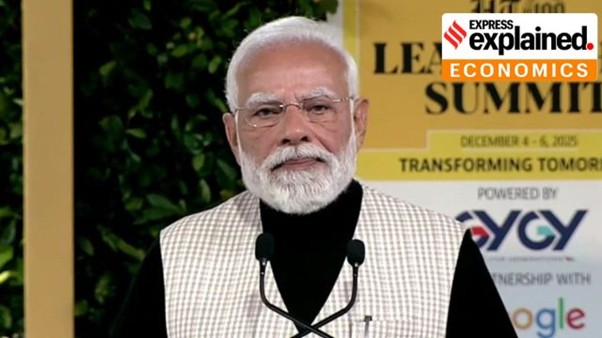
Copyright infringement not intended
Picture Courtesy: Indian Express
Context:
The expression “Hindu rate of growth” reflected a colonial mindset that linked India’s slow economic performance in earlier decades to the faith and identity of its people.
|
Must Read: INDIA’S GROWTH TRAJECTORY | INDIA IS 4TH LARGEST ECONOMY | |
What is Hindu rate of growth?
The term “Hindu rate of growth” refers to India’s low and stagnant GDP growth of around 3–3.5% annually from the 1950s to the late 1970s. It was coined by economist Raj Krishna in 1982. He used it as a polemical critique to highlight:
Despite political changes, wars, and crises, growth remained around 3%, which Raj Krishna labelled as “cultural–institutional stagnation”.
India’s growth journey after Independence:
Post-Independence Foundations (1950s–mid-1960s)
India adopted a state-led development strategy under Nehru, building the foundations of planning, heavy industry, and scientific institutions.
During this period, GDP growth rose from colonial stagnation to around 4%, reflecting industrial expansion and public investment.
However, agriculture remained weak, foreign exchange was scarce, and the economy was constrained by bureaucratic controls.
Stagnation and Strain (mid-1960s–1970s)
The economy slowed as wars, droughts, and the oil shock disrupted development momentum.
Growth hovered near 3–3.5%, which economist Raj Krishna famously termed the “Hindu rate of growth,” signalling structural bottlenecks rather than religious traits.
Yet, reforms like the Green Revolution improved food security and created institutional capacity for future growth.
Early Reforms and Take-off (late 1970s–1980s)
Recognising inefficiencies, governments initiated selective liberalisation, technology adoption, and sectoral reforms.
This shift elevated growth to nearly 6%, indicating that India began breaking out of its earlier low-growth trap.
Industrial modernisation, telecom development, and productivity gains characterised this decade.
Crisis-Driven Transformation (1991–2000)
A severe balance-of-payments crisis pushed India toward sweeping liberalisation, privatisation, and global integration.
The licence-permit raj weakened, tariffs were reduced, and foreign investments were welcomed, enabling markets to become growth engines.
Growth stabilised around 6%, while export-oriented services, especially IT, began emerging as a new pillar.
High-Growth Consolidation (2003–2011)
Economic reforms matured during this period, supported by global demand, infrastructure expansion, and fiscal discipline.
GDP grew at 8–9%, lifting millions out of poverty and marking India’s “golden growth phase.”
A new middle class expanded, capital markets deepened, and India became a prominent emerging economy.
Moderation and Reform Reset (2012–2019)
Headwinds from the global slowdown and domestic financial stress moderated growth to 6–7%.
Policy responses included GST, direct benefit transfers, and insolvency reforms to clean up the financial system and improve efficiency.
Despite challenges, the economy retained momentum through services, consumption, and digital transformation.
Pandemic Shock and Recovery (2020–2023)
The COVID-19 pandemic caused a sharp contraction, disproportionately affecting informal labour and small businesses.
A strong recovery followed, powered by digitisation, public capital expenditure, and manufacturing incentives such as PLI schemes.
India again emerged as the fastest-growing major economy, with growth rates above 8% in the rebound phase.
Current Growth Path (2023–present)
India today is transitioning toward a more innovation-driven, infrastructure-rich, and digitally enabled economy.
Focus is shifting to manufacturing revival, services exports, green transition, and inclusive growth.
As a result, growth is stabilising between 6.5% and 7.5%, positioning India as one of the world’s most dynamic emerging markets.
Challenges in India’s economic growth:
Employment generation remains weak: Even as GDP rises, job creation lags; for instance, Periodic Labour Force Survey data show unemployment among graduates exceeds 13%, signalling skill–market mismatch. Sectors such as textiles and electronics, which historically absorbed labour in East Asia, continue to suffer from scale and competitiveness constraints in India.
Agrarian Distress Persists: Around 43% of Indians depend on agriculture while the sector contributes only 15% to GDP, reflecting low productivity. The Maharashtra farmer suicide crisis (Vidarbha region) illustrates income volatility, debt traps, and structural weaknesses.
Low female workforce participation: India’s female labour force participation is ~27% (World Bank 2022), among the lowest in G20, limiting human capital utilisation.The McKinsey Global Institute (2015) estimated that India could add $700 billion to GDP by 2025 by bridging gender gaps, underscoring economic loss from exclusion.
Women-centred manufacturing clusters in Tamil Nadu’s garment sector demonstrate how targeted ecosystems can improve participation and bargaining power.
Productivity gaps: While India aims to leverage its demographic dividend, Annual Status of Education Report (ASER) reports consistently show 50% of rural students cannot read a Class 2 text in Class 5, revealing learning poverty.
The IT and start-up boom in Bengaluru and Hyderabad shows the growth potential of skilled labour, yet uneven skilling means this success is not replicable nationwide.
Regional disparities widen: States like Gujarat, Karnataka, Haryana and Tamil Nadu lead in industrialisation, whereas Bihar, UP, Odisha lag significantly, visible in stark per capita income gaps (Tamil Nadu ~₹2.7 lakh vs Bihar <₹50,000).
Government initiatives:
|
Challenge |
Scheme Name |
Description |
|
Weak job creation and industrial competitiveness |
Make in India |
This programme encourages investment and simplifies regulations so that domestic industries can expand and generate new employment opportunities. |
|
Production Linked Incentive Scheme |
By rewarding firms for raising output, this scheme builds scale in sectors like electronics and textiles, which in turn supports manufacturing-led job growth. |
|
|
Skill India Mission |
By training youth in practical competencies, this mission enhances employability and aligns labour supply with industry needs. |
|
|
Low agricultural income and rural distress |
Pradhan Mantri Kisan Samman Nidhi |
This scheme provides direct income support to small farmers, stabilising their earnings and strengthening rural demand. |
|
Soil Health Card Scheme |
By guiding farmers on nutrient use, this programme improves soil fertility and supports better crop productivity. |
|
|
Pradhan Mantri Fasal Bima Yojana |
This scheme protects farmers from crop failure by offering insurance against weather and market shocks, reducing vulnerability. |
|
|
Limited women participation in economic growth |
Beti Bachao Beti Padhao |
By focusing on the welfare and education of girl children, this scheme enhances long-term gender equity and women’s participation in the economy. |
|
National Rural Livelihood Mission |
Through self-help groups and credit support, this mission builds women’s livelihoods and strengthens their economic agency. |
|
|
Skill gaps and uneven learning outcomes |
New Education Policy |
This reform modernises curriculum and assessment, aiming to improve foundational learning and workforce readiness. |
|
Digital India Initiative |
By expanding digital infrastructure and literacy, this programme enhances access to knowledge, services and skill-building platforms. |
|
|
Regional imbalance and inequality |
Aspirational Districts Programme |
This initiative focuses on development gaps in backward districts, ensuring that social and economic progress reaches lagging regions. |
|
Pradhan Mantri Gram Sadak Yojana |
By connecting villages with all-weather roads, this scheme improves mobility, market access and rural growth integration. |
|
|
Financial sector stress and weak lending |
Insolvency and Bankruptcy Code Framework |
This reform speeds up the resolution of distressed firms so that credit flows improve and financial discipline strengthens. |
|
Bank Recapitalisation Programme |
By injecting capital into public sector banks, this programme restores lending capacity and supports economic recovery. |
|
|
Informality and narrow tax base |
Goods and Services Tax |
This reform unifies indirect taxes to create a single market and encourages business formalisation, improving compliance and state revenue. |
|
Unified Payments Interface Framework |
By expanding digital transactions, this system increases transparency and financial access, supporting formalisation. |
|
|
Manufacturing bottlenecks and infrastructure gaps |
Bharatmala Project |
This project builds road corridors to improve logistics, lower transport costs and enhance industrial efficiency. |
|
Sagarmala Programme |
By modernising ports and coastal connectivity, this initiative strengthens trade capacity and supports manufacturing supply chains. |
|
|
Environmental and climate risks |
National Solar Mission |
This mission expands renewable energy capacity, supporting clean growth and reducing dependence on fossil fuels. |
|
Swachh Bharat Mission |
By improving sanitation infrastructure and promoting behavioural change, this mission enhances public health and environmental quality. |
|
|
Jal Jeevan Mission |
Through universal access to clean drinking water, this mission strengthens human development outcomes and resilience. |
Conclusion:
India has made impressive economic gains, yet deep structural gaps continue to restrain its full potential.
Through a wide network of targeted schemes—ranging from industrial incentives and skill-building to farmer support, women’s empowerment, infrastructure expansion and climate resilience—the government is actively addressing these constraints.
While outcomes vary across sectors and regions, these reforms collectively mark a transition toward a more productive, inclusive and sustainable growth model.
The real challenge lies in strengthening implementation so that policies translate into lasting improvements in jobs, incomes and human well-being.
Source: Indian Express
|
Practice Question Q. Despite sustained economic growth, structural challenges continue to constrain India’s development trajectory. Critically examine (250 words) |
Structural challenges refer to deep-rooted issues like weak job creation, low farm productivity, skill gaps, inequality, and governance bottlenecks that slow long-term development.
Yes, India surpassed the slow-growth phase in the early nineteen eighties and has since sustained higher growth, especially after economic reforms.
Because high growth without adequate employment means rising inequality, stress on youth, and limited social mobility despite expanding output.




© 2026 iasgyan. All right reserved