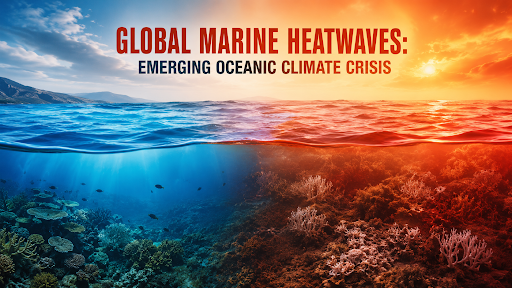
Record-breaking heatwaves severely impact health and economy, costing billions in lost labour hours. Driven by climate change and the Urban Heat Island effect, mitigating this "silent disaster" requires aggressive Heat Action Plans, climate-resilient infrastructure, and urgent global decarbonization
The World Health Organization said that over 1,300 excess deaths had been recorded in Europe since June 21 in connection with the heatwave.
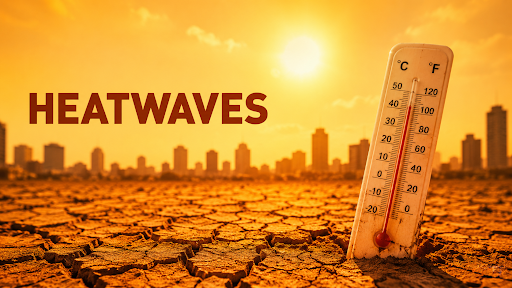
India Meteorological Department (IMD) declares a heatwave when the maximum temperature of a region consistently exceeds 45°C for two consecutive days.
The World Meteorological Organization defines a heatwave as five or more consecutive days where the daily maximum temperature exceeds the average maximum by 5°C.
A standard heatwave involves temperatures crossing regional baselines, while a Severe Heatwave involves prolonged, life-threatening anomalies that overwhelm human physiological adaptations.
The National Disaster Management Authority (NDMA) labels heatwaves a "silent disaster" due to their slow onset and massive, widespread impact on human and livestock populations.
Atmospheric Circulation: Moisture-depleted upper atmospheres prevent cloud formation, allowing intense, uninterrupted solar radiation to scorch the land.
Anticyclonic Formation: Massive anticyclonic flows compress sinking air, trapping hot air near the earth's surface.
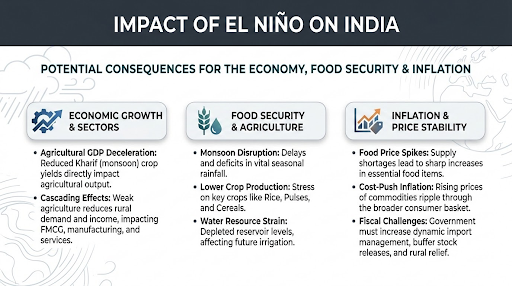
ENSO Dynamics: The absence of the cooling La Niña phenomenon and the onset of El Niño conditions disrupt weather patterns and elevate global temperatures.
Climate Change Multiplier: World Weather Attribution confirms that record-breaking heat is now 200 times more likely today than it was 20 years ago.
Western Disturbances: Inactive western disturbances cause severe rainfall deficits, driving up surface temperatures across plains and hilly regions.
The World Health Organization (WHO) emphasizes that Europe is the fastest-warming continent on Earth, heating at twice the global average rate. Driven by anthropogenic global warming, rare "once-in-a-generation" heatwaves are now annual occurrences.
Human Health: Extreme heat triggers exhaustion, heat cramps, and fatal heat strokes while exacerbating cardiovascular, respiratory, and cerebrovascular diseases.
Mortality Trends: 85% of heat-related excess deaths occur among vulnerable populations aged 65 and above.
Agricultural Losses: Soaring temperatures devastate temperature-sensitive crops like wheat during reproductive growth, threatening national food security.
Water Scarcity: High evaporation rates deplete reservoirs and accelerate the spread of water-borne and vector-borne diseases.
Economic Drain: India endures the largest heat exposure impact on heavy labour in South Asia, losing 247 billion labour hours and US$194 billion in income in 2024.
Indo-Gangetic Plains: Dusty, hot, and dry winds expose dense populations to severe thermal stress.
Central India: Anticyclonic traps lock in hot, dry weather, preventing atmospheric cooling.
Coastal Urban Centres: High humidity combined with high temperatures pushes populations toward the fatal 35°C wet-bulb temperature survival limit.
National Risk: Over 90% of the Indian landmass faces extreme heat risk, threatening progress toward the Sustainable Development Goals (SDGs).
NDMA Guidelines: The National Disaster Management Authority mandates hydration, avoidance of outdoor work between 12:00 noon and 3:00 PM, and the use of loose clothing.
Heat Action Plans (HAPs): Municipal bodies implement HAPs to mobilize local resources and disseminate survival information.
Early Warning Systems: Authorities broadcast temperature forecasts and heat alerts via bulk mobile messages and social media.
Hospital Upgrades: The government establishes dedicated heat-treatment wings and issues strict advisories to schools and workplaces.
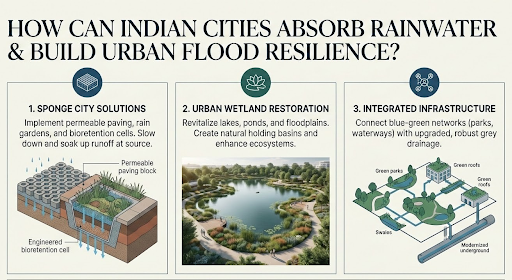
Sponge Cities: Urban planners design parks and green areas to absorb rainwater and provide natural cooling shade.
Green Infrastructure: Municipalities deploy white/reflective roofs and restore urban wetlands to increase albedo.
Passive Cooling: Building designs incorporate ventilation corridors to reduce reliance on energy-intensive air conditioning.
Decarbonization: The global community must phase out fossil fuels to prevent crossing fatal wet-bulb temperature thresholds.
Integrated Policy: State governments must link Heat Action Plans with agriculture, water management, and housing policies.
Occupational Shifts: The government must legally shift outdoor labour to cooler hours and enforce mandatory rest breaks.
Combating the silent disaster of heatwaves demands an integrated approach. By combining robust Heat Action Plans, climate-resilient urban infrastructure, and rapid global decarbonization, India can protect public health and ensure long-term economic stability.
Source: economictimes
|
PRACTICE QUESTION Q. The 'Urban Heat Island' effect acts as a threat multiplier during heatwaves. Discuss the causes of this phenomenon and suggest climate-resilient urban planning strategies to mitigate its impact. 150 words |
A heatwave is a prolonged period of abnormally high temperatures where the maximum temperature of a station reaches at least 40°C or more for Plains and at least 30°C or more for Hilly regions.
Climate change increases heatwaves by trapping excess greenhouse gas emissions in the atmosphere, which permanently raises global baseline temperatures, alters atmospheric jet streams, and multiplies the frequency, intensity, and duration of extreme thermal anomalies.
Heat Action Plans (HAPs) are comprehensive, state-level regulatory and administrative frameworks that establish early warning systems, coordinate inter-agency emergency responses, modify public infrastructure, and mandate localized cooling interventions to minimize heat-related mortality.
The regions facing the highest vulnerability comprise the Core Heatwave Zone (CHZ), which spans northwestern and central India including Rajasthan, Punjab, Haryana, Madhya Pradesh, Uttar Pradesh, and the highly urbanized, water-stressed National Capital Region (NCR).


© 2026 iasgyan. All right reserved