Intensifying heatwaves actively accelerate the formation of toxic ground-level ozone from precursor emissions, severely impacting public health and agriculture. This secondary pollutant exacerbates respiratory and cardiovascular diseases, demanding integrated climate action, airshed management, and robust health advisories within national policies.
Why In News?
A report published in journal “Clean Air”reveals that intensifying heatwaves accelerate surface ozone (O₃) formation in India.
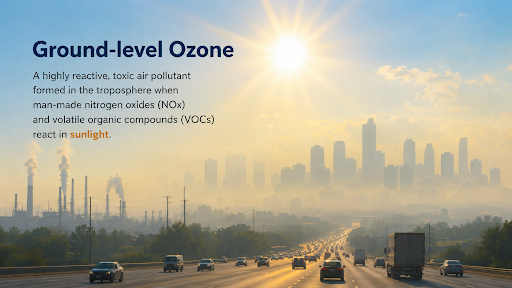
What is Ground-Level Ozone?
Toxic Gas: Ground-level ozone (O₃) acts as a colorless, invisible, and highly reactive toxic gas that severely damages the human respiratory system and plant ecosystems.
Invisible Threat: Unlike particulate matter (PM2.5 and PM10), it leaves no trail of soot but triggers chemical reactions that turn surrounding gases into microscopic particles, creating hazardous photochemical smog.
Secondary Air Pollutant: Human activities do not emit surface ozone directly; it operates as a secondary pollutant "baked" into existence in the open air through complex chemical reactions between primary pollutants.
Good vs Bad Ozone: Stratospheric ozone ("Good Ozone") occurs 12 to 50 km above the Earth's surface to shield the planet from UV radiation, whereas Tropospheric or Surface Ozone ("Bad Ozone") sits at the human breathing level and acts as a Short-Lived Climate Pollutant (SLCP).
How is Ground-Level Ozone Formed?
Nitrogen Oxides (NOx): Vehicular emissions, thermal power plants, and industrial activities (refineries, cement plants) release massive quantities of NOx during fossil fuel combustion.
Volatile Organic Compounds (VOCs): Paints, solvents, adhesives, and petrochemical products release VOCs into the air, while natural vegetation emits biogenic VOCs during extreme heat.
Sunlight-Driven Reactions: When NOx and VOCs mix under intense ultraviolet sunlight and high temperatures, they generate surface ozone via the formula:
Nitrogen Oxides (NOx) + Volatile Organic Compounds (VOCs) + Sunlight → Surface Ozone (O₃).
Link Between Heatwaves and Ozone Formation
Catalyst Effect: Intense solar radiation and high temperatures directly accelerate atmospheric photochemical activity, massively boosting the rate of ozone production.
Compound Hazard: Heatwaves transform regional atmospheres into giant outdoor ovens, creating a deadly compound heat–ozone hazard.
Stagnant Atmospheric Conditions: Heatwaves bring stagnant air masses and low wind speeds, heavily restricting pollutant dispersion and allowing toxic ozone to accumulate relentlessly.
Prolonged Episodes: The loss of natural cleansing mechanisms (clear skies and reduced rainfall) forces ozone to persist for an average of three to four days post-heatwave.
Health and Environmental Impacts
Respiratory Diseases: In 2024, extreme ozone exposure accounted for 10,898 deaths from Chronic Obstructive Pulmonary Disease (COPD).
Asthma Aggravation: Ozone acts as an aggressive oxidant, inducing airway inflammation and magnifying a patient's physical response to allergens like dust and pollen.
Cardiac Threat: The combined stress of extreme heat and ozone alters blood viscosity and causes vascular inflammation, triggering 15,615 deaths from Ischaemic Heart Disease (IHD) in 2024.
Crop Yield Losses: Ozone stunts photosynthesis, slashing yields for sensitive staples including wheat, rice, soybean, cotton, and pulses.
Ecosystem Stress: As an SLCP, ozone traps heat in the lower atmosphere, driving localized urban warming and exacerbating global climate change.
Ground-Level Ozone in India
Urban Hotspots: The Western Himalayan region records ozone levels 115% above the WHO guideline value (70 μg/m³). The Indo-Gangetic Plain, north-central India, and north-west India record surges between 85–110 μg/m³.
Seasonal Trends: 15 out of 25 major cities recorded summer seasonal averages soaring well above 100 µg/m³ in 2024.
Monitoring Mechanisms: Current infrastructure disproportionately prioritizes PM2.5; authorities must integrate ground-level ozone concentrations into national health alerts.
Government Initiatives
National Clean Air Programme (NCAP): Launched in 2019, this program targets a 40% reduction in PM10 levels by 2025-26 across 130 non-attainment cities.
Air Quality Monitoring: The CPCB operates 779 monitoring stations across 339 cities and provides real-time data via the Sameer 2.0 app.
Emission Standards: The government mandates Bharat Stage VI (BS-VI) norms to drastically cut NOx from vehicular exhaust.
Smart Cities Mission: This framework promotes non-motorised transport and green cover to combat the Urban Heat Island effect and reduce VOC buildup.
Way Forward
Reduction of NOx Emissions: The government must enforce time-bound emission load reductions for thermal power plants and polluting industries.
Cleaner Transportation: Scaling up Electric Vehicle (EV) infrastructure and electrifying public transit will definitively eliminate tailpipe NOx and VOC emissions.
Heatwave Preparedness: Municipal bodies must integrate ozone forecasting and air-quality health advisories into existing Heat Action Plans (HAPs).
Airshed Management: Policymakers must shift from city-specific boundaries to an Airshed approach, coordinating emission controls across regional clusters.
Public Health Integration: The Ministry of Health must link AQI data with frontline healthcare, training ASHA workers to counsel vulnerable groups during high ozone spikes.
Conclusion
India needs to integrate surface ozone monitoring into climate strategies and cut sectoral precursor emissions to prevent a public health crisis.
Source: INDIANEXPRESS
|
PRACTICE QUESTION Q. With reference to the environmental and health impacts of surface ozone, consider the following statements:
Which of the statements given above is/are correct? A) 1 and 2 only B) 2 only C) 1 and 3 only D) 1, 2, and 3 Answer: A Explanation: Statement 1 is correct: Surface (tropospheric) ozone is a potent Short-Lived Climate Pollutant (SLCP) and a greenhouse gas that traps heat in the atmosphere. Statement 2 is correct: Ground-level ozone is a severe respiratory irritant. Inhalation causes inflammation and oxidative stress, which are strongly linked to increased mortality and morbidity rates from COPD (Chronic Obstructive Pulmonary Disease) and asthma. Statement 3 is incorrect: Surface ozone actually damages plant tissues and impairs photosynthesis. It acts as a toxin to vegetation, leading to reduced crop yields for staples like wheat and rice, rather than enhancing them. |
Ground-level ozone is a highly reactive, toxic secondary air pollutant formed in the troposphere when man-made nitrogen oxides (NOx) and volatile organic compounds (VOCs) undergo a complex photochemical reaction in the presence of sunlight.
Heatwaves accelerate ozone buildup because extreme summer temperatures trigger faster chemical kinetics among precursor gases, while the accompanying high solar radiation and stagnant air masses prevent atmospheric dispersion.
Inhaled ozone aggressively attacks living tissue, causing severe airway inflammation, reduced lung capacity, and heightened asthma attacks, while drastically escalating nationwide mortality rates from Ischemic Heart Disease (IHD) and Chronic Obstructive Pulmonary Disease (COPD).
Good ozone occurs naturally in the stratosphere where it forms an essential protective shield against harmful solar ultraviolet (UV) radiation, whereas bad ozone resides in the lower troposphere where it acts as a toxic greenhouse gas and the primary component of urban smog.


© 2026 iasgyan. All right reserved