The Global Methane Push targets a rapid 30% reduction in highly potent methane emissions by 2030 to prevent catastrophic warming. While the UN aggressively monitors fossil fuel leaks, India rejects the pledge to protect its vital agricultural "survival emissions" and food security.
Why In News?
The United Nations Secretary-General António Guterres launches a global "Call to Action on Methane" to combat the twin climate and energy crises.
What is Methane?
Methane (CH4) functions as a potent, colorless, and odorless greenhouse gas (GHG) produced primarily through anaerobic decomposition of organic matter.
Global Warming Potential: Methane traps heat 80 times more effectively than CO2 over a 20-year period and 25 times more over a 100-year timescale.
Atmospheric Lifetime: As a Short-Lived Climate Pollutant (SLCP), methane persists for only 10 to 12 years before degrading into carbon dioxide and water.
Natural vs Anthropogenic Split: Natural sources like tropical wetlands and thawing permafrost contribute 40% of emissions, while human activities generate the remaining 60%.
Why is Methane Reduction Important?
Rapid Climate Benefits: Aggressive methane cuts provide the fastest mechanism to slow global warming, potentially preventing 0.2°C of warming by 2050.
Slowing Global Warming: Methane drives 30% of historical global warming since the pre-industrial era.
Improving Air Quality: Methane serves as a precursor to tropospheric (ground-level) ozone, a toxic pollutant that triggers respiratory and cardiovascular diseases.
Securing Global Agriculture: Reducing methane prevents 19 million tonnes of crop losses and avoids 180,000 premature human deaths annually by 2030.
Major Sources of Methane Emissions
Fossil Fuel Sector: The energy sector accounts for 38% of anthropogenic emissions (135 Mt annually) through coal-mine methane and flaring/venting of natural gas.
Agriculture and Livestock: This sector generates 42% of human-caused emissions (146 Mt annually), driven by enteric fermentation in ruminant livestock and manure management.
Rice Cultivation: Flooded paddy fields create anaerobic conditions that allow methanogenic bacteria to release significant methane volumes.
Landfills and Waste Management: The municipal sector contributes 20% of global emissions (71 Mt) via anaerobic decomposition in open landfills.
Destabilization of Natural Sinks: Rising temperatures cause Arctic permafrost and deep-ocean methane hydrates to thaw, turning these natural sinks into active emission sources
What is the Global Methane Push?
Objectives: The UN mandates the elimination of routine flaring and establishes a standard of near-zero methane emissions across the oil and gas value chain.
International Cooperation: The strategy leverages the Oil and Gas Decarbonization Charter (OGDC) and the Lowering Organic Waste Methane (LOW-Methane) Initiative.
Methane Monitoring Systems: The International Methane Emissions Observatory (IMEO) utilizes the Methane Alert and Response System (MARS) and satellite architectures like MethaneSAT and TROPOMI to detect and mitigate super-emitter plumes.
Global Methane Pledge (GMP)
Origin: The European Union and United States launched the GMP at COP26 in 2021.
Target: Signatories commit to slashing anthropogenic methane emissions by at least 30% below 2020 levels by 2030.
Participation: As of mid-2025, 159 countries and the European Commission have signed the pledge, covering 57% of global anthropogenic methane emissions.
India's Position on Methane Mitigation
Agricultural Concerns: India refuses to sign the GMP, classifying agricultural methane as "survival emissions" rather than industrial "luxury emissions."
Developmental Priorities: The government protects the livelihoods of 80 million dairy farmers and rural paddy cultivators, fearing that strict targets would destroy small-scale incomes.
Climate Equity: India invokes the UNFCCC principle of Common but Differentiated Responsibilities (CBDR), noting its total methane output is only one-third of China’s volume.
Challenges in Methane Reduction
Monitoring Difficulties: Many nations rely on outdated Tier 1 emission factors instead of accurate Tier 3 measurement-based inventories.
Technological Barriers: High capital costs for Regenerative Thermal Oxidizers (RTOs) hinder mitigation in the coal sector.
Agricultural Dependence: Lack of scalable solutions, such as methane inhibitors for livestock, complicates reduction in the Global South.
Fragmented Global Data: A significant discrepancy exists between self-reported corporate inventories and satellite-detected emission volumes.
Way Forward
Better Waste Management: Municipalities must mandate source segregation and utilize anaerobic biogas digesters to convert waste into energy.
Cleaner Energy Systems: Industry must adopt Leak Detection and Repair (LDAR) protocols and capture all vented associated gas.
Climate-Smart Agriculture: Farmers should adopt the System for Rice Intensification (SRI) and Direct Seeded Rice (DSR) to minimize water-logging.
Expanding India's Bio-Economy: The GOBAR-Dhan Scheme and National Livestock Mission incentivize biogas production and improved fodder to lower enteric methane intensity.
Conclusion
Prioritizing targeted technological interventions in fossil fuels and deploying climate-smart agricultural frameworks offers the fastest, most cost-effective global strategy to slash methane emissions, curb near-term warming, and secure food sovereignty for developing nations.
Source: DOWNTOEARTH
|
PRACTICE QUESTION Q. Consider the following statements regarding Methane (CH4) and the Global Methane Pledge (GMP):
Which of the statements given above is/are correct? A) 1 and 2 only B) 2 only C) 1 and 3 only D) 1, 2, and 3 Answer: A Explanation: Statement 1 is correct : Methane is a highly potent short-lived greenhouse gas. Over a 20-year timeline, it has a Global Warming Potential (GWP) approximately 80 to 84 times greater than carbon dioxide. Statement 2 is correct : The Global Methane Pledge (GMP) explicitly outlines a collective goal to reduce global anthropogenic methane emissions by at least 30% below 2020 levels by the year 2030. Statement 3 is incorrect : India did not sign the Global Methane Pledge. The country opted out due to concerns that binding methane reduction commitments would heavily impact its critical agricultural sector, which includes major livelihood sources like rice cultivation and livestock farming. |
Methane (CH₄) is an exceptionally dangerous greenhouse gas because it possesses a global warming potential 80 times greater than carbon dioxide over a 20-year timeline, making it a primary driver of near-term climate change.
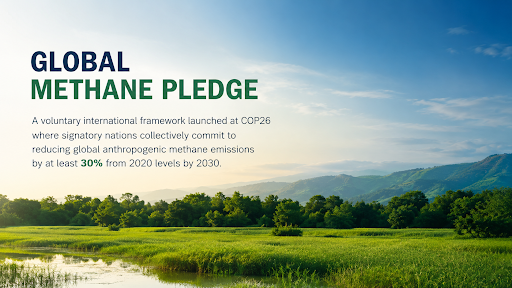
The Global Methane Pledge is a voluntary international framework launched at COP26 where signatory nations collectively commit to reducing global anthropogenic methane emissions by at least 30% from 2020 levels by the year 2030.
Reducing methane is the fastest, most effective way to immediately slow down global warming and prevent climate tipping points, while simultaneously avoiding millions of premature deaths globally by significantly reducing ground-level ozone pollution.
India has declined to sign the Global Methane Pledge due to major concerns that rigid international targets would severely threaten national food security, penalize smallholder livestock farmers, and compromise the livelihoods of millions dependent on agriculture.


© 2026 iasgyan. All right reserved