NPCI recently launched DRUNIX, an open-source, enterprise-grade blockchain platform re-engineered from Hyperledger Fabric. DRUNIX accelerates India's digital public infrastructure by enabling secure, scalable tokenisation of real-world assets, paving the way for transparent, interoperable, and efficient multi-organisation financial networks.
Why In News?
The National Payments Corporation of India (NPCI) officially released DRUNIX, as a high-performance enterprise blockchain platform.
What is DRUNIX?
DRUNIX functions as a high-performance, permissioned blockchain framework tailored for banking, payments, and public infrastructure sectors that require strict regulatory compliance and identity verification.
Hyperledger Foundation: NPCI engineers DRUNIX by re-engineering Hyperledger Fabric, maintaining full backwards compatibility with v2.5.x to allow seamless migration of existing smart contracts (chaincode).
Digital Public Infrastructure (DPI) Strategy: NPCI pivots from operating the Unified Payments Interface (UPI) to providing foundational DPI, standardizing the underlying architecture for digital assets nationwide.
Key Features of DRUNIX
Open-Source Licensing: NPCI releases the platform under the Apache License 2.0, permitting free use, modification, and commercial redistribution.
Language Support: The platform supports smart contracts written in Go, Java, JavaScript, and TypeScript.
Tokenization Support: It provides native architectural support for converting real-world assets into digital tokens, aligning with the Reserve Bank of India (RBI)’s e-Rupee ecosystem.
Segregated Peer Architecture: DRUNIX splits peer roles into Lite Peers (LP) for transaction endorsement and Committing Peers (CP) for block sanity checks and Multi-Version Concurrency Control (MVCC).
SQL Integration: It integrates YugabyteDB (SQL) for highly scalable state storage alongside traditional NoSQL options.
Interoperability: The framework removes data silos by enabling connectivity across financial institutions and regulatory bodies.
About Blockchain and Tokenisation
Distributed Ledger Technology (DLT): As defined by the Ministry of Electronics and Information Technology (MeitY), blockchain acts as an immutable database that allows transparent, decentralized information sharing.
Consensus Mechanisms: The network utilizes mechanisms like the Raft ordering service to validate blocks across the peer-to-peer network.
Tokenisation: This process converts ownership rights of real-world assets into digital tokens. The market for Real World Assets (RWA) is projected to reach $50 billion by the end of 2025.
Settlement Efficiency: Tokenisation enables T+0 (real-time) settlement, minimizing counterparty risk and democratizing access through fractional ownership.
Significance for India
Fintech Innovation: DRUNIX reduces compliance costs and operational friction for banks and payment aggregators.
Institutional Adoption: The platform integrates with the National Blockchain Framework (NBF) initiated by MeitY to support secure digital governance.
Start-up Ecosystem: It provides start-ups with enterprise-grade building blocks, eliminating the prohibitive costs of developing infrastructure from scratch.
Diverse Applications: Use cases include reusable KYC, trade finance, anti-counterfeit drug tracking, and debenture covenant monitoring as currently practiced by the National Securities Depository Limited (NSDL).
Source: BUSINESS-STANDARD
|
PRACTICE QUESTION Q. Consider the following statements regarding the "DRUNIX" platform recently in the news:
Which of the statements given above is/are correct? A) 1 and 2 only B) 2 and 3 only C) 1 and 3 only D) 1, 2, and 3 Answer: B Explanation: Statement 1 is Incorrect: DRUNIX was open-sourced by the National Payments Corporation of India (NPCI), not the Reserve Bank of India (RBI). Furthermore, it is described as a permissioned (private) blockchain framework, not a public, permissionless one (like Bitcoin or Ethereum). Statement 2 is Correct: It is explicitly described as a high-performance distributed ledger platform built as an enhanced fork of the Hyperledger Fabric framework. Statement 3 is Correct: The platform is specifically designed to support tokenisation, enabling the creation of digital asset ecosystems and the conversion of real-world assets into digital tokens. |
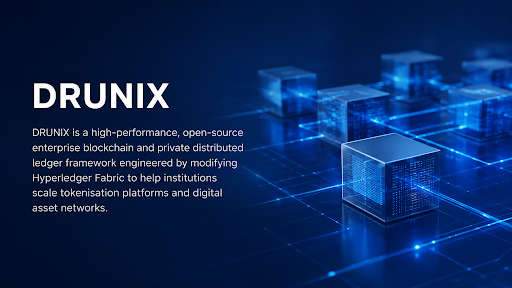
DRUNIX is a high-performance, open-source enterprise blockchain and private distributed ledger framework engineered by modifying Hyperledger Fabric to help institutions scale tokenisation platforms and digital asset networks.
The National Payments Corporation of India (NPCI) officially developed and launched DRUNIX to strengthen the nation's open-source digital public infrastructure.
Tokenisation is the secure cryptographic process of converting ownership rights of real-world or financial assets—such as real estate, commodities, or securities—into programmable digital tokens on a blockchain network.
Blockchain transforms the financial sector by providing an unalterable, immutable ledger that eliminates costly clearing intermediaries, reduces settlement times, prevents fraud, and enables fractional asset ownership.



© 2026 iasgyan. All right reserved