A Supreme Court-mandated committee said domestic workers do not need a separate law, citing coverage under new Labour Codes. Rights groups disagree, arguing these codes target formal establishments and ignore private households, leaving millions of women workers without social security, maternity benefits, or protection from exploitation.
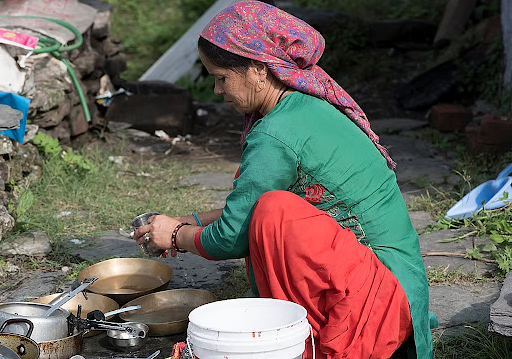
Copyright infringement not intended
Picture Courtesy: DOWNTOEARTH
An expert committee mandated by the Supreme Court has concluded that a separate law for domestic workers is not needed, as the existing four Labour Codes provide sufficient legal and social protections.
|
Read all about: Domestic Workers in India Explained l 92% Indian women take part in unpaid domestic work l Domestic Workers l Protect Domestic Workers' Rights |
Domestic workers are individuals employed to perform services within private households, such as cleaning, cooking, childcare, elder care, gardening, or driving.
Status of Domestic Workers in India
According to official statistics, based on the National Sample Survey (NSS), India has 4.75 million domestic workers, including three million women.
The sector is dominated by women, many of whom are migrants from socio-economically disadvantaged communities.
Invisibility and Isolation: They work within the confines of private homes, making them invisible to public scrutiny and isolated from other workers.
Low Wages and Job Insecurity: Lack of minimum wage enforcement leads to exploitation, and workers face the constant threat of arbitrary termination.
Long Working Hours: No regulation on hours of work, weekly offs, or paid leave.
No Social Security: Exclusion from benefits like health insurance, maternity leave, and pensions.
Informal Work Arrangements: Employment is based on informal verbal agreements, with no written contracts, fixed working hours, or defined job responsibilities.
Workplace Vulnerabilities: The isolated nature of their work exposes them to risks of physical, verbal, and sexual harassment with little effective recourse.
To address their inclusion, the government launched the e-Shram portal for unorganised workers. As of late 2023, over 32 crore workers, including domestic workers, have registered on the portal to access various welfare schemes (Source: PIB).
The Supreme Court, exercising its parens patriae jurisdiction, directed the Union government in 2025 to form an expert committee to explore the need for a dedicated legal framework for "largely unprotected" domestic workers.
The expert committee concluded that no separate law is required, as the legislative umbrella of the four new labour codes is adequate to cover domestic workers.
The committee advocates for implementing existing codes and registering domestic workers on platforms like e-Shram for social security access, rather than enacting a new law.
Argument for Relying on Labour Codes
Coverage is Provided
The codes are designed to be universal. The Code on Wages, 2019, and the Code on Social Security, 2020, explicitly include domestic workers, aiming to provide minimum wages and social security benefits.
Avoids Legislative Overload
The focus should be on effective implementation and registration on platforms like e-Shram to ensure benefits reach the workers.
Comprehensive Framework
The four codes together cover wages, industrial relations, social security, and occupational safety, providing a holistic legal umbrella.
Streamlined Governance
A single, unified legal framework simplifies compliance and governance for all sectors, including the unorganised sector.
Argument for a Separate Law
Applicability Gaps
The Code on Wages' main provisions apply only to establishments employing a minimum of five domestic workers. Because very few private households meet this five-worker threshold, the majority of domestic workers are excluded from the Code's coverage.
Private Home as a Unique Workplace
The codes are designed for formal, commercial workplaces. They fail to address the unique employer-employee dynamic in a private home, which complicates enforcement (e.g., inspection of premises).
Inadequate OSH Provisions
The Occupational Safety, Health and Working Conditions (OSH) Code, 2020, has worker-number thresholds, making it irrelevant for private homes. It offers no specific protection against workplace hazards unique to domestic work.
Unsuitable Grievance Redressal
The dispute resolution mechanisms under the Industrial Relations Code, 2020, are ill-suited for the individualised and informal nature of domestic employment relationships.
ILO Convention C189
The International Labour Organisation's (ILO) Convention C189 on Decent Work for Domestic Workers (2011) sets a global standard for protecting their rights. It calls for:
India supported the adoption of C189 but has not yet ratified it. The government's stance is that national laws must first align with the convention's provisions before ratification can occur.
The Philippines' 'Kasambahay Law' (RA 10361)
The Philippines' Domestic Workers Act (2013), or 'Batas Kasambahay', formally recognises and protects domestic workers. Its key provisions include:
Finalise the National Policy for Domestic Workers
The draft policy, which aims to legally recognise domestic workers and grant them rights, has been pending for years and needs to be finalised and implemented urgently.
Simplify Registration and Compliance
The process for both workers and employers to register (e.g., on e-Shram) must be simplified. Standardised, multilingual employment contract templates should be promoted.
Strengthen Social Security Delivery
Beyond registration, ensure the effective and last-mile delivery of benefits linked to the e-Shram portal. This requires targeted awareness campaigns and assistance for migrant workers.
Create Tailored Grievance Redressal Mechanisms
Establish simple, accessible, and effective dispute resolution bodies at the local level, as conventional labour courts are impractical for domestic workers.
Ratify ILO Convention C189: Ratifying the convention would signal India's commitment to global standards and provide a strong impetus for creating a robust domestic legal framework.
Including domestic workers in the Labour Codes is insufficient due to their unique home workplace, necessitating a specialised, context-sensitive legal and policy framework for genuine protection and decent work.
Source: DOWNTOEARTH
|
PRACTICE QUESTION Q. With reference to the ILO Convention C189 on Decent Work for Domestic Workers, consider the following statements: 1. It establishes global standards such as the right to a minimum wage and weekly rest. 2. India was one of the first countries to ratify this convention. 3. The convention is legally binding on all member nations of the ILO. Which of the statements given above is/are correct? (a) 1 only (b) 1 and 2 only (c) 2 and 3 only (d) 1, 2 and 3 Answer: A Explanation: Statement 1 is correct: The ILO Convention C189 (Domestic Workers Convention, 2011) establishes minimum labor standards for domestic workers, which include the right to a minimum wage and weekly rest of at least 24 consecutive hours. It aims to ensure equal treatment with other workers generally in relation to these conditions. Statement 2 is incorrect: India has not ratified Convention C189. While the Indian government has taken steps towards a national policy on domestic work and the extension of the Minimum Wages Act, the convention itself has not been ratified. Statement 3 is incorrect: ILO Conventions are only legally binding on the specific member nations that have ratified them, not on all member nations universally. |
The International Labour Organization (ILO) Convention C189 (2011) sets global standards for the decent work of domestic workers, including rights to minimum wage and weekly rest. India has supported the convention but has not yet ratified it.
The 'Kasambahay Law' is the Domestic Workers Act of the Philippines. It is considered a model because it successfully formalised domestic work by mandating written contracts, minimum wages, social security contributions, and regulated working hours, thereby empowering workers and providing clear legal recourse.
The e-Shram portal is a government platform for registering unorganised workers, including domestic workers. The aim is to create a national database to help them access various social security schemes and welfare benefits.




© 2026 iasgyan. All right reserved