CAFE standards mandate that a manufacturer's annual fleet-wide fuel consumption stays below specified limits. Aimed at reducing carbon footprints, these regulations penalize automakers whose total sales exceed CO2 targets, incentivizing the production of fuel-efficient internal combustion and electric vehicles.
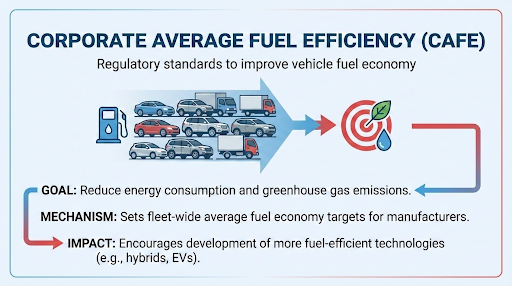
The Bureau of Energy Efficiency (BEE), under the Ministry of Power, introduced draft Corporate Average Fuel Efficiency (CAFE-3) norms, to be implemented by the Ministry of Road Transport and Highways (MoRTH) from April 1, 2027.
It is a regulatory standard that limits the total amount of Carbon Dioxide (CO2) emitted by an automobile manufacturer’s entire fleet of vehicles sold in a financial year.
Key Components of CAFE
Fleet-Wide Average: Unlike Bharat Stage (BS) norms which set limits for every individual vehicle, CAFE targets the weighted average of all cars sold by a company; high-emission vehicles must be balanced by low-emission ones.
Primary Objective: Its goal is to reduce the nation’s carbon footprint and lower fuel consumption, directly supporting India's energy security and climate goals.
The "Super-Credit" System: Manufacturers earn extra points for selling Electric Vehicles (EVs) or Strong Hybrids, as these significantly lower the company’s average CO2 output.
Measurement: Fuel efficiency is measured in terms of CO2 emissions (gm/km); the stricter the norm (e.g., CAFE-3), the lower the allowed CO2 limit.
Evolution: From CAFE-1 to CAFE-3
CAFE-1 (2017–2022): Targeted a fleet average of 130 gm CO2/km.
CAFE-2 (2022–2027): Lowered the target to 113 gm CO2/km.
CAFE-3 (2027–2032): Proposes stricter target of approximately 91.7 gm CO2/km, representing a nearly 19% reduction from current levels.
Strategic Significance
Climate Commitments: Essential for achieving India’s Panchamrit goal of reducing total projected carbon emissions by 1 billion tonnes by 2030.
Energy Security: By forcing higher fuel efficiency, these norms help reduce India’s massive crude oil import bill, which currently meets over 85% of domestic demand.
EV Push: CAFE norms indirectly incentivize Electric Vehicles (EVs) and Plug-in Hybrids, as these "zero-emission" vehicles help manufacturers pull down their fleet-wide CO2 averages.
Cost Escalation: Upgrading engines to be more fuel-efficient and integrating hybrid/electric powertrains will likely increase vehicle prices for consumers.
Diesel Phase-out: Since diesel engines generally emit less CO2 than petrol but more pollutants, manufacturers face a dilemma in balancing CAFE norms with strict BS-VI Phase 2 emission standards.
Technological Shift: Indian OEMs must invest heavily in CAFE compliance technologies like lightweighting materials, low-rolling-resistance tires, and advanced aerodynamics.
The Energy Conservation (Amendment) Act, 2022, introduced heavy penalties for manufacturers failing to meet CAFE targets:
Technology Diversification: Manufacturers must adopt a multi-pathway approach by integrating Strong Hybrids, Plug-in Hybrids (PHEVs), and Flex-fuel engines alongside EVs to lower fleet averages without relying on a single technology.
Strengthening Incentive Frameworks: Transitioning from subsidy-based models (like FAME) to performance-linked tax incentives for vehicles that exceed CAFE-3 efficiency benchmarks.
Circular Economy Integration: Developing a robust ecosystem for battery recycling and vehicle scrapping to recover critical minerals like Lithium and Cobalt, reducing the lifecycle carbon footprint of the automotive sector.
Infrastructure Synchronisation: Accelerating the rollout of the Green Energy Corridor to ensure that the electricity powering the growing EV fleet comes from renewable sources, maximizing the net CO2 reduction.
Stricter Enforcement: Monitoring through the Bureau of Energy Efficiency (BEE) and implementing the revised penalties under the Energy Conservation (Amendment) Act to maintain regulatory credibility.
CAFE standards are regulations that mandate automobile manufacturers to improve the average fuel efficiency of their entire fleet, thereby reducing overall CO2 emissions by penalizing companies whose total vehicle sales exceed specific fuel consumption targets.
Source: THEHINDUBUSINESSLINE
|
PRACTICE QUESTION Q. The Corporate Average Fuel Efficiency (CAFE) standards primarily aim to: A) Limit the maximum speed of commercial vehicles B) Regulate the average fuel consumption of an automaker's entire fleet C) Standardize the price of petrol and diesel across states D) Mandate the use of biofuels in all passenger cars Answer: B Explanation: According to the Bureau of Energy Efficiency (BEE), CAFE standards are designed to lower the total Carbon Dioxide (CO2) emissions of a manufacturer's entire sales volume, thereby improving national fuel security and reducing the environmental impact of the transport sector |
Corporate Average Fuel Efficiency (CAFE) norms are regulations that mandate automakers to lower the total carbon dioxide (CO2) emissions and improve fuel consumption averaged across their entire vehicle fleet sold in a financial year.
BS-VI norms limit toxic tailpipe pollutants (like NOx and PM) from individual vehicles to improve local air quality. In contrast, CAFE norms focus on lowering fleet-wide average CO2 emissions and fuel consumption to reduce the nation's overall carbon footprint and oil import dependency.
Automakers face major challenges including massive R&D costs for lightweighting and hybrid technology, the risk of severe financial penalties (up to ₹50,000 per vehicle) for non-compliance, and internal industry debates over whether small, entry-level cars should receive exemptions to remain affordable for consumers.



© 2026 iasgyan. All right reserved