The CITES project modernizes EPFO's legacy infrastructure by replacing 120+ regional databases with a single centralized system. Developed by C-DAC, it ensures real-time processing, auto-settlement of claims, and seamless account portability, enhancing social security delivery for Indian workers.
Why In News?
The Employees’ Provident Fund Organisation (EPFO) initiates the CITES 2.01 migration to overhaul its core IT architecture.
What is the CITES Project?
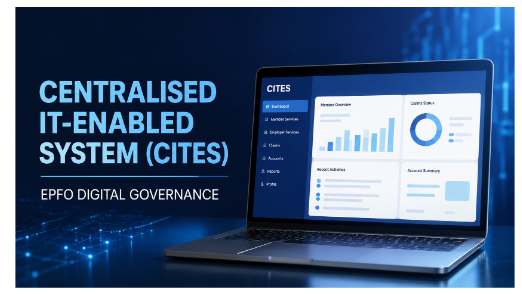
CITES (version 2.01) serves as a next-generation digital platform designed by the Centre for Development of Advanced Computing (C-DAC) under the Ministry of Electronics and Information Technology (MeitY) to centralize data management and automate workflows.
The EPFO replaces an archaic 2008-era software architecture—which previously relied on outdated systems like Windows Vista—to eliminate manual interventions and fragmented, employer-centric processing models.
Objectives:
Why is the CITES Project Important?
Digital Governance: Manages over 277 million accounts within a National Government Cloud architecture.
Social Security Delivery: Deploys the Centralised Pension Payment System (CPPS) to credit monthly pensions for over 78 lakh pensioners instantly.
Ease of Living: Transforms the system into an employee-centric interface, removing the need for physical visits to regional offices.
Transparency: Empowers workers to track real-time claim status via the UMANG app and the unified member portal, bypassing middlemen.
Formalization: Integrates social security networks with the e-Shram portal and DigiLocker.
Asset Management: Streamlines administrative oversight of a retirement fund corpus exceeding ₹20 lakh crore.
What are the Key Features of the CITES Project?
Centralized Architecture: Ensures "any bank, any branch" functionality through a single national cloud ledger.
Auto-Settlement: Processes claims up to ₹5 lakh for emergencies without human intervention.
Digital Profile Corrections: Allows workers to update names and dates of birth independently via Aadhaar OTP.
Automated Compliance: Re-engineers the electronic challan-cum-return (ECR) workflow for seamless employer filings.
Integrated Modules: Combines 6 core modules covering Member Accounts, Employer Filings, Claims, Pensions, Finance, and Compliance.
Digital Life Certificates: Integrates Jeevan Pramaan with India Post Payments Bank to remove physical submission requirements.
What Benefits Does the CITES Project Offer?
Faster Settlement: Settles over 60% of automated withdrawal requests within three working days.
High-Volume Processing: Clears over 3.5 crore fast-track auto-claims during FY 2025-26.
Grievance Redressal: Resolves technical errors at any national office, removing dependency on the original registering office.
Data Accuracy: Facilitates 32.23 lakh direct digital profile corrections annually, reducing rejection rates.
Seamless Portability: Executes automatic transfers of EPF balances upon job changes, removing the need for Form 13.
Pension Efficiency: Abolishes the mandatory transfer of Pension Payment Orders (PPOs) during relocation.
Source: THEHINDU
|
PRACTICE QUESTION Q. With reference to the Centralised IT-Enabled System (CITES) 2.01 project of the EPFO, consider the following statements: 1. It aims to replace 120+ decentralized regional databases with a single national cloud database. 2. It removes the necessity of transferring Pension Payment Orders (PPOs) when a pensioner changes their bank branch. 3. The system paves the way for EPFO subscribers to withdraw PF funds instantly via the Unified Payments Interface (UPI). Which of the statements given above are correct? A) 1 and 2 only B) 2 and 3 only C) 1 and 3 only D) 1, 2, and 3 Answer: D Explanation: Statement 1 is correct: The primary objective of the CITES 2.01 project (often referred to as EPFO 3.0) is to consolidate the organization's existing infrastructure, replacing over 120 decentralized regional databases with a single national central database. This shift is designed to ensure seamless service delivery and eliminate data silos. Statement 2 is correct: A key component of this modernization is the Centralized Pension Payment System (CPPS). This system enables pension disbursement through any bank or branch across India, explicitly removing the need for pensioners to transfer their Pension Payment Orders (PPOs) when they relocate or change their bank branch. Statement 3 is correct: The system paves the way for integrating EPFO services with the Unified Payments Interface (UPI). This feature allows subscribers to view their accounts directly within UPI apps and settle claims (withdrawals) instantly, reducing processing times from days to near real-time for eligible claims. |
CITES (Centralised IT-Enabled System) is EPFO's digital modernization initiative, built by C-DAC, which consolidates over 120 fragmented regional databases into a single national cloud database to automate workflow and process claims seamlessly.
It enables auto-settlement of claims up to Rs 5 lakh within 72 hours, removes the need for manual Form 13 during job transfers, permits "any bank, any branch" pension disbursal via the Centralised Pension Payment System (CPPS), and allows subscribers to update KYC details digitally without strict employer intervention.
Centralization removes regional jurisdictional barriers, meaning any PF office across India can process any member's request. It solves the issue of delayed record reconciliations and provides a unified dashboard for subscribers.
Major challenges include executing large-scale data migration of legacy "garbage in, garbage out" (GIGO) data without severe downtimes, mitigating cybersecurity risks for a Rs 20 lakh crore corpus, managing system integration with UPI/NPCI networks, and addressing the digital literacy gaps of the blue-collar workforce





© 2026 iasgyan. All right reserved