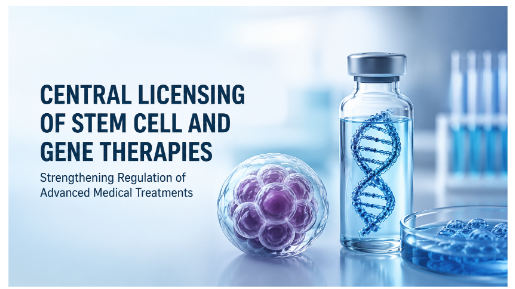
The Central Government amended the Drugs Rules, 1945, establishing centralized licensing for stem cell therapies, gene therapies, and xenografts under the CLAA framework. This reform ensures uniform oversight, promotes clinical safety, and targets unproven, exploitative medical practices across India.
Why In News?
The Ministry of Health and Family Welfare notified the Drugs (Eighth Amendment) Rules, 2026, bringing Cell or Stem Cell-derived products, Gene Therapeutic Products, and Xenografts under the Centrally License Approving Authority (CLAA) framework.
What are Stem Cell and Gene Therapies?
Stem Cell Therapy utilizes specialized, undifferentiated cells capable of differentiation and self-renewal to repair or replace damaged tissues
Objectives: These therapies treat genetic disorders at the root DNA/RNA level, address previously incurable diseases like severe blood cancers and inherited blindness, promote regenerative medicine, and shift patient outcomes from lifetime management to one-time, permanent cures.
Types of Stem Cells: Therapies utilize Pluripotent stem cells (e.g., Embryonic Stem Cells, iPSCs) capable of forming all 200+ body cell types, and Multipotent stem cells (e.g., adult bone marrow) for related tissue types.
Gene Editing Mechanisms: Practitioners deploy tools like CRISPR-Cas9, Zinc Finger Nucleases (ZFN), and viral vectors (lentivirus, AAV) to deliver healthy genetic codes.
Target Delivery Modes: Advanced therapies use In-vivo delivery (direct injection) and Ex-vivo delivery (extraction, modification, and reinfusion).
Key Features of the New Regulatory Framework
Centralised Licensing: The Drugs Rules, 1945 amendment brings stem cell products, gene therapies, and Xenografts under the CLAA.
Enhanced Oversight: The framework mandates joint supervision by the Central Licensing Authority and State Licensing Authorities
Safety and Quality: Facilities must adhere to Good Manufacturing Practices (GMP) and maintain transparent records of manufacturing and disposal.
Standardised Approval: The Form CT-10 "Prior Intimation" system allows manufacturers to commence production for analytical testing immediately upon acknowledgment.
Long-term Monitoring: The Central Drugs Standard Control Organisation (CDSCO) mandates a minimum 15-year post-market surveillance for gene therapies.
Reduced Timelines: The framework slashes central approval timelines for manufacturing permissions from 90 to 45 working days.
Strict Exclusions: The "prior intimation" relaxation excludes high-risk categories like live microorganisms, cytotoxic drugs, and sex hormones.
Benefits of Central Licensing
Patient Safety: Central oversight prevents unregulated clinics from marketing unproven treatments.
Quality Control: The policy standardizes complex processes like leukapheresis and viral vector transduction across all facilities.
Public Trust: Stringent clinical trial mandates eradicate "Therapeutic Misconceptions."
Responsible Innovation: Harmonizing protocols with standards builds international investor confidence.
Clinical Governance: The system binds practitioners to Evidence Based Status of Stem Cell Therapy (EBSSCT) guidelines, classifying unproven interventions as malpractice.
Combating Tourism: The framework eliminates "Stem Cell Tourism" where patients seek unverified, dangerous injections.
Regulatory Clarity: It codifies manipulated stem cell and gene products as "New Drugs" under the New Drugs and Clinical Trial Rules, 2019.
Source: INDIANEXPRESS
|
PRACTICE QUESTION Q. Under the Indian regulatory framework, which body is primarily responsible for evaluating the biosafety classification of viral vectors and overseeing the contained use of genetically modified organisms (GMOs)? A) National Medical Commission (NMC) B) Central Drugs Standard Control Organisation (CDSCO) C) Review Committee on Genetic Manipulation (RCGM) D) Institutional Ethics Committee (IEC) Answer: C Explanation: Under India’s biosafety framework (notified under the Environment Protection Act, 1986), the Review Committee on Genetic Manipulation (RCGM) evaluates the biosafety classification of viral vectors, sets containment requirements, and monitors ongoing research projects involving genetically modified organisms (GMOs). |
Stem cell therapy, a core pillar of regenerative medicine, utilizes unspecialized cells capable of differentiating into specialized cell types to repair, replace, or regenerate damaged tissues and organs. A prominent example is CAR-T cell therapy, which genetically engineers a patient's immune cells to combat cancers.
Gene therapy involves modifying, introducing, or replacing defective genetic material within a patient's cells to treat or prevent diseases at a fundamental molecular level. It is frequently deployed to cure rare genetic disorders and target complex malignancies.
The government amended the Drugs Rules, 1945 to place highly complex, rapidly evolving biological treatments (stem cells, gene therapies, xenografts) under the joint oversight of the Central and State Licensing Authorities. This central licensing (CLAA) ensures strict uniform regulatory standards across all states, eliminates regulatory loopholes exploited by unverified clinics, and dramatically improves patient safety.
Major ethical concerns revolve around "therapeutic misconception," where experimental and unproven procedures are falsely marketed to desperate patients as guaranteed cures. This practice undermines informed consent, causes severe financial exploitation, and exposes patients to high toxicity risks (such as cytokine release syndrome) without the safety nets normally provided by regulated clinical trials.






© 2026 iasgyan. All right reserved