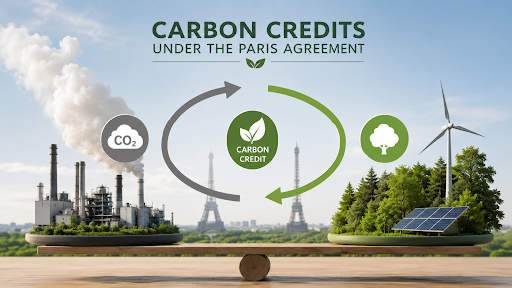
Carbon markets under Paris Agreement Article 6 allow nations to trade emission reductions globally. While they drive green investments and tech transfer, severe concerns like greenwashing, human rights violations, and over-crediting demand strict UN safeguards and transparent domestic policies like India's CCTS.
The United Nations issues its first-ever carbon credits under Article 6.4 of the Paris Agreement for a Myanmar clean-cooking project.
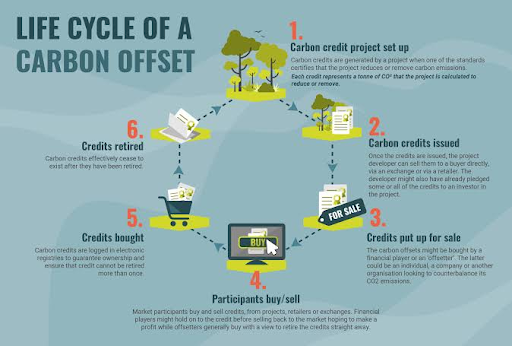
A carbon credit is a tradable permit granting the holder the right to emit one metric tonne of carbon dioxide (CO2) or an equivalent greenhouse gas (GHG).
The United Nations defines these credits as high-integrity financial assets designed to funnel international capital towards verifiable, sustainable climate solutions.
Carbon Offset Mechanism
This mechanism functions as a market-based strategy that delivers financial incentives to enterprises to actively reduce their environmental footprint.
In legally binding systems, polluters purchase these offsets to compensate for their excess emissions, balancing the global carbon ledger.
Emission Reduction Units
Under previous frameworks like the Kyoto Protocol, projects generated Emission Reduction Units (ERUs) and Certified Emission Reductions (CERs).
The modern framework transitions these legacy units into new, high-integrity credits, though analysts warn that transferring outdated units risks injecting "hot air" (a surplus of low-quality units) into the current market.
Under the Paris Agreement, the Article 6 Framework enables voluntary cooperation to meet Nationally Determined Contributions (NDCs). It mandates strict accounting to ensure transparency and prevent double-counting of reductions.
Internationally Transferred Mitigation Outcomes (ITMOs) facilitate direct trading of emission reductions between nations, allowing buyers to count purchased credits toward their NDCs.
The Paris Agreement Crediting Mechanism (PACM) replaces the legacy Clean Development Mechanism (CDM), focusing on reducing global GHG emissions while promoting sustainable development in host countries.
|
Key Components of Article 6 Article 6.2: A bilateral framework for direct country-to-country ITMO trading. India uses this via the Joint Crediting Mechanism (JCM) with Japan to trade mitigation outcomes. Article 6.4: A centralized, UN-governed global market for carbon credits. The Supervisory Body manages methodologies and verification to ensure compliance. Cooperative Approaches: These leverage international capital for emerging technologies. The India-Japan partnership focuses on green hydrogen, renewable energy storage, sustainable aviation fuel, and Carbon capture, utilisation, and storage (CCUS). |
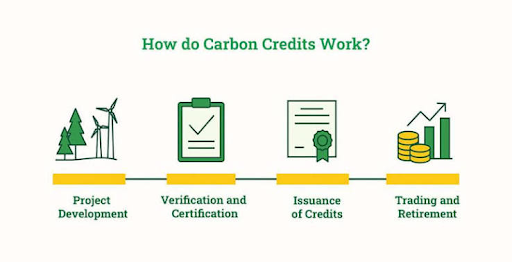
Emission Reduction Project
Developers implement specialized emission reduction projects on the ground. For example, the UN approves its first Article 6.4 project in Myanmar, where developers distribute clean-cooking stoves to replace traditional wood-fired stoves, reducing firewood consumption and indoor air pollution.
Verification and Certification
Projects require strict third-party verification by independent auditors. Auditors verify the avoided emissions using scientifically updated, conservative baselines to ensure the reductions are real and measurable.
Trading of Credits
Once verified, the UN issues the carbon credits to the project participants. The host nation utilizes a portion of these credits for its own NDC, while the remainder undergoes a cross-border transfer to the partner nation (e.g., South Korea) for compliance in its domestic Emissions Trading System (ETS).
Climate Change Mitigation
Putting a price on carbon drives climate change mitigation. The system establishes a financial penalty for pollution, incentivizing the fastest, most scalable pathways to transition away from fossil fuels.
Green Investment Mobilization
The mechanism catalyzes green investment by attracting private capital into the climate sector. The World Bank estimates that optimized carbon trading reduces the cost of implementing NDCs by more than half, saving up to $250 billion by 2030.
Technology Transfer
Markets accelerate technology transfer from developed to developing economies. International mechanisms finance the direct adoption of advanced industrial technologies in sectors like steel, cement, and power generation.
Sustainable Development Financing
Projects deliver socio-economic co-benefits. Clean cooking projects protect public health, halt deforestation, and directly empower vulnerable women and girls who disproportionately suffer from household air pollution.
Greenwashing Risks
Critics warn that carbon markets frequently enable greenwashing. Instead of structurally decarbonizing their operations, massive corporations merely purchase cheap offset credits, perpetuating their overall emissions without investing in clean technologies.
Double Counting of Emissions
Double counting poses a major systemic risk where both buyer and seller claim identical reductions. To combat this, Article 6 mandates rigorous corresponding adjustments within national GHG inventories.
Human Rights Concern
Carbon projects frequently involve human rights risks. For example, the first UN cookstove project in Myanmar, managed by a junta-linked ministry in the conflict-ridden Sagaing Region, faces criticism for legitimizing an oppressive regime during ongoing atrocities.
Transparency and Accountability Issues
Verification remains a challenge; in Myanmar, conflict prevented on-site audits, forcing reliance on remote interviews. This led to climate benefits being over-credited by 7 to 14 times.
India's Position on Carbon Markets
Carbon Credit Trading Scheme (CCTS)
India notified the CCTS 2023 to build a domestic carbon framework. The Bureau of Energy Efficiency (BEE) administers the market, and the Central Electricity Regulatory Commission (CERC) regulates trading to accelerate economic decarbonization.
Energy Transition Financing
India advocates for grant-based adaptation finance from developed nations rather than restrictive loans. It leverages carbon markets to attract international capital to fund 500 GW non-fossil capacity goal.
Climate Commitments
India integrates carbon markets into its strategy to reach Net-Zero by 2070. While championing Equity and Historical Responsibility, it opposes unilateral measures like the Carbon Border Adjustment Mechanism (CBAM).
Conclusion
Effective climate action requires global carbon markets to shift from corporate offset loopholes to systems prioritizing human rights, transparent accounting, and environmental integrity.
Source: DOWNTOEARTH
|
PRACTICE QUESTION Q. Consider the following statements regarding the carbon market mechanisms established under Article 6 of the Paris Agreement:
Which of the statements given above is/are correct? (a) 1 and 2 only (b) 3 only (c) 2 and 3 only (d) 1, 2, and 3 Answer: (b) Explanation: Statement 1 is incorrect: Article 6.2 provides a decentralized framework that allows countries to trade carbon credits (known as Internationally Transferred Mitigation Outcomes, or ITMOs) through voluntary bilateral or multilateral agreements. It is not a centralized market and is not exclusively regulated by a UN Supervisory Body. Instead, it is Article 6.4 that establishes a centralized global carbon market directly overseen by the UN Article 6.4 Supervisory Body. Statement 2 is incorrect: The framework does not prohibit transferring ITMOs or carbon credits to private corporate entities. Under Article 6.2, governments can authorize ITMO transfers for "other purposes," which explicitly includes voluntary use by private companies and non-state actors. Similarly, credits under the Article 6.4 mechanism (A6.4ERs) can be purchased by countries, companies, and individuals. Statement 3 is correct: The UN Article 6.4 Supervisory Body officially mandated the Sustainable Development Tool (SD Tool). This tool sets up a mandatory framework requiring all projects under the Article 6.4 mechanism to identify, evaluate, and mitigate environmental risks while strictly enforcing environmental and social safeguards (including human rights, gender equality, and indigenous rights). |
A carbon credit is a tradable financial permit that represents the verified removal or avoidance of exactly one metric tonne of carbon dioxide or its equivalent greenhouse gas from the atmosphere.
Article 6 establishes the pivotal framework that allows countries to voluntarily cooperate to achieve their climate targets by trading carbon credits internationally through standardized public and private market mechanisms.
Article 6.2 facilitates decentralized, bilateral, or plurilateral agreements between countries to trade Internationally Transferred Mitigation Outcomes (ITMOs). Article 6.4 creates a centralized, UN-supervised global carbon marketplace (replacing the CDM) governed by a dedicated Supervisory Body to issue verified carbon credits
India launched the Carbon Credit Trading Scheme (CCTS) in 2023 to price GHG emissions and decarbonize the domestic economy. The Bureau of Energy Efficiency (BEE) acts as the administrator, while the Central Electricity Regulatory Commission (CERC) regulates the trading activities.



© 2026 iasgyan. All right reserved