APEDA's export of 20 metric tons of Baksa honey from Assam to the USA secured higher profits for tribal beekeepers under the One District One Product (ODOP) scheme, boosting regional agricultural diplomacy and strengthening rural northeastern livelihoods.
Why In News?
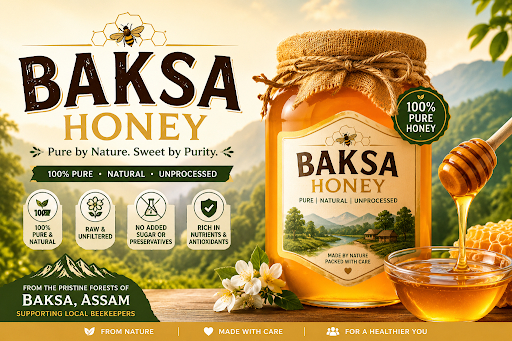
The Agricultural and Processed Food Products Export Development Authority (APEDA) facilitated the first export of 20 metric tons of ODOP honey from Baksa, an Aspirational District in Assam, to the USA.
About Baksa Honey
Indigenous communities produce Baksa Honey, a premium, near-organic honey variety, in the Baksa district of Assam, a part of the Bodoland Territorial Region (BTR).
Government promotes it as the signature product of the Baksa district under the One District One Product (ODOP) initiative to maximize its export potential and livelihood generation.
Key Characteristics
Natural Purity: Beekeepers harvest this honey from eco-friendly and pesticide-free environments, giving it high quality and near-organic characteristics.
Floral Diversity: The honey captures the rich biodiversity of the region, as bees collect nectar from diverse forest and agricultural flora.
Nutritional and Medicinal Value: Indigenous groups, specifically the Bodo, Karbi, and Mishing tribes, historically consume this honey for food, medicine, and traditional cultural practices.
About One District One Product (ODOP)
Origin
The Uttar Pradesh government originally launched the One District One Product (ODOP) program in 2018 to revive traditional, local industries and reduce rural out-migration.
The framework draws direct inspiration from international models like Japan's One Village One Product (OVOP) and Thailand's One Tambon One Product (OTOP).
The Department for Promotion of Industry and Internal Trade (DPIIT) under the Ministry of Commerce and Industry scaled the program nationwide.
Core Objectives
Identify, brand, and promote one signature product from each district to transform districts into thriving global export hubs.
Empower local artisans, weavers, and farmers by generating sustainable rural livelihoods and preserving indigenous cultural heritage.
Align local manufacturing efforts with overarching national economic missions like Aatmanirbhar Bharat, Make in India, and Vocal for Local.
Implementation Strategy
States and Union Territories take the lead in selecting their district-specific products (agricultural, handicraft, or industrial) based on historical prominence and local ecosystems.
The Ministry of Food Processing Industries (MoFPI) leverages the ODOP approach under the PMFME Scheme to support micro food processing enterprises
Source: PIB
|
PRACTICE QUESTION Q. Honey from the Baksa district is produced within which specific autonomous administrative region of Assam? (A) Karbi Anglong Autonomous Council (B) Dima Hasao Autonomous Council (C) Bodoland Territorial Region (BTR) (D) Rabha Hasong Autonomous Council Answer: C Explanation: Baksa is one of the administrative districts that makes up the Bodoland Territorial Region (BTR) in western Assam. The region's unique biodiversity allows local beekeepers to produce highly valued, near-organic honey, which is promoted under the government's One District One Product (ODOP) initiative. |
Baksa honey is a premium, near-organic honey variety known for its natural purity and rich nutritional profile. It is sourced from the diverse floral environments of Assam without the use of pesticides.
Baksa honey is produced in the Baksa district of Assam, which is a part of the Bodoland Territorial Region (BTR).
The ODOP initiative is a transformative program aimed at identifying, branding, and promoting one unique product (agricultural, handicraft, or industrial) from each district in India to turn them into global export hubs.



© 2026 iasgyan. All right reserved