Atal Innovation Mission launched “AI-Preneurs of India” at the India AI Impact Summit 2026, showcasing 45 deep-tech startups in health and agriculture. Backed by the ₹10,372 crore IndiaAI Mission, it reflects India’s shift to responsible AI, stressing innovation, Antyodaya, sovereign compute, data security, and talent development.
Copyright infringement not intended
Picture Courtesy: PIB
Context
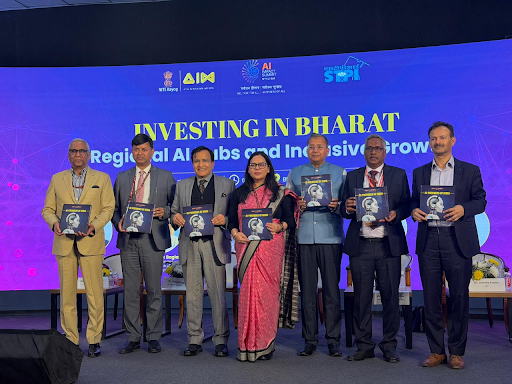
The Atal Innovation Mission (AIM), operating under NITI Aayog, launched a book titled "AI-Preneurs of India", as part of AIM's ‘Innovations For You’ series.
|
Read all about: About Atal Innovation Mission l About AIM 2.0 Boost Innovation Ecosystem |
What are the highlights of the ‘AI-Preneurs of India’?
Value Over Valuation: Emphasizes startups' "value creation" and real-world impact over high financial valuation (unicorns), highlighting the human element in tech innovation.
Wide Diversification: AI startups are spread across 30+ diverse sectors (e.g., healthcare, sustainability, sports, mobility), signaling a focus on solving core, real-world challenges
Responsible Global AI Player: India is shifting from a data consumer to a key contributor of Responsible AI solutions, supporting the national goal of "AI for All."
What is the Current Status of the AI Ecosystem in India?
Market Growth: Projected to reach $17 billion by 2027, growing at a Compound Annual Growth Rate (CAGR) of 25-35%. (Source: NASSCOM-BCG Report)
Government Support
The Union Cabinet has approved the IndiaAI Mission with an outlay of ₹10,372 crore to build robust AI compute infrastructure, including over 10,000 GPUs.
Global Ranking
India leads globally in AI skill penetration and talent concentration (2.8 penetration score, 16% of global talent), according to Stanford AI Index 2024 and NASSCOM reports.
Digital Public Infrastructure (DPI)
Unique "AI-on-DPI" models have emerged by integrating AI with the India Stack (Aadhaar, UPI). A key example is Bhashini, the national language translation mission.
What is Atal Innovation Mission (AIM)?
It was launched in 2016 under NITI Aayog to promote a culture of innovation and entrepreneurship across the country, from schools to research institutions and MSMEs.
Key Initiatives
Atal Tinkering Labs (ATL): Workspaces in schools (grades 6–12) equipped with 3D printers, robotics, and IoT kits to encourage hands-on STEM learning.
Atal Incubation Centres (AIC): Business incubators that provide startups with mentorship, infrastructure, and funding access.
Atal Community Innovation Centres (ACIC): Focused on promoting innovation in underserved regions, including Tier 2/3 cities and tribal areas.
Atal New India Challenges (ANIC): A grant-based mechanism (up to ₹1 crore) that supports technology-driven innovations addressing national challenges like health and energy.
Mentor India: A nationwide network of over 6,200 professional volunteers who guide students and entrepreneurs.
AIM 2.0
In late 2024, the government approved the continuation of the mission as AIM 2.0. This new phase includes:
How is Atal Innovation Mission (AIM) Catalyzing the Deep-Tech Revolution?
Decentralized Incubation: By establishing a vast network of Atal Incubation Centres (AICs) in tier-2 and tier-3 cities, AIM ensures that innovation is not restricted to major metropolitan hubs.
Bridging the 'Valley of Death': AIM addresses the "Valley of Death" (the gap between product development and market success) by providing patient capital, mentorship, and infrastructure to deep-tech startups.
What are the Challenges Facing Indian AI Startups?
Compute Infrastructure Deficit
India holds less than 2% of global AI compute capacity, forcing startups to rely on expensive foreign cloud providers for GPU access. (Source: MeitY Working Group Report)
Data Quality and Privacy
While data is abundant, much is unstructured. Compliance with the Digital Personal Data Protection (DPDP) Act, 2023, adds cost burden for early-stage startups
Ethical Concerns and Bias
AI models trained on Western datasets often show bias and perform poorly in the Indian context, such as in facial recognition for diverse skin tones. (Source: NITI Aayog)
Talent Gap in R&D
There is a shortage of high-level researchers (Ph.D.s) capable of building foundational models like Large Language Models (LLMs), even though India has many AI application developers.
Way Forward
Sovereign Compute
Accelerate the procurement and deployment of GPUs under the IndiaAI Mission to provide affordable and accessible computing power to domestic startups.
Sovereign Data
Develop "India Datasets" platforms, as envisioned under the National Data Governance Policy, to train AI models on India-specific languages, cultures, and contexts, reducing bias
Sovereign Models
Encourage and fund the development of indigenous Foundational Models (like BharatGPT) to move beyond creating applications on top of foreign models and build core AI capabilities
Conclusion
To transition from being "AI Adopters" to "AI Architects," India must build sovereign AI infrastructure to democratise access and develop inclusive, localized solutions that empower the last mile.
Source: PIB
|
PRACTICE QUESTION Q. Consider the following statements about the ‘AI-Preneurs of India’ initiative: 1. It was launched by the Ministry of Science and Technology. 2. It focuses exclusively on software-service startups in metropolitan cities. 3. It is part of the 'Innovations For You' series by the Atal Innovation Mission. Which of the statements given above is/are correct? A) 1 only B) 2 and 3 only C) 3 only D) 1, 2, and 3 Answer: C Explanation: Statement 1 is incorrect: The initiative was launched by the Atal Innovation Mission (AIM), which is under NITI Aayog, not the Ministry of Science and Technology. Statement 2 is incorrect: It does not focus exclusively on metropolitan cities. Instead, it highlights the geographic diversity of India’s AI landscape, specifically featuring startups from Tier-2 and Tier-3 cities and across more than 30 diverse sectors including healthcare, agriculture, and sustainability. Statement 3 is correct: The ‘AI-Preneurs of India’ initiative is launched as the 7th edition of the 'Innovations For You' series. This series is published by the Atal Innovation Mission (AIM) to showcase successful startups supported by its network. |
It is a coffee table book launched by the Atal Innovation Mission (NITI Aayog) that profiles 45 deep-tech AI startups incubated under Atal Incubation Centres. It highlights their journey in solving core physical-world problems.
Approved with an outlay of Rs. 10,372 crore, the IndiaAI Mission aims to build a robust AI ecosystem in India by procuring 10,000+ GPUs for compute capacity, promoting indigenous datasets, and supporting deep-tech startups.
AIM supports startups through Atal Incubation Centres (AICs) by providing physical infrastructure, mentorship, and "patient capital" to help them survive the early-stage cash crunch known as the 'Valley of Death'.


© 2026 iasgyan. All right reserved