Dating back 150 million years, the Archaeopteryx fossil beautifully reveals the evolutionary transition from dinosaurs to modern birds. Recent studies using synchrotron imaging identified specialized tertial feathers enabling active flight, alongside preserved trace metals within the Solnhofen limestone matrix.
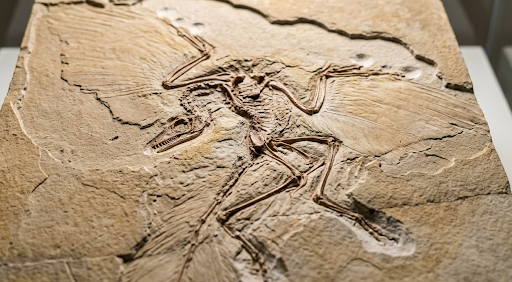
A 150-million-year-old fossil found in Germany provides critical evidence linking dinosaurs to the evolution of modern birds.
Definition: Archaeopteryx (meaning "ancient wing") is an extinct genus of bird-like dinosaurs.
Time Period: Lived approximately 150 million years ago during the Late Jurassic period.
Location: Fossils are exclusively found in the Solnhofen-Eichstätt area of Bavaria, Germany.
Diet: Evidence suggests it was a predator that likely ate insects, small reptiles, and possibly aquatic prey in its tropical lagoon habitat.
Why is it called a "Transitional Fossil"?
A transitional fossil exhibits traits common to both an ancestral group and its derived descendant group.
Archaeopteryx is the definitive connecting link between non-avian feathered dinosaurs (reptiles) and modern birds (aves) because it possesses distinct characteristics of both classes.
A. Reptilian Features (Dinosaur-like):
B. Avian Features (Bird-like):
Evolutionary Significance
Evidence of Organic Evolution: The Archaeopteryx provides fossil evidence that birds evolved from small theropod dinosaurs.
Development of Flight: Aids in understanding the evolutionary shift from land-dwelling dinosaurs to tree-dwelling and flying birds.
Darwinian Support: It remains one of the strongest paleontological proofs for the concept of common descent and macroevolution.
Source: TIMESOFINDIA
|
PRACTICE QUESTION Q. Archaeopteryx, frequently seen in news, is considered a "connecting link" between which two groups? A) Amphibians and Reptiles B) Reptiles and Birds C) Birds and Mammals D) Fishes and Amphibians Answer: B Explanation: Archaeopteryx exhibits a "mosaic" of traits from Reptiles and Birds.
|
Archaeopteryx is an ancient fossil dating back approximately 150 million years that serves as a crucial evolutionary bridge between ground-dwelling dinosaurs and modern birds.
Using Synchrotron Rapid Scanning X-ray Fluorescence (SRS-XRF), scientists mapped the fossil's chemistry to find that trace metals like zinc and copper are highly conserved in its bones, while phosphorus and sulfur remnants trace back to the original soft tissues of its feathers.
It possesses distinct avian features like feathered wings and asymmetric feathers for flight, alongside reptilian dinosaur traits such as jaws with sharp teeth, clawed wings, a long bony tail, and a hyperextensible "killing claw" on its toes.





© 2026 iasgyan. All right reserved