Tribal communities in central-eastern India are demanding a separate "Sarna" religious code in the 2026 census to preserve their distinct, nature-worshipping cultural identity. While supported by states like Jharkhand, groups like the RSS oppose it, claiming tribals are Hindus.
Jharkhand's Chief Minister has requested President Droupadi Murmu and Prime Minister Narendra Modi to include 'Sarna Religion Code' for tribal groups in the 2026 census.
The Sarna Code is a proposed separate religious category in the Census specifically for Adivasi communities who practice Sarnaism.
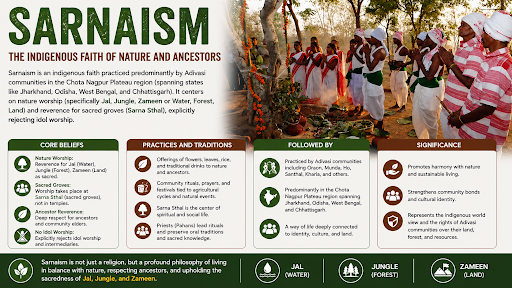
Definition of Sarna: The term refers to sacred groves of Sal trees where tribal communities traditionally worship.
Core Beliefs: Sarnaism centers on nature worship, focusing on Jal, Jungle, Zamin. Practitioners worship a supreme being (known as Dharmes, Singbonga, or Thakur Jiu) and honor ancestors.
Demographics: Main practitioners include the Munda, Ho, Santali, Oraon, and Kurukh tribes. In the 2011 Census, approximately 5 million people across 21 states voluntarily identified as "Sarna" under the "Other" category.
Distinct Rituals: Sarna followers are not idol worshippers and do not follow the Varna (caste) system. Their social rituals regarding birth, marriage, and death (such as burying the dead in courtyards) differ from mainstream religions.
Census Exclusion: Since 1951, the Census has excluded separate columns for tribal religions.
Cultural Preservation: Proponents believe a separate code will protect distinct tribal languages, customs, and traditional lands like the Parasnath Hills (Marangburu) from being subsumed by other faiths.
Safeguarding Reservation Status: Tribal advocates argue that identifying as "Hindu" or "Christian" weakens their claim to Scheduled Tribe (ST) status and associated constitutional protections.
Demographic Accuracy: Data indicates that more people identified as Sarna (about 5 million) than as Jains (4.4 million) in 2011, yet Jains possess a separate religious code. (Source: Census 2011)
Arguments Support and Oppose the Demand
|
Arguments Supporting the Sarna Code |
Arguments Opposing the Sarna Code |
|
Distinct Identity: Adivasis claim they are neither Hindus nor Christians; their nature-based faith existed before these religions. |
Hindu Integration: Organizations like the Vanvasi Kalyan Ashram, RSS argue tribal belief systems are fundamentally part of Sanatan (Hindu) traditions. |
|
Historical Precedent: The British Census (1871–1931) categorized tribals as 'Aboriginal' or 'Animism'. |
Conspiracy Claims: Opponents claim the demand is a "conspiracy" driven to divide Hindu society and facilitate conversions. |
|
Legal Entitlement: Article 25 of the Constitution guarantees freedom of religion; supporters argue this must include Sarnaism. |
Loss of Benefits: Critics warn that if Adivasis are classified as a separate religious minority, they might lose ST reservation benefits intended for those within the Hindu fold. |
|
Technical Accuracy: Providing a separate code ensures better data collection in a digitalized census process. |
Demographic Impact: Opponents argue that identifying as "Other" or "Sarna" leads to demographic changes that "weaken the country". |
State-Level Action: The Jharkhand State Assembly unanimously passed a resolution seeking the inclusion of the Sarna Code in the Census.
Union Government Decision: The final authority to grant a religious code rests with the Parliament. The Jharkhand government has formally requested the President and Prime Minister to implement the code in the upcoming 2026 Census.
Legal Review: There is an ongoing need for a clear legal framework to determine how a separate religious code would interact with Scheduled Tribe status and Uniform Civil Code (UCC) exemptions.
The demand for a Sarna Code represents an effort by tribal communities to achieve official recognition of their distinct nature-worshiping identity and secure their future constitutional rights
Source: THEPRINT
|
PRACTICE QUESTION Q. Consider the following statements about the Sarna religious faith:
Which of the statements given above is/are correct? A) 1 and 2 only B) 2 and 3 only C) 1 and 3 only D) 1, 2, and 3 Answer: A Explanation: Statement 1 is correct. Sarnaism is an indigenous faith practiced predominantly by Adivasi communities in the Chota Nagpur Plateau region (spanning states like Jharkhand, Odisha, West Bengal, and Chhattisgarh). It centers on nature worship (specifically Jal, Jungle, Zameen or Water, Forest, Land) and reverence for sacred groves (Sarna Sthal), explicitly rejecting idol worship. Statement 2 is correct. During the British colonial period, specifically from 1871 to 1931, a separate category called "Animism" was available in the census to count the tribal population's religious affiliation. This category was later replaced by "Tribal Religion" in 1941 and subsequently removed after independence. Statement 3 is incorrect. The Indian census currently provides specific religious codes for only six religions: Hinduism, Islam, Christianity, Sikhism, Buddhism, and Jainism. There is a longstanding demand from tribal communities to include a separate code for the Sarna religion, but it has not yet been granted by the Central Government. |
It is the indigenous religious faith followed by India's Scheduled Tribes, primarily in Central and Eastern India. It is characterized by the worship of nature (mountains, forests, flora, and fauna) and sacred groves (sal trees) rather than idol worship.
Adivasis are demanding a separate code to preserve their unique religious and cultural identity. They argue that they are not Hindus, Christians, or followers of the other six recognized religions, and want official recognition in the upcoming 2026 national census.
Sarna followers are largely concentrated in the states of Jharkhand, West Bengal, Odisha, Assam, and Bihar.



© 2026 iasgyan. All right reserved