The Bhojshala complex in Madhya Pradesh, originally an 11th-century Sanskrit learning centre built by Raja Bhoja, was recently declared a Hindu temple by the High Court based on ASI surveys, quashing the 2003 order permitting Muslim prayers.
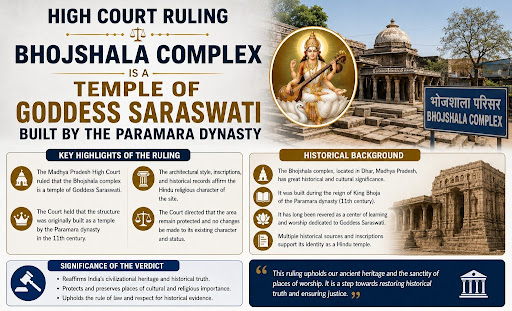
The Madhya Pradesh High Court ruled the Bhojshala complex is a temple of Goddess Saraswati built by the Paramara dynasty, granting unrestricted worship rights to Hindus.
The Bhojshala Complex, an 11th-century structure located in Dhar, Madhya Pradesh. The Archaeological Survey of India (ASI) protects the site as a Monument of National Importance.
Origins: The Paramara King Raja Bhoja established the complex around 1034 AD. He created the site as a centre of Sanskrit learning and built a temple dedicated to Goddess Saraswati (Vagdevi).
Architectural Features: The structure contains reused temple pillars, Sanskrit grammatical inscriptions shaped like serpents, and Prakrit verses carved into stone.
Kamal Maula Mosque: The complex also have the Kamal Maula Mosque, which Islamic rulers constructed centuries later by reusing structural fragments and pillars from the earlier Hindu temple.
The Relocated Idol: British archaeologists excavated and removed the original idol of the deity in 1875. The British Museum in London currently houses this idol.
Competing Religious Claims:
In 2003, the ASI issued a circular that allowed Hindus to hold puja on Tuesdays and Muslims to offer namaz on Fridays, triggering communal friction.
Scientific Survey Findings (2024): An ASI scientific survey uncovered a pre-existing Paramara-period temple plinth, Hindu iconography, mutilated idols, and reused temple materials buried beneath the existing mosque.
Judicial Verdict (May 2026): The Madhya Pradesh High Court declared the complex a Hindu temple dedicated to Goddess Saraswati.
Source: THEHINDU
|
PRACTICE QUESTION Q. With reference to the Bhojshala complex, consider the following statements:
Which of the statements given above is/are correct? (A) 1 only (B) 2 only (C) Both 1 and 2 (D) Neither 1 nor 2 Answer: (C) Explanation: Statement 1 is correct: The Bhojshala complex, located in the Dhar district of Madhya Pradesh, was originally established in the 11th century (around 1034 AD) by Raja Bhoja, the most celebrated monarch of the Paramara dynasty. It was built as a premier temple dedicated to Goddess Vagdevi (Saraswati) and served as a prominent centre of Sanskrit learning and university (Gurukul). Statement 2 is correct: The Places of Worship (Special Provisions) Act, 1991, which freezes the religious character of a place of worship as it existed on August 15, 1947, explicitly carves out exceptions under Section 4(3). It states that the law does not apply to ancient and historical monuments or archaeological sites covered by the Ancient Monuments and Archaeological Sites and Remains Act, 1958. Because Bhojshala has been an officially protected monument under the Archaeological Survey of India (ASI) since the early 20th century, it is exempted from the Act. |
The Bhojshala dispute centers around an 11th-century monument in Dhar, Madhya Pradesh. Hindus claim the site as a temple dedicated to Goddess Saraswati (Vagdevi), while Muslims recognize it as the Kamal Maula Mosque.
The complex was built by Raja Bhoja of the Paramara dynasty in 1034 AD as a prominent centre for Sanskrit learning and a temple dedicated to Goddess Saraswati.
The Bhojshala complex is exempted under Section 4(3) of the Places of Worship Act, 1991, because it is recognized as an ancient monument protected under the Ancient Monuments and Archaeological Sites and Remains (AMASR) Act, 1958.

© 2026 iasgyan. All right reserved