The Koraga tribe is a PVTG in Karnataka and Kerala historically oppressed by the inhuman Ajalu practice. The UN-Habitat Report 2026 highlights their housing inequality, though recent award-winning initiatives successfully secured their foundational land rights.
Why In News?
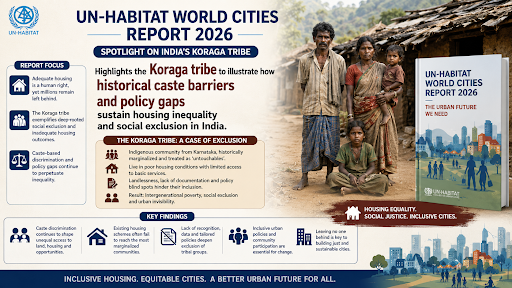
The UN-Habitat World Cities Report 2026 highlights the Koraga tribe to illustrate how historical caste barriers and policy gaps sustain housing inequality and social exclusion in India.
About Koraga Tribe
The Government of India classifies the Koraga tribe as a Particularly Vulnerable Tribal Group (PVTG) and a Scheduled Tribe (ST).
They primarily inhabit the Dakshina Kannada and Udupi districts of Karnataka, and the Kasaragod district of Kerala—a region collectively known as Tulu Nadu.
Language & Society
They speak Koraga Bhasha, an independent Dravidian language, and also communicate in Tulu, Kannada, and Malayalam.
The community traditionally follows a matrilineal inheritance system (Aliya Santana), although some families now practice a patrilineal system (Makkala Santana).
They divide their society into exogamous clans known as balis, and a village headman known as the Mooppan leads the community.
Historically, conservative society treated the Koragas as untouchables of Chandala origin, segregating their settlements and forcing them into menial jobs.
Culture & Religion
They practice a tribal religious system where they worship spirits known as Bhutas, a sun god, and various deities.
They celebrate nature through festivals like Bhoomi Habba (worshipping the earth).
They possess a rich musical heritage and specialize in drum beating (dollu/dolu) and flute music.
They traditionally perform the drum beating during events like Kambala (an annual buffalo race) to drive away evil spirits.
Economy & Livelihood
They rely heavily on agriculture and forest resources for their livelihood.
They preserve a traditional skill in basket weaving, utilizing forest creepers and bamboo.
Poverty and historical landlessness force many Koragas to work as daily wage earners, agricultural laborers, or Safai Karamcharis (manual scavengers).
They suffer from high rates of malnutrition and historically survived on a poor diet of Rice Ganji (boiled rice with water) and naturally deceased animal meat.
Exploitation & Legal Protection
Upper-caste subjected the Koragas to the inhuman Ajalu practice, forcing them to eat leftover food mixed with hair and nails to "ward off evil".
The government outlawed this exploitation by passing the Karnataka Koragas (Prohibition of Ajalu Practice) Act, 2000.
Global Recognition
The UN-Habitat World Cities Report 2026 highlights the Koraga tribe to demonstrate how caste barriers and policy gaps create severe housing inequality and social exclusion.
An empowerment initiative titled 'Restoration of Dignity and Human Rights of Indigenous Tribal Community in Karnataka' won the Gold Award at the 2019 World Habitat Awards.
Source: THEPRINT
|
PRACTICE QUESTION Q. The UN-Habitat World Cities Report 2026 recently highlighted which of the following indigenous communities to showcase the impact of systemic caste discrimination on urban housing access? (A) Toda (B) Sentinelese (C) Koraga (D) Jenu Kuruba Answer: (C) Explanation: The UN-Habitat World Cities Report 2026 spotlighted the Koraga tribal community of Karnataka and Kerala as a prime example of how entrenched caste structures and social exclusion hinder indigenous access to housing and government welfare schemes. |
The Koragas are a Particularly Vulnerable Tribal Group (PVTG) who primarily inhabit the Dakshina Kannada and Udupi districts of Karnataka, and the Kasaragod district of Kerala.
Ajalu was an inhuman socio-cultural practice where upper-caste Hindus forced Koraga people to eat leftover food mixed with hair, fingernails, and other inedible waste. The government officially criminalized this practice in 2000.
The community traditionally relies on basket weaving using forest creepers, playing flute music, and drum beating (dollu). Due to poverty and landlessness, conservative society also historically forced many to work as manual scavengers.



© 2026 iasgyan. All right reserved