Veera Pasi was a Dalit commander in the 1857 Revolt who bravely rescued Rana Beni Madhav from British captivity. Excluded from mainstream texts, his legacy survives through oral traditions and is now reclaimed for socio-political empowerment.
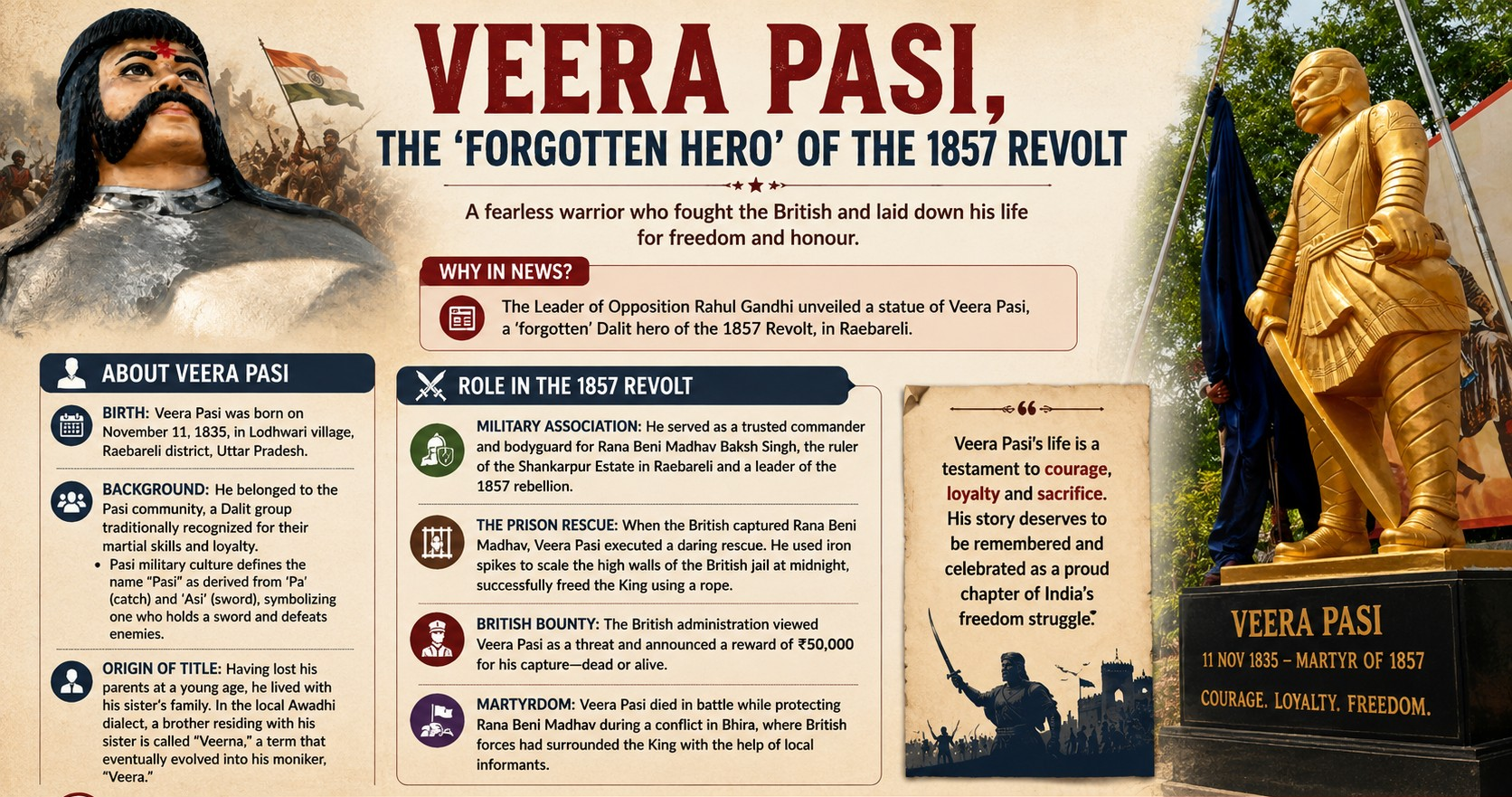
The Leader of Opposition Rahul Gandhi unveiled a statue of Veera Pasi, a 'forgotten' Dalit hero of the 1857 Revolt, in Raebareli.
Birth: Veera Pasi was born on November 11, 1835, in Lodhwari village, Raebareli district, Uttar Pradesh.
Background: He belonged to the Pasi community, a Dalit group traditionally recognized for their martial skills and loyalty.
Origin of Title: Lost his parents at a young age, he lived with his sister’s family. In the local Awadhi dialect, a brother residing with his sister is called "Veerna," a term that eventually evolved into his moniker, "Veera."
Role in 1857 Revolt
Military Association: He served as a trusted commander and bodyguard for Rana Beni Madhav Baksh Singh, the ruler of the Shankarpur Estate in Raebareli and a leader of the 1857 rebellion.
The Prison Rescue: When the British captured Rana Beni Madhav, Veera Pasi executed a rescue.
British Bounty: The British administration viewed Veera Pasi as a threat, announced a reward of ₹50,000 for his capture—dead or alive.
Martyrdom: Veera Pasi died in battle while protecting Rana Beni Madhav during a conflict in Bhira, where British forces had surrounded the King with the help of local informants.
| The Pasis constitute approximately 7% of Uttar Pradesh’s Scheduled Caste population, making them the second-largest Dalit group in the state after the Jatavs. |
Source: INDIAN EXPRESS
|
PRACTICE QUESTION Q. Consider the following statements regarding Veera Pasi:
Which of the statements given above is/are correct? A) 1 only B) 2 only C) Both 1 and 2 D) Neither 1 nor 2 Answer: A Explanation: Statement 1 is correct: Veera Pasi served as a trusted military commander and personal bodyguard to Rana Beni Madhav Baksh Singh of the Shankarpur Estate in Raebareli, Awadh. He is celebrated in folklore for audaciously rescuing the Rana from British captivity. Statement 2 is incorrect: The Eka movement in the Awadh region (in the 1920s) was led by Madari Pasi, not Veera Pasi. |
He was a Dalit freedom fighter from the Pasi community, born in 1835 in Lodhwari village, Raebareli, who served as a trusted commander for Rana Beni Madhav Baksh Singh during the 1857 revolt.
He executed a rescue mission using iron nails to free his king, Rana Beni Madhav, from a British prison, for which the frustrated British administration placed an unprecedented ₹50,000 bounty on his head.
He lost his parents early and lived with his sister; in the local Awadhi dialect, a brother living with his sister's family was called "Veerna", which eventually evolved into "Veera".


© 2026 iasgyan. All right reserved