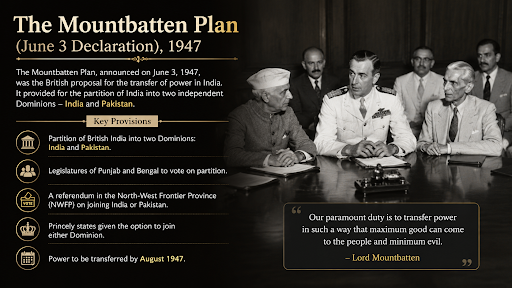
The Mountbatten Plan, announced on June 3, 1947, proposed partitioning British India into two independent dominions, India and Pakistan. It established Boundary Commissions, mandated territorial referendums, and aggressively accelerated the historic transfer of power to August 15, 1947.
Why In News?
Announced on June 3, 1947, the Mountbatten Plan was a proposal by Viceroy Lord Louis Mountbatten that partitioned British India into the independent dominions of India and Pakistan.
What Was the Mountbatten Plan of 1947?
Lord Louis Mountbatten, the last Viceroy of India, introduced the plan on June 3, 1947 (widely known as the June 3 Declaration).
The plan officially proposed the partition of British India into two independent dominions: India and Pakistan.
Mountbatten developed this practical proposal to replace the rejected Dickie Bird Plan (or Plan Balkan), which had threatened to fragment India into multiple weak states.
What Political Circumstances Led to the Plan?
The Cabinet Mission Plan (1946) failed to achieve a constitutional consensus between the Indian National Congress and the Muslim League.
Severe communal violence engulfed the subcontinent, escalating rapidly after the Calcutta killings of August 1946 and spreading to Noakhali, Bihar, and Punjab.
British Prime Minister Clement Attlee mandated Mountbatten to transfer power to Indian hands no later than June 30, 1948.
Mountbatten concluded that creating a separate state of Pakistan remained the only unavoidable solution to bypass the constitutional deadlock.
What Were the Key Provisions of the Mountbatten Plan?
Creation of Two Dominions: The plan authorized the creation of two independent dominions, India and Pakistan, each forming its own Constituent Assembly.
Provincial Voting: The Legislative Assemblies of Punjab and Bengal held votes to decide whether they would partition their respective provinces.
Sindh's Autonomy: The Sindh Assembly received the right to vote on whether to join India or Pakistan.
Public Referendums: The plan mandated referendums in the North-West Frontier Province (NWFP) and the Sylhet district of Assam to determine their territorial future.
Boundary Commission: A designated Boundary Commission received the task of demarcating the ultimate borders in Punjab and Bengal.
Princely States: The plan required the Princely states to accede to one of the two newly formed dominions.
Advanced Timeline: The British advanced the date for the transfer of power to August 15, 1947.
How Did Indian Political Leaders Respond?
Indian National Congress: Leaders like Jawaharlal Nehru and Sardar Vallabhbhai Patel reluctantly accepted the partition to halt spiraling bloodshed.
Muslim League: Muhammad Ali Jinnah accepted the plan because it guaranteed the creation of Pakistan, achieving his central political objective.
Sikh Leaders: Representatives like Baldev Singh accepted the plan, even though partitioning Punjab meant inevitably splitting the Sikh community across the new border.
How Did the Plan Accelerate Transfer of Power?
The British Government bypassed the lengthy process of waiting for a fully agreed all-India constitution by transferring power immediately under Dominion status.
Mountbatten advanced the withdrawal timeline from June 1948 to August 15, 1947, leaving Sir Cyril Radcliffe a mere five weeks to demarcate the complex borders.
The British Parliament enacted the Indian Independence Act of 1947, granting immediate sovereignty based on the Mountbatten Plan's framework.
What Were the Immediate Consequences of Partition?
Mass Migration: The announcement triggered immense confusion, resulting in one of the greatest mass migrations in human history.
Catastrophic Bloodshed: Extreme violence engulfed the newly drawn borders, leading to the deaths of lakhs of people and the displacement of crores.
Administrative Chaos: Millions of citizens in Punjab remained entirely unsure whether they belonged to India or Pakistan.
Infrastructure Disruption: The arbitrary boundary lines severed vital unitary systems, disrupting the Upper Bari Doab Canal irrigation network, railway communications, and the Mandi Hydro-electric Scheme.
Long-Term Conflicts: Congress underestimated Jinnah and failed to foresee the disastrous long-term consequences of rushed border demarcations, which directly spawned the enduring Kashmir conflict.
Source: INDIANEXPRESS
|
PRACTICE QUESTION Q. Consider the following statements regarding the "Dickie Bird Plan" of 1947:
Which of the statements given above is/are correct? A) 1 only B) 2 only C) Both 1 and 2 D) Neither 1 nor 2 Answer: A Explanation: Statement 1 is correct: the "Dickie Bird Plan" (or Plan Balkan) was indeed drafted by Lord Mountbatten and his advisors, Sir Hastings Ismay and Sir George Abell. Statement 2 is incorrect: Instead of directly joining a centralized union, the plan proposed that provinces be declared independent successor states, allowing them the choice to join either India or Pakistan, or to remain entirely independent. |
The Mountbatten Plan, officially known as the June 3 Declaration, was the final British proposal to transfer power. It formally established the partition of British India into two independent dominions: India and Pakistan.
Informally known as Plan Balkan, it was Mountbatten’s initial draft proposing that British provinces become independent states first before choosing a union. It was abandoned after Jawaharlal Nehru warned it would trigger India's complete political fragmentation.
Congress leaders, including Sardar Patel and Jawaharlal Nehru, reluctantly accepted partition to halt massive communal violence and to ensure a strong, centralized Indian government, realizing that enforcing unity with the Muslim League was impossible.


© 2026 iasgyan. All right reserved