Description
Why In News?
The Prime Minister paid tributes to Dharti Aaba Bhagwan Birsa Munda Ji on his martyrdom day on 9th June.
Who was Birsa Munda?
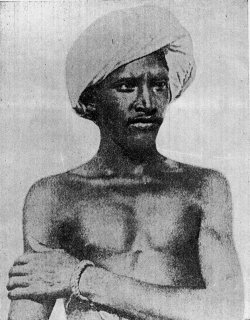
Birsa Munda was a tribal freedom fighter, religious reformer, and folk hero from the Munda tribe of the Chotanagpur Plateau (present-day Jharkhand)
Birth and Background
- Birsa Munda was born on November 15, 1875, at Ulihatu village in the Khunti district of present-day Jharkhand.
- He belonged to the Munda tribe, an Austro-Asiatic tribal community inhabiting the Chota Nagpur Plateau.
- His father, Sugana Munda, worked as a tenant farmer under Zamindars (Dikus).
- The British colonial administration and non-tribal moneylenders systematically displaced tribals from their ancestral lands.
- Birsa experienced poverty, land alienation, and cultural oppression firsthand during his childhood.
Education and Influences
- Received early education under Jaipal Nag, a local teacher at Salga village.
- Birsa attended a German Mission School at Burudi for a brief period but left due to caste discrimination.
- He rejected missionary education and embraced traditional tribal beliefs.
- He interacted with Anand Panre, a Vaishnavite monk, who introduced him to Hindu religious texts.
- Birsa synthesized tribal animism with Hindu reformist ideas, creating a unique spiritual framework.
- He emerged as a self-taught religious leader and began preaching against British exploitation by 1895.
The Munda Rebellion (Ulgulan)
Causes of the Revolt
- British colonial rulers imposed the Zamindari system, which replaced communal tribal land ownership.
- Landlords (Dikus) — non-tribal outsiders — usurped tribal lands through forged documents and forced mortgages.
- Christian missionaries converted tribals and undermined traditional Munda culture.
- Forced labor (Beth-Begari) and exorbitant taxes impoverished tribal communities.
Exploitation of Tribal Communities
- Tribals lost land rights under the Bengal Tenancy Act of 1885.
- Moneylenders charged usurious interest rates and seized tribal properties.
- Forest laws restricted tribal access to forest produce, their traditional livelihood source.
- Police and courts favored Zamindars, leaving tribals without legal recourse.
- Tribal women faced sexual exploitation by landlords and colonial officials.
British Land Policies
- The British introduced the Permanent Settlement (1793) in non-tribal areas and extended landlordism into tribal regions.
- The Chota Nagpur Tenancy Act (1908) came too late — after the rebellion.
- The government recognized Khuntkatti rights (ancestral tribal land rights) only after Ulgulan.
- Birsa demanded: "Restore the old Munda Raj. Expel the Dikus and the British."
Major Contributions of Birsa Munda
Tribal Rights Movement
- Birsa organized the Munda tribe into a political force for the first time in history.
- He demanded the restoration of tribal land rights and the expulsion of non-tribal intermediaries.
- He established a parallel tribal government with its own laws and tax system.
- His movement forced the British to enact the Chota Nagpur Tenancy Act, 1908 — the first tribal protective legislation in India.
Resistance Against Colonial Rule
- Birsa led guerrilla warfare against British police stations, churches, and Zamindar estates.
- His followers attacked police stations at Tamar, Ranchi, and Khunti in 1899-1900.
- He declared himself the divine ruler under "Dharam Raj" — a kingdom free from British control.
- The British deployed armed forces and crushed the rebellion at Dumbari Hill in January 1900.
Social and Religious Reforms
- Birsa preached monotheism — worship of one God, "Birsait".
- He banned animal sacrifice, alcohol consumption, and witchcraft among tribals.
- He promoted education, cleanliness, and unity across tribal clans.
- He rejected caste hierarchy and advocated gender equality within tribal society.
What was Ulgulan?
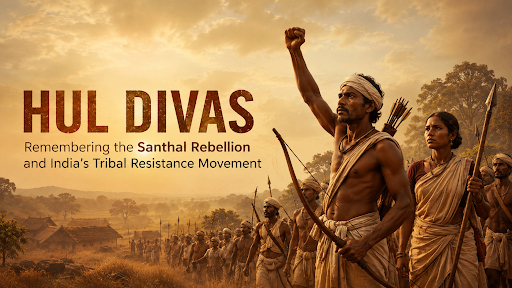
"Ulgulan" translates to "The Great Tumult" or "The Great Rebellion" in the Mundari language. It signifies a total revolution — political, social, economic, and spiritual.
Course of the Movement
- Phase 1 (1895-1897): Birsa preaches religious reform and organizes tribals across villages.
- Phase 2 (1897-1899): He declares "Dharam Raj" and calls for armed resistance.
- Phase 3 (1899-1900): Guerrilla attacks on British installations; tribals boycott colonial markets.
- Climax (January 1900): British forces surround Birsa's camp at Dumbari Hill; he is captured.
- Birsa died in Ranchi Jail on June 9, 1900 — officially from cholera, though poisoning is suspected.
Impact on Tribal Society
- Ulgulan instilled a lasting sense of tribal pride and political consciousness.
- It forced the British to recognize tribal distinctiveness and pass protective laws.
- It inspired subsequent tribal movements in Orissa, Madhya Pradesh, and Maharashtra.
- It established Birsa as the archetypal tribal hero in Indian nationalist historiography.
Legacy of Birsa Munda
Tribal Identity and Empowerment
- Birsa became the supreme symbol of Adivasi resistance and self-respect.
- His portrait hangs in the Indian Parliament — the only tribal leader so honored.
- Jharkhand, carved out of Bihar in 2000, claims Birsa as its founding icon.
- Tribal communities celebrate his birth anniversary as Janjatiya Gaurav Divas (since 2021).
Influence on Modern Tribal Movements
- The Jharkhand Mukti Morcha (JMM) and other tribal parties draw ideological inspiration from Ulgulan.
- Contemporary tribal protests — against mining, displacement, and forest rights violations — invoke Birsa's name.
- The PESA Act (1996) and Forest Rights Act (2006) echo Birsa's demands for self-governance.
- Global indigenous movements recognize Birsa as an early anti-colonial freedom fighter.
Recognition in Independent India
- The Indian government issued a postage stamp in his honor in 1988.
- Birsa Munda Airport (Ranchi) and Birsa Agricultural University bear his name.
- The Jharkhand government built a 25-foot statue at Dumka.
- PM Modi inaugurated the Birsa Munda Memorial in 2023, elevating him to national icon status.
Source: pib
|
PRACTICE QUESTION
Q. Consider the following statements regarding Birsa Munda:
- He belonged to the Munda tribe.
- He led the Ulgulan movement.
- He founded the Birsait religious movement.
Which of the statements given above are correct?
A. 1 and 2 only
B. 2 and 3 only
C. 1 and 3 only
D. 1, 2 and 3
Answer: D
Explanation:
Statement 1 is correct: Birsa Munda was an iconic indigenous freedom fighter and folk hero who belonged to the Munda tribe, native to the Chotanagpur Plateau region.
Statement 2 is correct: He led the historic tribal uprising known as the Ulgulan movement (The Great Tumult) between 1899 and 1900 against British colonial exploitation, unfair land systems, and deceptive local middlemen.
Statement 3 is correct: In the early 1890s, he successfully founded the Birsait movement, a distinct socio-religious faith that urged the tribal community to reject superstition, give up animal sacrifices, and worship a single God.
|
Frequently Asked Questions (FAQs)
Birsa Munda was a 19th-century tribal freedom fighter, religious leader, and folk hero from the Munda tribe who spearheaded a historic anti-colonial resistance movement against British rule in the Chhotanagpur plateau.
The Ulgulan, or the Great Tumult, was a fierce tribal rebellion launched between 1899 and 1900 to overthrow British administrative control, eliminate exploitative middlemen (dikis), and re-establish sovereign Munda self-governance.
His followers affectionately titled him Dharti Aba, meaning "Father of the Earth," because they revered him as a divine messenger possessing miraculous healing powers who would liberate them from systemic suffering.
The rebellion compelled the British government to enact the landmark Chota Nagpur Tenancy (CNT) Act of 1908, which strictly prohibited the illegal sale and transfer of tribal landholdings to non-tribal outsiders.