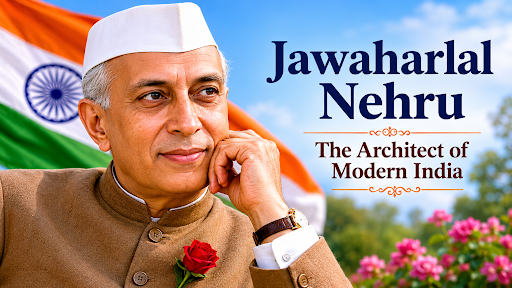
Jawaharlal Nehru, India's first Prime Minister, shaped the nation through his visionary emphasis on parliamentary democracy, secularism, planned economic development, and scientific temper. His enduring legacy includes vital institutions, the Non-Aligned Movement, and a robust democratic framework.
Why In News?
On the death anniversary of Pandit Jawaharlal Nehru on May 27, 2026, leaders across the political spectrum paid floral tributes to India's first Prime Minister.
Who Was Jawaharlal Nehru?
First Prime Minister: Jawaharlal Nehru served as the first Prime Minister of independent India for 16 years and 286 days (1947–1964).
Statesmanship: He guides the nation as a leading statesman, secular humanist, and social democrat.
Architect of Modern India: Historians recognize him for building India’s democratic, secular, and institutional framework.
Political Heir: He emerges as Mahatma Gandhi’s chosen political heir and a paramount freedom fighter.
Literary Contributions: He authored globally acclaimed books during his imprisonment, including The Discovery of India, Glimpses of World History, and An Autobiography.
Children’s Day: The nation celebrates his birthday on November 14 as Children's Day.
What Was the Early Life and Political Background of Jawaharlal Nehru?
Birth: He was born on November 14, 1889, in Allahabad into a wealthy Kashmiri Pandit family.
Parentage: His father, Motilal Nehru, is a prominent barrister and Congress president; his mother is Swarup Rani.
Early Education: He receives tutoring from Ferdinand T. Brooks, who introduces him to theosophy.
Foreign Education:
What Was Jawaharlal Nehru’s Role in India’s Freedom Movement?
Entry into Politics: He returns to India in 1912 and joins the Indian National Congress (INC), aligning with radical factions demanding self-governance.
Home Rule League: He joined and supported the Home Rule League in 1916.
Gandhian Influence: He meets Mahatma Gandhi at the 1916 Lucknow Congress session and adopts methods of civil disobedience.
Non-Cooperation Movement (1920-1922): He directs political activities in the United Provinces and faces his first imprisonment in 1921.
1929 Lahore Session: He presides over this session and introduces the historic resolution for Purna Swaraj (complete independence).
Tricolor Flag: He hoists the Indian tricolor on the banks of the Ravi River at midnight on New Year’s Eve, 1929.
Salt Satyagraha (1930): He manufactures contraband salt and receives a six-month sentence.
Quit India Movement (1942): He moved the resolution in August 1942, leading to incarceration at Ahmednagar Fort until 1945.
INA Trials (1945-1946): He defends Indian National Army (NIA) soldiers in court.
Why Is Jawaharlal Nehru Called the Architect of Modern India?
Constitutional Framework: He introduces the Objectives Resolution in the Constituent Assembly, forming the basis for the Preamble.
Parliamentary Democracy: He advocated secularism and institutional frameworks to unite a diverse nation.
Scientific Temper: He founded premier institutions including IITs, IIMs, NITs, and AIIMS.
Social Reform: He enacts the Hindu Code Bills (1955-1956) to criminalize caste discrimination and expand the legal rights of women.
Infrastructure: He constructs massive projects like the Bhakra-Nangal Dam, calling them the "Temples of Modern India."
What Were the Major Features of Nehruvian Economic Policy?
Establishes a Mixed Economy model.
Creates the Planning Commission and utilizes Five-Year Plans.
Promotes Import Substitution Industrialization to reduce foreign dependence.
Focuses on heavy industries (steel, coal, power) with state subsidies.
Abolishes giant landholdings through agrarian reforms.
How Did Jawaharlal Nehru Shape India’s Foreign Policy?
Co-founds the Non-Aligned Movement (NAM) to maintain Cold War neutrality.
Formulates the Panchsheel Agreement (1954) (Five Principles of Peaceful Coexistence).
Maintains India's status within the Commonwealth of Nations.
Supports global decolonization and Asian-African solidarity (e.g., 1955 Bandung Conference).
Advocates for global de-nuclearization.
Uses military force for national integration in Hyderabad (1948) and Goa (1961).
What Were the Major Criticisms of Jawaharlal Nehru?
Military Unpreparedness: Critics highlight his failure to prepare for the 1962 Sino-Indian War, leading to a humiliating defeat.
Economic Stagnation: Economists note that an average GDP growth of 4% failed to reduce poverty significantly.
Selective Secularism: Critics argue he reformed Hindu traditions through the Hindu Code Bills but allowed Muslims to retain orthodox personal laws.
License-Raj: Analysts blame his centralized planning and state control for the restrictive "License-Raj" system.
Partition Responsibility: Some historians argue his highly centralized vision alienated Muhammad Ali Jinnah, contributing to the Partition.
Language Policy: His attempt to make Hindi the sole official language caused intense opposition in South India.
What Is the Legacy of Jawaharlal Nehru in Contemporary India?
Democratic Longevity: He leaves a resilient republic based on universal adult suffrage.
Pluralism: His model of Dharma Nirpekshta (neutrality toward religion) serves as a safeguard against fundamentalism.
Institutional Foundation: His focus on scientific temper laid the groundwork for India’s current space and nuclear programs.
Geopolitical Identity: The Non-Aligned Movement remains a cornerstone of India's sovereign foreign policy.
Source: ANINEWS
|
PRACTICE QUESTION Q. Consider the following statements regarding Pandit Jawaharlal Nehru:
Which of the statements given above is/are correct? (a) 1 and 2 only (b) 2 and 3 only (c) 1 and 3 only (d) 1, 2, and 3 Answer: A Explanation: Statement 1 is Correct: Pandit Jawaharlal Nehru moved the historic 'Objectives Resolution' in the Constituent Assembly in December 1946. It laid down the fundamentals and philosophy of the constitutional structure, and its modified version was adopted as the Preamble of the Constitution. Statement 2 is Correct: Nehru is widely regarded as the chief architect of India's foreign policy. He played a pivotal role in the formation of the Non-Aligned Movement (NAM) and advocated for the "Panchsheel" principles of peaceful coexistence to maintain India's sovereignty and avoid alignment with Cold War power blocs. Statement 3 is Incorrect: While Nehru did author the classic book The Discovery of India, he wrote it during his imprisonment at the Ahmednagar Fort in Maharashtra (1942–1946), not at the Cellular Jail in Port Blair. |
Nehru's model of secularism, often described as "Dharma Nirpekshta," emphasized the state's strict neutrality and equal treatment toward all religions. Unlike the Western Marxian model that is anti-religion, Nehru’s approach was accommodating, aiming to separate politics and education from religious dominance to foster harmony and counter communalism in a highly diverse society.
Nehru coined the phrase "Temples of Modern India" to describe the massive infrastructure and scientific projects initiated after independence. This included major dams like the Bhakra-Nangal Dam, integrated steel plants, and premier research and educational institutes (like IITs and AIIMS) which he saw as the ultimate symbols of India's scientific progress and self-reliance.
Nehru was one of the founding fathers and the chief architect of the Non-Aligned Movement (NAM). He formulated this policy to ensure that newly decolonized Asian and African nations could maintain their strategic autonomy, sovereignty, and peaceful coexistence without being forced to align with either the US or the USSR during the Cold War.

© 2026 iasgyan. All right reserved