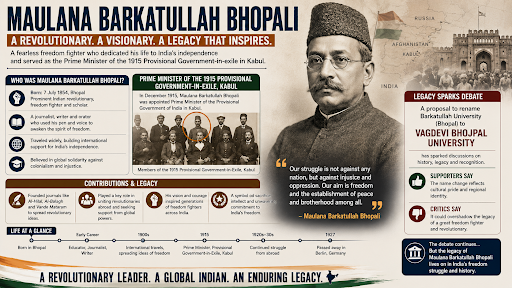
Maulana Barkatullah was an Indian freedom fighter, a founding member of the Ghadar Party, and the Prime Minister of the first Provisional Government of independent India, established in exile in Kabul in 1915
Why In News?
The executive council of Barkatullah University in Bhopal has passed a resolution to rename the institution to 'Vagdevi Bhojpal University,' sparking a debate over the legacy of Maulana Barkatullah Bhopali.
Who Was Maulana Barkatullah?
Maulana Abdul Hafiz Mohammad Barkatullah originates from the Itwara Mohalla of Bhopal, born on July 7, 1854.
He completes his religious education at Madrasa-e-Sulaimaniya, qualified as an Alim in 1878, and initially worked as a teacher.
He masters Arabic, Persian, and English, and later learns German, French, and Japanese, making him a brilliant polyglot and global scholar.
He sacrifices his personal life for the nation, never marrying and declaring the freedom struggle as his only bride.
Revolutionary Activities Against British Rule
He spends almost his entire life in exile, traveling across England, Germany, France, Russia, Japan, and the United States to build global alliances against the British.
He secured a position as a professor of oriental languages at the University of Tokyo in 1909.
He publishes anti-colonial journals, notably The Islamic Fraternity and El Islam, which the British government bans in India.
Tokyo University terminated his academic appointment in 1914 due to his relentless anti-British propaganda.
Role in the Ghadar Movement
He acted as a founding member of the Ghadar Party in San Francisco in 1913, collaborating closely with Lala Har Dayal.
He advocated armed struggle and revolutionary warfare to forcefully overthrow British rule in India.
He instills the revolutionary spirit among the Indian diaspora across the US and Canada, transforming immigrants into freedom fighters.
India's First Provisional Government in Exile
He established the Provisional Government of India in Kabul, Afghanistan, on December 1, 1915.
He serves as the First Prime Minister of this government-in-exile, working alongside Raja Mahendra Pratap (President) and Maulana Ubaidullah Sindhi (Home Minister).
He issued stamps, appointed ambassadors, and sought military assistance from Germany, Turkey, and Soviet Russia to attack British India.
Political Philosophy of Maulana Barkatullah
He advocates for Hindu-Muslim unity, recognizing that a divided India only strengthens the British divide-and-rule policy.
He authored the 1924 book The Khilafet, synthesizing Pan-Islamism, nationalism, and socialist thought.
He demands a strict separation of religion and politics, advocating for a secular, law-based state to govern politics alongside a purely spiritual Caliphate.
Global Dimension of His Freedom Struggle
He traveled to Moscow in May 1919 to meet Soviet leader Vladimir Lenin, directly seeking Soviet help for India's liberation.
He forms a strategic alliance with Bolsheviks, declaring that despite not being a communist, they share the common goal of expelling British imperialism and European capitalism from Asia.
He urges the global Muslim community and Asian nations to ally with the Soviet government to defeat imperialist forces.
He meets with prominent international leaders, including Pan-Africanist Marcus Garvey, uniting African-American and Indian anti-colonial struggles.
Legacy of Maulana Barkatullah
He died in exile in Sacramento, California, on September 20, 1927, with Raja Mahendra Pratap by his side.
The Indian government renamed Bhopal University to Barkatullah University in 1988 to honor his immense sacrifices.
Source: INDIANEXPRESS
|
PRACTICE QUESTION Q. With reference to the revolutionary leader Maulana Barkatullah Bhopali, which of the following statements is incorrect? A) He was a founding member of the Ghadar Party and organized expatriate Indians in the US. B) He authored the 1924 book 'The Khilafat', proposing the idea of a "Caliphate Republic." C) He served as the President of the Indian National Congress during the Surat Split of 1907. D) He met Vladimir Lenin in Moscow in 1919 to seek Soviet support against British imperialism in Asia. Answer: C Explanation: Option A (Correct): He was indeed a founding member of the Ghadar Party established in 1913 in San Francisco. He actively organized Indian expatriates in the US to fight for independence. Option B (Correct): He authored the book The Khilafet (published around 1924–1925), in which he proposed reformulating the Caliphate as a "Caliphate Republic" to align religious leadership with modern democratic principles. Option C (Incorrect): Barkatullah was a revolutionary who spent most of his life in exile (England, USA, Japan, Afghanistan) and was not involved in the leadership of the Indian National Congress. The INC Surat Session in 1907 was presided over by the moderate leader Rash Behari Ghosh. Option D (Correct): In May 1919, Barkatullah traveled to Moscow and met Vladimir Lenin to seek Soviet support for the Indian freedom struggle against British imperialism. |
Maulana Barkatullah was an eminent Indian revolutionary leader, scholar, and anti-colonial journalist from Madhya Pradesh who fought against British rule from overseas territories.
Established in December 1915, this entity was India's historic first government-in-exile formed in Afghanistan during World War I to overthrow British colonial administration.
Maulana Barkatullah served as the first Prime Minister of this revolutionary provisional government-in-exile, working alongside President Raja Mahendra Pratap.

© 2026 iasgyan. All right reserved