The Sanchi Stupa in Madhya Pradesh is a UNESCO World Heritage Site and one of India's oldest stone structures. Commissioned by Emperor Ashoka in the 3rd century BCE, this hemispherical brick and stone dome enshrines sacred relics of Lord Buddha.
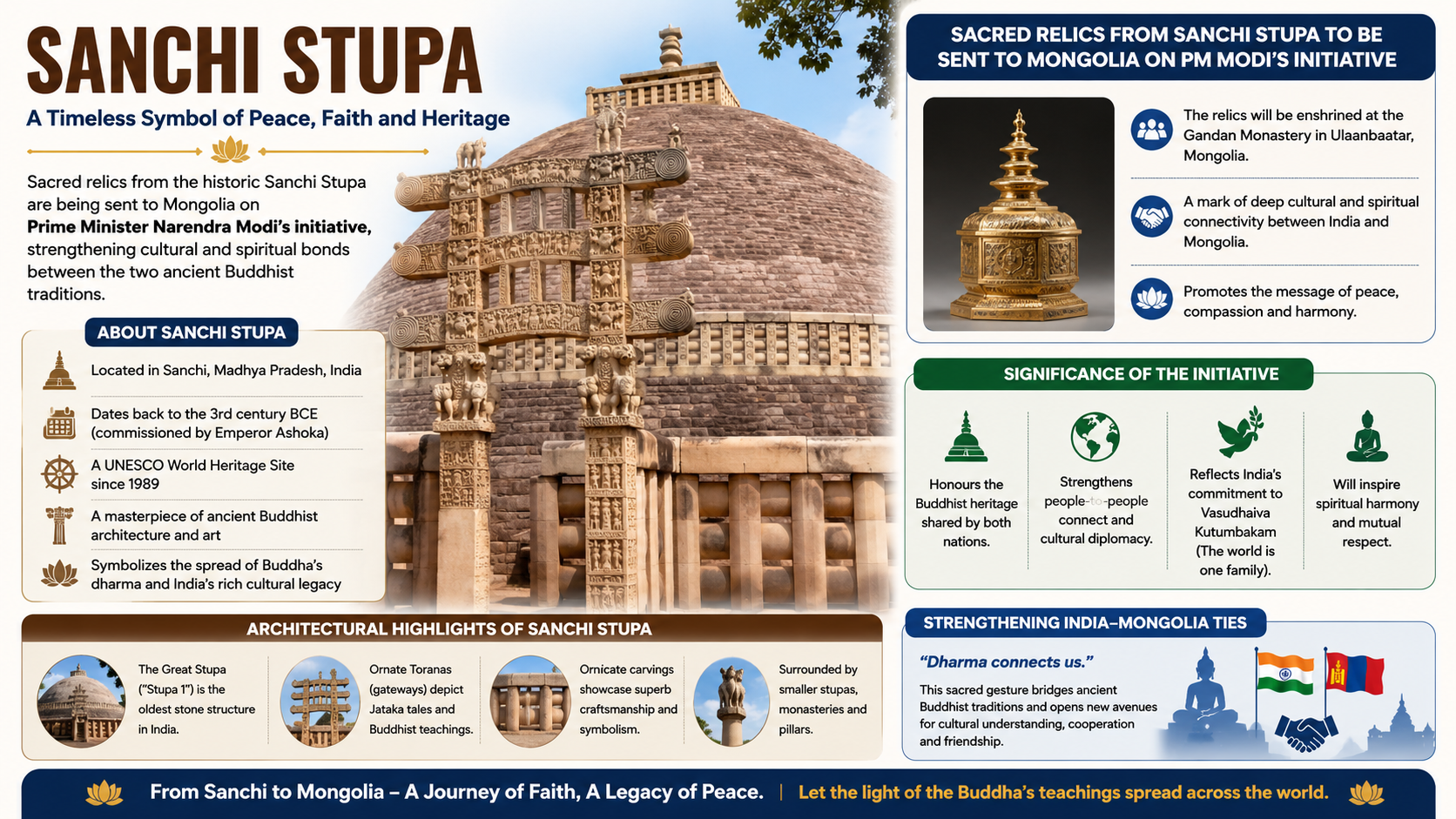
The sacred relics of Lord Buddha's chief disciples, Arhant Sariputra and Arhant Maudgalyayana, preserved at the Sanchi Stupa, were flown to Mongolia for a 10-day exposition.
The Sanchi Stupa is a Buddhist architecture site located in the Raisen district of Madhya Pradesh.
Discovery: British officer General Henry Taylor first documented the site in 1818. Alexander Cunningham and Frederick Charles Maisey conducted the first formal excavations in 1851.
Restoration: Sir John Marshall, Director-General of the Archaeological Survey of India (ASI), oversaw major restoration between 1912 and 1919.
It is one of the oldest stone structures in India. The Reserve Bank of India features the Sanchi Stupa on the reverse of the ₹200 currency note to signify its cultural importance.
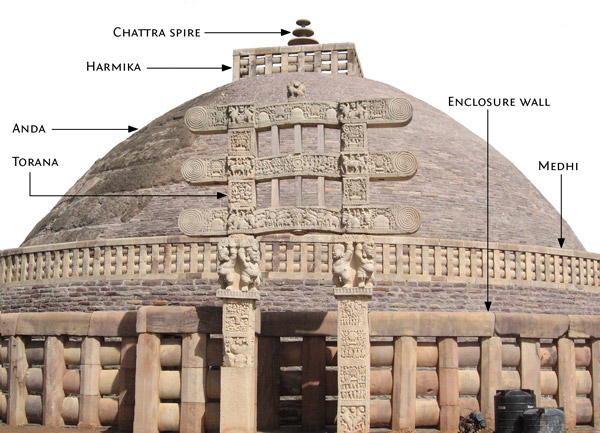 How Did the Sanchi Stupa Evolve Through Different Historical Periods?
Mauryan Period (3rd Century BCE)
Emperor Ashoka commissioned the original Great Stupa (Stupa No. 1).
The original nucleus consists of a simple hemispherical brick structure built over the relics of the Buddha.
Ashoka Pillar: Erection of a finely polished sandstone pillar near the Southern Gateway. It features a four-lion capital (similar to Sarnath) and contains the Schism Edict, warning against divisions in the Buddhist Sangha.
Temple 40: One of India's first free-standing temples, originally a timber-built apsidal hall on a rectangular stone platform.
Shunga Period (2nd Century BCE)
The Shungas nearly double the size of the original stupa by encasing the brick structure in stone slabs.
They flatten the dome at the top and add a square railing (Harmika) and three superimposed umbrellas (Chatra).
Stupa No. 2: Established during this time, featuring the earliest Buddhist reliefs (medallions dated c. 115 BCE). These reliefs show Kharoshthi mason marks, suggesting craftsmen from the Gandhara region.
Stupa No. 3: Built to house the relics of the Buddha’s chief disciples, Sariputra and Mahamoggallana.
Satavahana Period (1st Century BCE – 1st Century CE)
King Satakarni II conquers Eastern Malwa and sponsors the construction of the four highly decorated Toranas (Gateways).
Ivory Carvers of Vidisha: An inscription on the Southern Gateway reveals that the Guild of Ivory Carvers performed the intricate stone carvings, applying wood/ivory techniques to stone.
Aniconism: During this phase, the Buddha is never depicted in human form. Artists use symbols like footprints, empty thrones, the Bodhi tree, or a wheel (Dharmachakra).
Gupta and Later Periods (4th Century CE – 12th Century CE)
Temple 17: A tetrastyle prostyle temple from the 5th century featuring a flat roof and square sanctum, representing an early version of the Classical Hindu temple style.
Lion Pillar No. 26: A Gupta-era imitation of the Ashokan pillar, though with less refined artistry.
Temple 18: A 7th-century apsidal chaitya-hall rebuilt over Mauryan foundations.
Temple 45: The last Buddhist temple built on the site (9th century), marking the late stages of Buddhist influence in Central India.
The Sanchi Stupa serves as the prototype for the classic Buddhist Stupa design:
|
Component |
Description |
Symbolic Meaning |
|
Anda |
The massive hemispherical mound of the stupa. |
Symbolizes the dome of heaven enclosing the earth. |
|
Harmika |
A square railing at the apex of the dome. |
Represents the abode of the gods. |
|
Yasti |
A central mast or pillar rising from the Harmika. |
Symbolizes the Cosmic Axis connecting heaven and earth. |
|
Chatra |
Three superimposed umbrellas on the Yasti. |
Represents the Triratna (Buddha, Dhamma, Sangha) or celestial realms. |
|
Pradakshinapatha |
Circumambulatory paths at both ground and upper levels. |
Allows devotees to walk around the relics in prayer. |
|
Vedica |
A high stone railing or fence encircling the entire structure. |
Separates the sacred precinct from the secular world. |
|
Toranas |
Four ceremonial gateways at cardinal directions. |
Features intricate carvings of Jataka tales and Buddha’s life. |
The Four Toranas (Gateways)
Southern Gateway: The oldest and main entrance. It emphasizes the War over the Relics and Ashoka’s role in spreading Buddhism.
Northern Gateway: The best preserved. It features the Miracle at Sravasti and the Vessantara Jataka.
Eastern Gateway: Depicts historical events like the Great Departure (Siddhartha leaving his palace) and the Royal Procession of King Bimbisara.
Western Gateway: Features the Mahakapi Jataka (the monkey king story) and depictions of the Temptation of Mara.
Key Entities and Iconography
The Chief Disciples: The relics of Arhant Sariputra (known for wisdom/understanding) and Arhant Maudgalyayana (known for supernatural powers) are central to the site's sanctity. They are traditionally positioned on the Buddha’s right and left, respectively.
Jataka Tales: Narrative reliefs depict the previous lives of the Buddha as a Bodhisattva (e.g., Syama Jataka, Vessantara Jataka).
Foreign Influence: Reliefs depict Yavanas (Greeks) in kilted tunics and piloi hats, playing musical instruments like the aulos (double flute) and carnyx. Inscriptions confirm gifts from Yavana donors.
Shalabhanjika: The figure of a Yakshini (tree spirit) hanging from the architraves of the gateways, symbolizing fertility and protection.
Source: NEWSONAIR
|
PRACTICE QUESTION Q. Consider the following statements regarding the Sanchi Stupa:
Which of the statements given above is/are correct? A) 1 and 2 only B) 1 and 3 only C) 2 and 3 only D) 1, 2, and 3 Answer: B Explanation: Statement 1 is Correct: The original construction of the Great Stupa at Sanchi was commissioned by the Mauryan Emperor Ashoka in the 3rd century BCE. Initially, it was a modest hemispherical brick structure built over the relics of the Buddha. Statement 2 is Incorrect: In the earliest carvings of the Sanchi Stupa (such as those on the toranas/gateways), the Buddha is represented symbolically rather than in human form. This "aniconic" phase uses symbols like the Bodhi tree, a wheel (Dharmachakra), an empty throne, or footprints to signify his presence. Human representations of the Buddha appeared in later Buddhist art. Statement 3 is Correct: While Stupa No. 1 (the Great Stupa) is associated with the Buddha, Stupa No. 3 at Sanchi is famous for historically enshrining the sacred relics of his chief disciples, Sariputra and Mahamoggallana. These relics were discovered by Alexander Cunningham in the 19th century. |
The original hemispherical brick core of the Great Stupa was commissioned by the Mauryan Emperor Ashoka in the 3rd century BCE to enshrine the sacred relics of the Buddha. It was later expanded and encased in stone during the Shunga period.
They were two of Lord Buddha's chief and most trusted disciples. Sariputra was renowned as the "Dharma General" for his supreme wisdom and understanding, while Maudgalyayana was highly regarded for his mastery over supernatural powers.
Relic diplomacy is a form of cultural diplomacy where India leverages its shared material culture and spiritual heritage—such as sending sacred Buddhist relics to foreign nations—to strengthen diplomatic, political, and civilizational ties, emphasizing the concept of "Vasudhaiva Kutumbakam".


© 2026 iasgyan. All right reserved