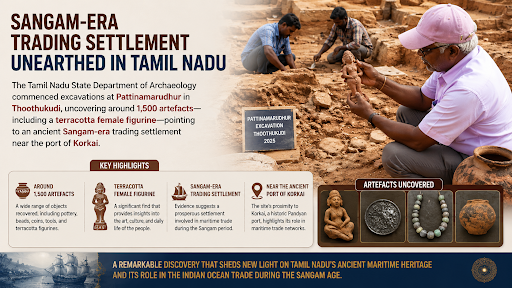
Excavations at Pattinamarudhur in Thoothukudi by the Tamil Nadu government have revealed an ancient trading settlement linked to the Pandyan port of Korkai. Findings, including a terracotta figurine, highlight Sangam-era maritime trade and refined craftsmanship.
The recent excavations at Pattinamarudhur in the Thoothukudi district of Tamil Nadu provide critical insights into the maritime history and cultural evolution of ancient Tamil society.
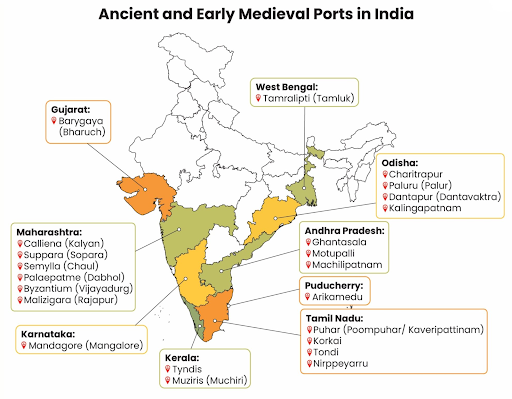
The importance of Pattinamarudhur lies in its strategic coastal location and its historical parallels with other major Sangam Age sites.
Coastal Trade Hub: Archaeologists identify the site as a thriving coastal trade center that operated during ancient times.
Parity with Korkai: Experts suggest that Pattinamarudhur’s trade equals that of Korkai, the famous ancient port and capital of the Early Pandyas.
Successive Cultural Phases: The site preserves evidence of successive cultural phases, indicating long-term human habitation and development.
Official Recognition: The Tamil Nadu government has officially declared the location an archaeological site due to its historical potential.
What Artefacts Have Archaeologists Discovered?
Excavations have yielded a high volume of diverse artefacts, numbering approximately 1,500 items.
Numismatics and Ceramics: The finds include ancient coins and porcelain pottery fragments, which serve as indicators of economic activity and trade.
Ornaments and Art: Excavators recovered shell ornaments and various figurines from the site.
Terracotta Female Figurine: A notable discovery features a female torso with intricate ornamentation and a finely modeled hair bun.
What Do the Findings Reveal About Ancient Tamil Society?
Maritime Trade: The presence of porcelain and coins points to active maritime trade with regions like the Roman Empire and the Far East.
Craftsmanship: Intricate details on figurines, such as the modeled hair bun, reflect the refined craftsmanship of the ancient period.
Economic Basis: The proximity to Korkai and the nature of the coastal finds suggest the society engaged heavily in pearl fishing and international commerce.
Cultural Continuity: Findings confirm the region hosted a complex Iron Age culture that evolved through different phases of interaction and settlement.
Source: THEHINDU
|
PRACTICE QUESTION Q. Consider the following statements about the recently excavated Pattinamarudhur archaeological site:
Which of the statements given above is/are correct? (a) 1 only (b) 2 only (c) Both 1 and 2 (d) Neither 1 nor 2 Answer: (c) Explanation: Statement 1 is correct: The Pattinamarudhur archaeological site is located in the Thoothukudi district of Tamil Nadu. Statement 2 is correct: It is situated on the east coast near Korkai, which was a prominent ancient port city and early capital of the Pandya kingdom, renowned during the Sangam Age for maritime trade. |
It is located within a 300-acre excavation zone in the Thoothukudi district of Tamil Nadu, situated near the ancient Pandya port of Korkai.
Around 1,500 artefacts have been excavated, most notably an intricately ornamented terracotta female figurine with a finely modeled hair bun, reflecting the refined craftsmanship of the ancient period.
During the Sangam Age, the nearby port of Korkai was famous for pearl fishing and conducting maritime trade with the Roman Empire and regions in the Far East.


© 2026 iasgyan. All right reserved