Raja Rammohan Roy, the Father of the Indian Renaissance, pioneered social reforms like Sati abolition. He founded the Brahmo Samaj and early Indian newspapers like Sambad Kaumudi, blending Western education with Indian philosophy to modernize 19th-century India.
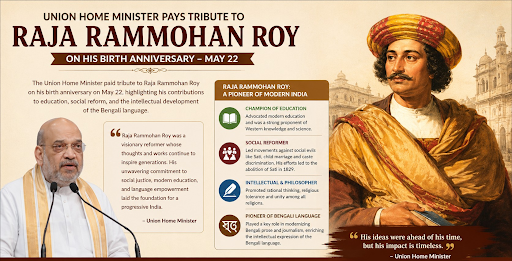
The Union Home Minister paid tribute to Raja Rammohan Roy on his birth anniversary on May 22.
Birth: Born into an orthodox Rarhi Kulin Brahmin family in Radhanagar, Bengal.
Titles: Mughal Emperor Akbar II conferred the title of "Raja" on him in 1830. He is widely recognized as the "Father of Indian Renaissance".
Linguistic Mastery: He mastered multiple languages, including Sanskrit, Persian, Arabic, English, Greek, and Latin.
Death: He died of meningitis in Bristol, England, in 1833 while serving as an ambassador for the Mughal Emperor.
Socio-Religious Reforms
Abolition of Sati: He witnessed the forced immolation of his sister-in-law, which ignited his crusade against Sati.
Monotheism: He promoted monotheism and the worship of "The Nameless, Eternal, Immutable Being." In 1804, he wrote Tuhfat-ul-Muwahhidin (A Gift to Monotheists) in Persian.
Anti-Idolatry: He campaigned against idol worship, polytheism, and meaningless religious rituals.
Caste and Social Equality: He attacked the caste system and untouchability. He advocated for women’s rights, including education for women, widow remarriage, and the right to property.
Kulinism: He fought against Kulin practices, particularly polygamy and the dowry system prevalent among Bengali Brahmins.
Educational Contributions
Integration of Knowledge: He advocated for a synthesis of Western scientific learning and traditional Indian philosophy (Vedanta).
Institutional Foundation:
Literary Contributions: He wrote Gaudiya Vyakaran, the first complete Bengali grammar book.
Contribution to Journalism
The Brahmo Samaj
Core Doctrines of Brahmoism:
Economic and Political Views
Economic Drain: Roy was among the first to estimate the economic drain of wealth from India to England. He estimated that nearly half of India's total revenue was sent abroad.
Free Trade: He believed that the unrestricted settlement of Europeans in India under free trade would help mitigate the economic crisis.
Administrative Reform: He campaigned for the induction of Indians into high ranks of service and the separation of the executive and judiciary.
Internationalism: He supported global struggles for liberty, including revolutions in Europe and Latin America.
Legacy and Historical Impact
Bridge Between Eras: He is regarded as the first individual of his generation to recognize the significance of the Modern Age.
Inspiration for Successors: His journalistic and reformist models inspired later leaders like Ishwar Chandra Vidyasagar, Jyotirao Phule, Bal Gangadhar Tilak, and Mahatma Gandhi.
Constitutional Influence: His advocacy for free expression laid the groundwork for Article 19(1)(a) of the Indian Constitution (Freedom of Speech and Expression).
Source: NEWSONAIR
|
PRACTICE QUESTION Q. Consider the following statements about Raja Rammohan Roy:
Which of the statements given above is/are correct? A) 1 only B) 1 and 2 only C) 2 and 3 only D) 1, 2, and 3 Answer: B Explanation: Statement 1 is correct: In 1814, he established the Atmiya Sabha in Calcutta (now Kolkata) as a philosophical discussion circle to promote monotheistic Vedanta ideals and campaign against idolatry. Statement 2 is correct: He published the Persian newspaper Mirat-ul-Akhar in 1822. When acting Governor-General John Adam introduced the restrictive Licensing Regulations of 1823, Roy shut down his newspaper in bold protest of the muzzling of the press. Statement 3 is incorrect: Roy supported the induction of Western education and physical sciences in India. He believed European education was a vital tool for liberating Indian society from orthodox dogmas and superstitions. |
The Mughal Emperor Akbar II bestowed the title of 'Raja' upon him in 1830 before his diplomatic envoy mission to the court of King William IV in England.
He led a relentless campaign against Sati, utilizing print media, scriptural evidence, and public debates to expose its inhumanity, which culminated in Governor-General Lord William Bentinck passing the Bengal Sati Regulation Act in 1829, making the practice illegal.
He founded the Bengali weekly Sambad Kaumudi in 1821 and the Persian newspaper Mirat-ul-Akhbar in 1822 to spread political awareness and push for social reforms.



© 2026 iasgyan. All right reserved