Banda Singh Bahadur, a legendary Sikh warrior who defeated the Mughals, captured Sirhind, abolished the Zamindari system, and established the first sovereign Khalsa Raj.
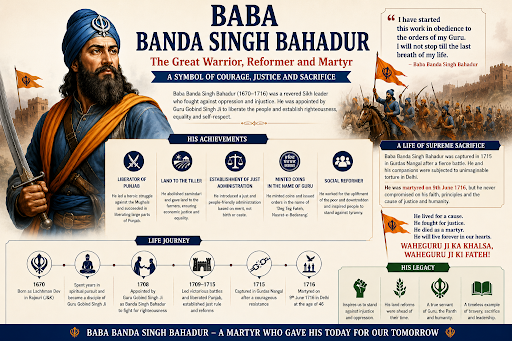
The Union Home Minister honored Baba Banda Singh Bahadur Ji on Sirhind Fateh Divas for his courage, farmer empowerment, and victory over Mughal rule.
Early Life
Lachhman Dev (later Banda Singh Bahadur) born in 1670, in the village of Tachhal near Rajouri (present-day Jammu and Kashmir) in a Rajput farming family.
He kills a pregnant doe during a hunt, experiences deep remorse over the dying fawns, and renounces worldly life to become an ascetic named Madho Das Bairagi.
He established a Dera (monastery) on the banks of the Godavari River in Nanded, Maharashtra.
Meeting Guru Gobind Singh
Guru Gobind Singh visited his monastery in 1708.
Madho Das submits his will to the Guru, declares himself the Guru's "Banda" (slave), and receives the Khande di Pahul (baptism).
The Guru renames him Gurbaksh Singh, though history universally records him as Banda Singh Bahadur.
Guru Gobind Singh grants him full political and military authority to lead the Khalsa Army in Punjab against Mughal tyranny.
The Guru equips him with five arrows, a Nagara (war drum), a Nishan Sahib, and an advisory council of Panj Pyare (five beloved ones), including commanders like Baj Singh and Binod Singh.
Major Military Campaigns
Banda Singh marches to Punjab and sacks the Mughal provincial capital of Samana in 1709.
He led the Khalsa forces into the decisive Battle of Chappar Chiri on May 12, 1710.
Socio-Economic and Administrative Reforms
Banda Singh establishes the Khalsa capital at Mukhlisgarh and renames it Lohgarh (Fortress of Iron).
He completely abolishes the Zamindari (feudal) system.
He transfers property rights directly to the tillers and peasants, deeply empowering the rural lower classes.
He strikes sovereign Khalsa coins bearing the names of Guru Nanak and Guru Gobind Singh.
He issued an official state seal carrying the inscription "Deg-o-Tegh-o-Fateh" (Economic power, the Sword, and Victory received from the Gurus).
He recruits individuals from the lowest castes and elevates them to ruling positions, shattering the social hierarchy.
He promotes religious tolerance; he allows Muslims to read the Khutba and Namaz, and recruits 5,000 Muslims into his army.
The Siege of Gurdas Nangal and Martyrdom
Mughal Emperor Farrukh Siyar ordered the absolute suppression of Banda Singh's movement.
Source: PIB
|
PRACTICE QUESTION Q. With reference to Banda Singh Bahadur, consider the following statements:
Which of the statements given above is/are correct? A) 1 and 2 only B) 2 and 3 only C) 1 and 3 only D) 1, 2, and 3 Answer: A Explanation: Statement 1 is correct: Banda Singh Bahadur conquered the fort of Mukhlispur, repaired it, and renamed it Lohgarh (Fortress of Iron), making it the capital of the first Sikh state. Statement 2 is correct: He is credited with abolishing the oppressive Zamindari system in the Punjab region, granting property rights directly to the tillers (peasants), which was a revolutionary fiscal reform. Statement 3 is incorrect: Banda Singh Bahadur did not strike coins in the name of the Mughal Emperor Bahadur Shah I. Instead, he struck coins in the name of the Sikh Gurus (Guru Nanak Dev Ji and Guru Gobind Singh Ji) to assert the sovereignty of the Sikh Panth. |
Banda Singh Bahadur was a prominent Sikh military commander. Born as Lachman Dev, he became an ascetic named Madho Das Bairagi. In 1708, he met Guru Gobind Singh in Nanded, accepted the Sikh faith (taking the name Gurbaksh Singh), and was commissioned by the Guru to lead the Khalsa army against the oppressive Mughal rule in Punjab.
Fought on May 12, 1710, the Battle of Chappar Chiri was a turning point in Sikh history. Banda Singh Bahadur's forces defeated the Mughal army and killed Wazir Khan, the Governor of Sirhind. This victory avenged the execution of Guru Gobind Singh’s younger sons and paved the way for the establishment of the first sovereign Sikh state.
Banda Singh Bahadur’s most revolutionary reform was the abolition of the exploitative Zamindari (feudal) system, returning land ownership directly to the cultivating peasants. He also struck sovereign Khalsa coins and issued a state seal in the names of Guru Nanak and Guru Gobind Singh.



© 2026 iasgyan. All right reserved