Shaheed Veer Gunda Dhur was a tribal leader from Bastar, Chhattisgarh. He spearheaded the 1910 Bhumkal Rebellion against British forest laws. Masterminding guerrilla warfare, he united local tribes to defend their land rights before mysteriously disappearing into the forests.
.
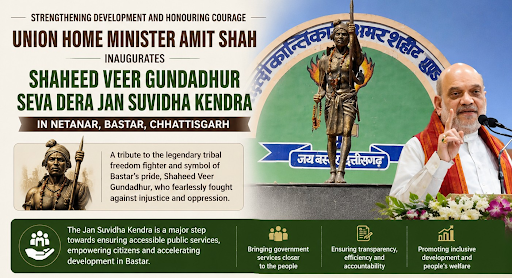
The Union Home Minister Amit Shah inaugurated the Shaheed Veer Gundadhur Seva Dera Jan Suvidha Kendra in Netanar, Bastar, Chhattisgarh.
Shaheed Veer Gundadhur originally bore the name Baga Dhurva and belonged to the Dhurva tribe.
He lived in the Nethanar village within the Jagdalpur tehsil of the Bastar district, Chhattisgarh, where he served as a tribal leader.
He mastered guerrilla warfare and deeply understood the traditional interests and culture of his people.
He strongly opposed British colonial policies that created reserve forests, barred tribal communities from their traditional livelihoods, and displaced tribal villages to exploit resources like iron and timber.
He fought against the influx of outside moneylenders, the oppressive system of forced labor (begar), and the British suppression of the tribal ghotul culture.
The Bhumkal Movement (1910)
Gundadhur organized and led the historic Bhumkal Movement in 1910 to overthrow the British Raj in the Bastar State.
He directly challenged the Bastar monarch, King Rudrapratap, who collaborated with the British administration.
Rebels secretly circulated red chilies, mango branches, clay bows and arrows, and lumps of earth from village to village to signal the start of the war.
Tribal warriors systematically targeted government institutions, destroyed British communication systems, and attacked oppressive forest officials and outside traders.
The rebellion spread across the region, resulting in the tragic sacrifice of nearly 25,000 tribal people who fought for their independence.
Betrayal and Escape
The British administration summoned additional military forces, led by Major Gere and De Brett, from Raipur to brutally suppress the uprising.
A traitor betrayed Gundadhur and revealed his secret location at the village of Amarnar to the British forces.
British soldiers surrounded him, but Gundadhur faced their guns and successfully escaped. The British forces never captured him.
Legacy and Modern Recognition
The tribal communities of Bastar celebrate his legacy every year on Bhumkal Diwas (February 10).
Local communities continue to sing tales of his heroism in traditional Bastar folk songs.
The Chhattisgarh Government honors his memory by awarding the Shaheed Gundadhur Award to state athletes.
Union Home Minister Amit Shah recently inaugurated the Shaheed Veer Gundadhur Seva Dera in Bastar.
Source: NEWSONAIR
|
PRACTICE QUESTION Q. Who among the following is credited as the primary leader and organizer of the guerrilla warfare during the Bhumkal Rebellion of 1910? (a) Veer Narayan Singh (b) Gunda Dhur (c) Raj Mohini Devi (d) Rani Avantibai Answer: B Explanation: Gunda Dhur, a tribal leader from Nethanar village in Bastar, Chhattisgarh, is credited as the primary organizer of the guerrilla warfare during the historic Bhumkal Rebellion (also known as the Bastar Rebellion) of 1910. He successfully mobilized the Dhurwa tribe and other local communities to resist British colonial policies and oppressive forest reservation rules. |
He was a prominent leader from the Dhurva tribe who fearlessly led the 1910 Bhumkal Rebellion against the British Raj in Bastar.
The rebellion was primarily sparked by exploitative British forest policies that barred tribals from using forests for their traditional livelihoods and displaced tribal villages.
The rebels covertly circulated red chillies, mango branches, clay bows and arrows, and lumps of earth from village to village to signal the start of the uprising.


© 2026 iasgyan. All right reserved