The PoSH Act of 2013 mandates safe working environments for women by prohibiting workplace sexual harassment. It establishes Internal and Local Complaints Committees for redressal and emphasizes prevention, accountability, and the protection of fundamental constitutional rights.
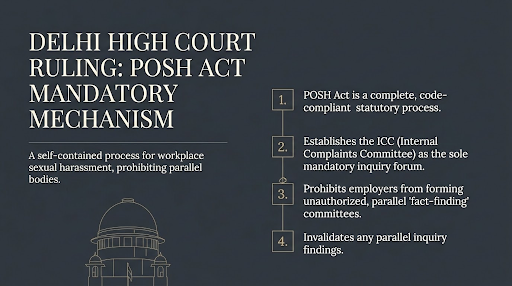
The Delhi High Court ruled the PoSH Act is a mandatory, self-contained mechanism, prohibiting employers from establishing parallel fact-finding bodies.
The Sexual Harassment of Women at Workplace (Prevention, Prohibition and Redressal) Act, 2013, commonly known as the PoSH Act, aims to protect women from sexual harassment at their place of work.
It was enacted to uphold the fundamental rights of a woman to equality under Articles 14 and 15, and her right to life and to live with dignity under Article 21 of the Constitution.
It aligns with the UN Convention on the Elimination of All Forms of Discrimination against Women (CEDAW), ratified by India in 1993.
The PoSH Act defines sexual harassment as any unwelcome, direct or indirect sexually determined behavior.
The workplace is broadly defined to include offices, hospitals, informal sectors, and remote locations like home offices.
The Act identifies two main forms: "Quid Pro Quo," involving promises of preference or threats of detriment for sexual favors, and "Hostile Work Environment".
Internal Committee (IC): Every employer of a workplace with 10 or more employees is legally mandated to constitute an Internal Committee at each office or branch.
Local Committee (LC): For workplaces with fewer than 10 employees or where the complaint is against the employer themselves, the government mandates a Local Committee at the district level.
Powers of the Committees: Both the IC and LC are granted specific legal powers to ensure they can function effectively as a quasi-judicial body:
The Act provides an option for conciliation before initiating an inquiry, provided the aggrieved woman requests it and no monetary settlement is used as the basis.
The Supreme Court clarified that an aggrieved woman can approach the ICC of her own workplace, even if the respondent works in a different department or organization, ensuring jurisdiction cannot be used to delay or deny complaints.
Fear-Driven Underreporting: Stigma, character assassination, and fear of retaliation or job loss deter many women from reporting harassment.
Informal Sector Risks: Over 90% of women work in the unorganized sector, remaining outside corporate compliance protections.
High Rates of Non-Compliance: Non-compliance remains high, with 36% of Indian firms and 25% of MNCs failing to implement valid ICCs or treat the Sexual Harassment Act, 2013, as more than a formality.
(Source: FICCI)
Remote Work Ambiguities: Supervision gaps in remote settings complicate detection, while blurred professional and personal life can result in digital misconduct, such as inappropriate after-hours contact.
Conciliation and Privacy Risks: Employers may misuse conciliation to force settlements, and confidentiality lapses during inquiries undermine trust and discourage victims from reporting.
Lack of Training: Members of the IC often lack legal training on how to conduct inquiries, handle evidence, and maintain neutrality, leading to procedural lapses that get challenged in court.
Defining the "Workplace": With the rise of "Work from Home" and the Gig Economy, determining the jurisdictional boundary of a "workplace" for online harassment (via Zoom, WhatsApp, etc.) remains a grey area in practice.
Set Virtual Engagement Rules: Organizations should establish clear online boundaries, banning unsolicited video calls or after-hours messaging without consent.
Specialized Training: Companies must provide annual POSH training to educate staff on digital conduct, compliance, and harassment definitions.
Compliance and Reporting: To ensure transparency and reduce legal risks, companies must file timely annual reports with the District Officer and maintain standardized complaint records and meeting minutes.
Accessible Reporting: Integrating tools like the SHe-Box into remote workflows provides safe, easy-to-use channels for early issue detection.
Gender Neutrality: Expanding the scope of the Act to protect all genders and non-binary individuals is a growing demand to align with modern workplace realities and Article 14 of the Constitution.
Defining "Workplace" for the Gig Economy: The law must clearly define "workplace" to include digital spaces and the homes of remote workers/gig partners to cover platform-based harassment
Linking Compliance to Business Licensing: Making the constitution of an IC a prerequisite for renewing business licenses or filing GST/Company returns would ensure 100% corporate compliance.
Reforming the Conciliation Clause: To prevent coercion, conciliation should only be permitted in the presence of a neutral third-party mediator or legal counsel, ensuring the victim isn't pressured into a "settlement".
Strengthening Local Committees (LCs): Ensure LCs in every district are adequately funded and publicized so that women in the informal sector can report harassment.
The PoSH Act serves as a vital legislative milestone to safeguard women's dignity at work, but its true success relies on strict institutional compliance, continuous sensitization, and proactive adaptation to modern and remote work environments.
Source: LAWTREND
|
PRACTICE QUESTION Q. "The true success of social welfare legislation lies in its accessible redressal mechanisms rather than mere statutory existence." Evaluate. 150 words |
The definition of a "workplace" is broad and extends beyond traditional office setups to include any department, organization, hospital, sports institute, dwelling place, or any place visited by the employee during the course of employment, including transportation provided by the employer. It also covers remote working spaces and home offices.
"Quid Pro Quo" literally means "this for that." Under the Act, it involves an implied or explicit promise of preferential treatment or a threat of detrimental treatment regarding present or future employment in exchange for sexual favors.
The Act provides for the creation of an Internal Complaints Committee (ICC) at every office with 10 or more employees, and a Local Complaints Committee (LCC) at the district level to handle complaints from the unorganized sector, domestic workers, or establishments with fewer than 10 employees.



© 2026 iasgyan. All right reserved