The RBI manages a trilemma, balancing growth and inflation against a strong USD. Through spot market interventions and NDF influence, it curbs rupee volatility rather than fixing a rate, navigating geopolitical risks and trade deficits to maintain macroeconomic stability.
Why In News?
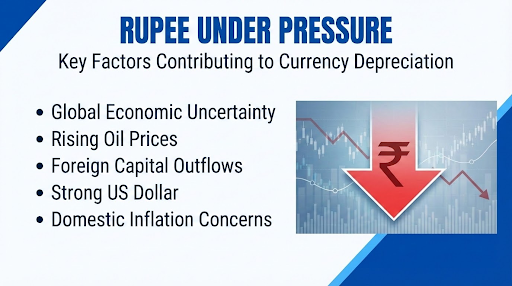
The Indian Rupee has hit record lows, dropping past ₹95 per U.S. dollar, driven by geopolitical tensions in West Asia, high oil prices, and capital outflows.
|
Read all about: RUPEE DEPRECIATION : CAUSES, IMPACTS & INSTITUTIONAL RESPONSE l DOES A WEAK RUPEE REALLY HELP INDIA'S ECONOMY |
Depreciation of the rupee is the decline in the value of the Indian Rupee (INR) relative to foreign currencies, most commonly the US Dollar (USD), driven by market forces of demand and supply.
|
Feature |
Depreciation |
Devaluation |
|
Exchange Regime |
Managed Float (Market-driven) |
Fixed Exchange Rate (Policy-driven) |
|
Key Cause |
Demand-Supply dynamics in Forex market |
Official government/RBI decision |
|
Speed |
Gradual and continuous |
Sudden and one-time |
|
Example |
₹74 → ₹95 (2022–2026) |
1966 and 1991 BoP Crises |
The "Dollar Strength" Phenomenon: Expectations of "higher-for-longer" interest rates by the US Federal Reserve have led to a surge in the US Dollar Index (DXY).
Foreign Portfolio Investment (FPI) Outflows: Heightened geopolitical tensions in the Middle East and Eastern Europe have triggered a "risk-off" sentiment.
Widening Trade Deficit: Despite robust service exports, India’s merchandise trade deficit remains structural.
The RBI does not target a specific level for the Rupee but intervenes to prevent excessive volatility. However, the current pressure sharpens three specific challenges:
Managing "Imported Inflation"
A weaker Rupee makes imports (especially crude oil, electronic components, and edible oils) more expensive. This "imported inflation" threatens to push the Consumer Price Index (CPI) above the RBI’s comfort zone of 4% (+/- 2%).
Depletion of Foreign Exchange (Forex) Reserves
To support the Rupee, the RBI sells Dollars from its reserves and buys Rupees. While India’s Forex reserves are robust (exceeding $700 billion as of early March 2026), aggressive intervention to defend can lead to rapid depletion, reducing the "import cover" for future exigencies.
The Liquidity Dilemma
When the RBI sells Dollars to support the Rupee, it sucks out Rupee liquidity from the domestic banking system. This "tight liquidity" can push up short-term interest rates, hurting private investment and India’s GDP growth targets.
Spot Market Intervention: The RBI sells Dollars from India’s Foreign Exchange Reserves to bridge the demand-supply gap, preventing sharp falls.
Controlling Speculation: Through the Foreign Exchange Management Act (FEMA), the RBI restricts speculative trading in the NDF (Non-Deliverable Forward) and domestic futures markets to prevent "panic-selling".
Monetary Policy Adjustments: The Monetary Policy Committee (MPC) may maintain higher interest rates to prevent capital outflows, making Indian debt instruments more attractive to global investors.
NDF Market Influence: The RBI has allowed Indian banks to participate in the Non-Deliverable Forward (NDF) market in GIFT City to influence offshore Rupee rates.
Currency Swap Agreements: Utilizing bilateral swap lines (like those with Japan) to manage liquidity without depleting the core Forex chest.
Competitive Depreciation: Some economists argue that a "managed depreciation" is beneficial. It makes Indian Exports (Textiles, Chemicals, and Engineering goods) more competitive against peers like Vietnam and Bangladesh whose currencies have also weakened.
Structural Reforms: To reduce Rupee sensitivity to oil shocks, the National Green Hydrogen Mission and E20 (20% Ethanol Blending) must be fast-tracked to achieve the target of reducing oil import bills by 20% by 2030.
Real Effective Exchange Rate (REER): As of March 2026, the INR’s 40-currency REER suggests the Rupee is still slightly "overvalued" compared to its long-term average, justifying a natural market correction rather than aggressive RBI defense.
The RBI manages the Rupee’s "glide" to balance export competitiveness against inflation and debt risks. To ensure resilience, India must deepen bond markets and internationalize the Rupee, reducing dependence on the Dollar and volatile global shifts.
Source: INDIANEXPRESS
|
PRACTICE QUESTION Q. Evaluate the concept of the 'Internationalisation of the Rupee' as a sustainable solution to India's structural trade deficit vulnerabilities. 150 words |
The Rupee's depreciation is primarily driven by global headwinds such as the persistent strength of the US Dollar, geopolitical tensions causing Foreign Portfolio Investors (FPIs) to pull out capital, and India's structural merchandise trade deficit inflated by high crude oil and gold import bills.
The trilemma refers to the RBI's complex challenge of balancing three conflicting policy objectives simultaneously: controlling domestic inflation, promoting economic growth, and maintaining exchange rate stability amidst global financial volatility.
REER is the weighted average of a country's currency relative to an index or basket of other major trading partners' currencies, adjusted for the effects of inflation. It serves as a crucial indicator of the international competitiveness of a nation's exports.





© 2026 iasgyan. All right reserved