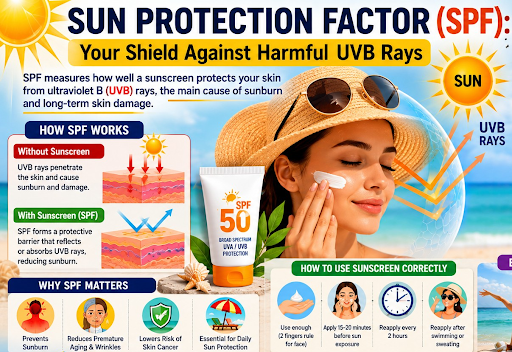
Sun Protection Factor (SPF) measures how well a sunscreen shields skin from ultraviolet B (UVB) rays, which cause sunburn. The number indicates the relative amount of solar radiation needed to burn protected skin compared to unprotected skin.
Why In News?
Sun Protection Factor (SPF) indicates how long a sunscreen defends against UVB rays compared to bare skin.
What is SPF Number?
Sun Protection Factor (SPF) measures the exact solar energy necessary to redden sunscreen-protected skin relative to unprotected skin.
SPF evaluates protection specifically against UVB rays (burning rays), completely ignoring UVA rays.
SPF calculates the amount of solar exposure, rather than the exact duration of time spent outdoors.
Scientists define SPF mathematically as the strict ratio of the Minimal Erythemal Dose (MED) on protected skin versus unprotected skin.
How do UVA and UVB rays affect human skin?
UVB Rays (Burning Rays):
UVA Rays (Aging Rays):
Higher SPF not guarantee complete protection
Non-Linear Protection: SPF 30 filters 97% of UVB rays, while SPF 50 filters 98%; this fractional 1% gain proves no sunscreen provides 100% UV blockage.
Missing UVA Defense: High SPF ignores UVA rays entirely unless the label specifically guarantees broad-spectrum coverage or high PA ratings.
False Security: High numbers manipulate consumers into extending sun exposure and skipping crucial two-hour reapplications.
Flawed Application Rates: Laboratories determine SPF using a strict 2.0 mg/cm² application thickness, but average users apply just 25% to 50% of this dose, which exponentially slashes the real-world protection level.
Source: THEHINDU
|
PRACTICE QUESTION Q. Consider the following statements regarding Ultraviolet (UV) Radiation and Sun Protection Factor (SPF):
Which of the statements given above is/are correct? A) 1 and 2 only B) 2 and 3 only C) 1 and 3 only D) 1, 2, and 3 Answer: B Explanation: Statement 1 is incorrect: The roles of the rays are swapped. UVA rays have longer wavelengths and penetrate deep into the dermis, leading to premature aging (photoaging). UVB rays have shorter wavelengths, primarily strike the epidermis, and are the main cause of immediate sunburn. Statement 2 is correct: Sun Protection Factor (SPF) is specifically a measure of how well a sunscreen protects the skin from UVB radiation. It does not traditionally measure UVA protection; that is typically indicated by a PA rating or a "broad-spectrum" label. Statement 3 is correct: Physical (or mineral) sunscreens commonly use zinc oxide and titanium dioxide. These ingredients primarily function by reflecting and scattering UV rays, though they also absorb a portion of the radiation. |
SPF works on a non-linear scale. SPF 30 blocks approximately 97% of UVB rays, while SPF 50 blocks 98%. No sunscreen blocks 100% of UV rays.
Physical sunscreens use minerals (zinc oxide, titanium dioxide) to block and scatter UV rays, while chemical sunscreens use organic compounds (avobenzone, octocrylene) to absorb UV rays and convert them into heat.
Authorities ban chemical filters like oxybenzone and octinoxate because research links these ingredients to severe coral reef bleaching and marine toxicity.





© 2026 iasgyan. All right reserved