The Delhi High Court’s ruling reinforces that judges must resist litigant-driven recusal to prevent "forum shopping." While protecting judicial independence, the ruling emphasizes that structural reforms and transparent self-regulation are essential to maintain public trust amidst increasingly politicised legal battles.
The Delhi High Court rejected a petition by Arvind Kejriwal seeking the recusal of Justice Swarana Kanta Sharma in an excise policy case.
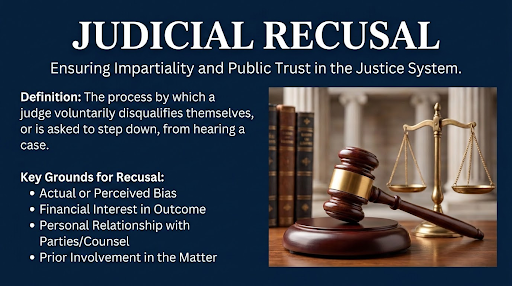
Judicial recusal is the act of a judge withdrawing from a legal case because of a conflict of interest, ensuring that their personal bias—perceived or real—does not influence the delivery of justice.
It is rooted in the maxim: "Nemo debet esse judex in propria causa" (No one should be a judge in their own cause).
While the Indian Constitution does not explicitly use the term "recusal," it is derived from the Oath of Office and the Principles of Natural Justice.
A judge recuses themselves when there is a "Reasonable Apprehension of Bias." Key grounds include:
In India, the process is largely self-regulated by the judge.
Forum Shopping: Practice of litigants trying to choose a "favourable" judge. The Supreme Court has warned that frequent requests for recusal could be misused to avoid specific benches, leading to "bench hunting".
Judicial Duty vs Recusal: Judge has a "duty to sit" just as much as a "duty to recuse." Unnecessary recusal places a burden on other judges and delays the justice system.
Transparency: Judges often do not provide detailed written reasons for recusal, there are calls for a formal, transparent mechanism to record such decisions.
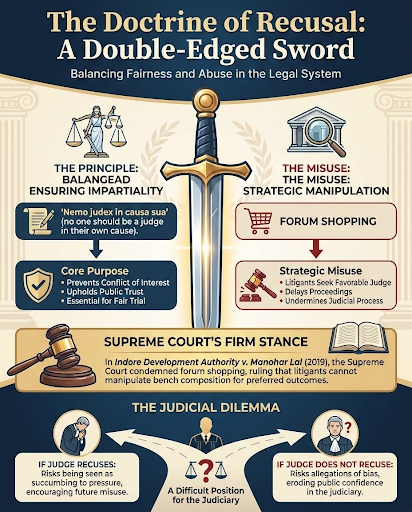
Recusal is vital for maintaining Public Confidence in the judiciary. However, the absence of a formal code of conduct for recusal remains a gap.
Experts suggest that a codified set of rules—as seen in jurisdictions like the US or UK—could help distinguish between legitimate concerns of bias and strategic attempts at forum shopping.
Source: INDIANEXPRESS
|
PRACTICE QUESTION Q. In the context of the Indian legal system, the term "Forum Shopping" most accurately refers to: A) The practice of litigants moving a case from a District Court to a High Court to ensure a speedier trial. B) A strategic move by litigants to choose a specific court or bench where they expect a more favourable outcome. C) The process of the Supreme Court transferring cases from one State High Court to another for administrative ease. D) An international legal process where a case is tried in multiple countries simultaneously. Answer: B Explanation: Forum shopping is the practice of litigants or lawyers deliberately selecting a particular judge or court among several options that could properly exercise jurisdiction, specifically because they believe that court or judge will provide a more favourable judgment. |
The Doctrine of Recusal is a legal principle ensuring impartiality in the courtroom. Based on the natural justice maxim Nemo judex in causa sua (no one should be a judge in their own cause), it requires a judge to step down from hearing a case if there is a potential conflict of interest or bias.
Forum shopping refers to the unethical practice where litigants attempt to have their cases heard by a specific judge or court that they believe will provide a favorable outcome. Litigants sometimes misuse recusal pleas to manipulate bench composition and achieve this.
The presiding judge rejected the plea by stating that litigants cannot evaluate a judge's competence or demand recusal based on speculative biases, ideology, or hearsay without tangible, concrete evidence of a conflict of interest.




© 2026 iasgyan. All right reserved