China's Hainan Free Trade Port implemented island-wide customs closure, creating a zero-tariff hub. Offering 15% corporate taxes and a 30% value-added processing exemption, it aims to reshape global supply chains while rivaling Hong Kong.
Why In News?
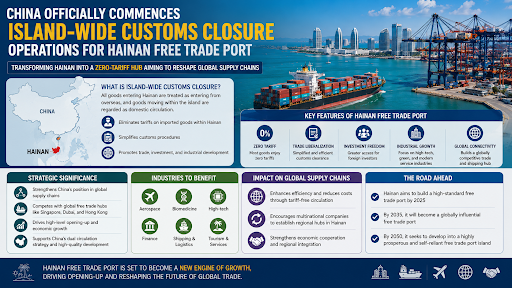
China officially commenced "island-wide customs closure" operations for the Hainan Free Trade Port, transforming it into a zero-tariff hub aiming to reshape global supply chains.
What is Hainan Free Trade Port (FTP)?
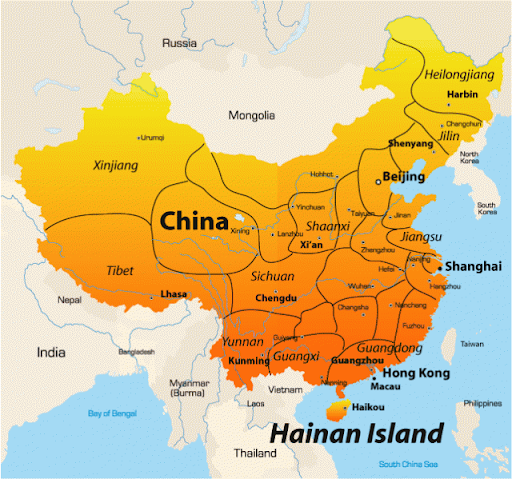
The Hainan Free Trade Port (FTP) is China’s southernmost province and its largest Special Economic Zone. Situated in the South China Sea.
Official Launch: The FTP officially commenced island-wide special customs operations in December 2025.
Geographic Scope: The FTP covers the entire 33,900 to 35,400 square kilometer area of Hainan Island.
Customs Framework: It operates under a "Two-Line" supervision system:
The "30% Value-Added" Rule: Goods produced by encouraged industries using imported materials are exempt from import tariffs when entering the mainland if the value-added processing in Hainan exceeds 30%.
Tax Incentives:
Expanded Zero-Tariff Scope: Post-customs closure, zero-tariff categories expanded from 1,900 to 6,600 tariff lines, covering approximately 74% of all product categories.
Why China Promotes the Hainan FTP?
China positions the Hainan FTP as a strategic necessity to counter rising protectionism and unilateralism while deepening domestic market reforms.
Strategic Gateway: It functions as a "super interface" and gateway connecting China with the Global South, particularly the ASEAN markets.
Pilot for Reform: Hainan serves as a litmus test for China’s commitment to explore radical liberalization in trade, investment, and cross-border capital flows.
Economic Hub: China aims to transform the island into a "China Hub" for global supply chains, leveraging its proximity to the Pacific and Indian Oceans.
Industrial Modernization: The FTP prioritizes three core pillars: Tourism, Modern Services, and High-Tech Industries (including deep-sea technology, aerospace, and seed industry biotechnology).
Institutional Innovation: Hainan aligns with high-standard international trade frameworks like the CPTPP (Comprehensive and Progressive Agreement for Trans-Pacific Partnership) and DEPA (Digital Economy Partnership Agreement).
Impact on Global Trade and Supply Chains
The Hainan FTP reshapes regional trade geography by offering a cost-advantaged alternative to traditional Asia-Pacific hubs.
Supply Chain Reshaping: Multinational corporations use Hainan for "Cost Restructuring," establishing production bases that benefit from duty-free hardware and raw material imports.
Competition with Singapore: Hainan challenges Singapore’s transshipment model. Direct routing from Southeast Asian ports (e.g., Indonesia) to Hainan’s Yangpu Port can reduce shipping costs by up to 32%.
Synergy with Hong Kong: While some competition exists in duty-free consumption, the model encourages "Hong Kong Services + Hainan Manufacturing." Hong Kong remains the financial/legal core, while Hainan provides the manufacturing and mainland market access.
RCEP Integration: Hainan aligns its zero-tariff policies with the Regional Comprehensive Economic Partnership (RCEP) to optimize industrial linkages and cost facilitation for member nations.
Digital Economy: The FTP facilitates cross-border data transfers and internet open-access pilots, aiming to build a significant regional digital economy.
Opportunities and Risks for India
Opportunities
Market Entry Gateway: Indian exporters in pharmaceuticals, agriculture, and tropical products can use Hainan as a low-cost processing hub to access the Chinese mainland market via the 30% value-added tariff exemption.
Service Outsourcing: Hainan’s negative list for service trade is more open than national standards, potentially creating openings for Indian IT and business service providers.
Regional Cooperation: Enhanced connectivity between the Indian Ocean and the South China Sea through Hainan provides a platform for deeper engagement in the Blue Economy.
Risks
Investment Competition: Hainan directly competes with India as a preferred destination for Foreign Direct Investment (FDI).
Supply Chain Divergence: If global multinationals consolidate manufacturing in Hainan to serve the China-ASEAN corridor, it may divert supply chain diversification away from Indian manufacturing hubs.
Geopolitical Sensitivity: Hainan’s strategic location at the northern edge of the South China Sea places it at the center of regional maritime disputes, potentially complicating trade security in India’s extended neighborhood.
Conclusion
The Hainan Free Trade Port is a high-level strategic experiment designed to integrate China into the global economy through tax incentives and a unique "two-line" customs system
Source: THEHINDU
|
PRACTICE QUESTION Q. Hainan Island, which has recently been transformed into the world's largest Free Trade Port by area, is geographically located in which of the following water bodies? A) Yellow Sea B) East China Sea C) South China Sea D) Sea of Japan Answer: C Explanation: Hainan Island is geographically located in the C) South China Sea. It is situated off the southern coast of mainland China and is separated from the Leizhou Peninsula to the north by the Qiongzhou Strait. |
The Hainan FTP is China's largest free trade zone, covering the entirety of Hainan island (33,900 sq km). It operates under an independent customs regime to promote the highest level of free trade and investment liberalization in China.
It is a special customs supervision system where goods move freely without tariffs between Hainan and overseas ("first line"), but face standard import regulations and tariffs when entering mainland China from Hainan ("second line").
Hainan offers a significantly reduced 15% corporate income tax rate for companies in encouraged industries. Additionally, eligible high-end and in-demand talents benefit from an individual income tax exemption for any portion exceeding 15%.

© 2026 iasgyan. All right reserved