The new VB-G RAM G Act to replace MGNREGA on July 1, 2026, guaranteeing 125 days of rural employment. It shifts to a strict 60:40 Centre-State funding model, mandates an agricultural pause, and prioritizes digital governance and durable rural asset creation.
Why In News?
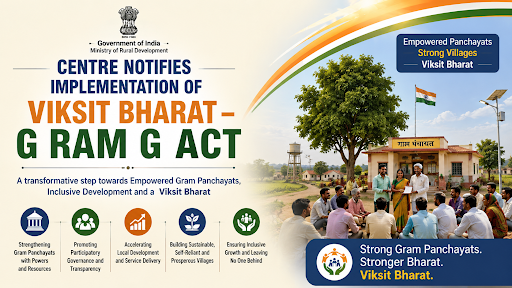
The Government of India has notified that the Viksit Bharat – Guarantee for Rozgar and Ajeevika Mission (Gramin) (VB-G RAM G) Act will take effect on July 1, 2026.
What Is the Viksit Bharat–G RAM G Act?
The Viksit Bharat–Guarantee for Rozgar and Ajeevika Mission (Gramin) (VB-G RAM G) Act, 2025 replaces the Mahatma Gandhi National Rural Employment Guarantee Act (MGNREGA), 2005.
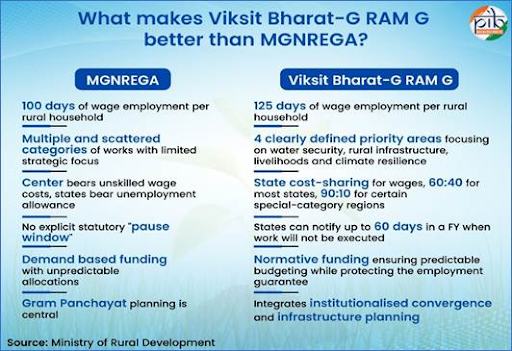
The framework aligns rural job creation with the Viksit Bharat @2047 vision by developing productive rural assets across four major domains: water security, core rural infrastructure, livelihood-related infrastructure, and extreme weather mitigation.
Why the Government Replaced MGNREGA with the VB-G RAM G Act?
To modernize rural employment and reflect changing socioeconomic realities, such as a drop in the rural poverty rate to 5.3% in 2022-23.
To move beyond merely "digging holes" by integrating open-ended employment with long-term infrastructure development and climate resilience goals.
To enforce a comprehensive digital ecosystem—using biometric authentication, GPS monitoring, and AI—to eliminate leakages, combat "ghost worker" fraud, and enhance transparency.
To ensure farmers have access to adequate farm labor during peak agricultural seasons.
How Is the VB-G RAM G Act Different from MGNREGA?
Employment Guarantee
The government raised the statutory work guarantee from 100 days to 125 days per financial year.
Funding Pattern
MGNREGA required the Union to pay 100% of unskilled wage costs; the new Act shifts this to a 60:40 cost-sharing model between the Center and most States for wages, materials, and administration (90:10 for North-eastern and Himalayan states).
Allocation Mechanism
The new Act replaces the demand-driven labor budget with a State-wise normative allocation set by the Central Government, forcing States to bear any excess expenditure out of pocket.
Agricultural Pause
The Act legally compels State governments to announce a 60-day pause on scheme works during peak sowing and harvesting seasons.
Wage Disbursal
The law pushes for weekly wage payments directly into bank or post office accounts via Direct Benefit Transfer (DBT), and strict compensation for delays.
What Are the Potential Benefits of the Act?
Increased Income
Additional 25 days of work to provide an increase earning for vulnerable families, aiding them in consumption and covering emergency expenses.
Durable Asset Creation
The convergence with PM Gati Shakti and the Viksit Gram Panchayat Plans (VGPP) guarantees the construction of productivity-enhancing infrastructure, such as rural haats, storage structures, and farm ponds.
Women Empowerment
The law makes one-third women participation mandatory, prioritizes individual assets for women-headed households, mandates crèche facilities at worksites, and introduces a distinct Schedule of Rates for female workers.
Digital Governance
The integration of the Viksit Bharat Rural Infrastructure Stack and face authentication mechanisms restricts fund mismanagement.
What are the Challenges in Implementation?
Dilution of the Right to Work
Transitioning from an open-ended, legally enforceable right to a budget-constrained welfare scheme limits the program's ability to scale up and act as a safety net during sudden economic shocks.
Increased Fiscal Burden on States
The new 60:40 cost-sharing model places severe financial strain on fiscally weak states, which creates powerful incentives for them to artificially restrict work demand to save money.
Risk of Digital Exclusion
Mandating biometrics and smartphone-based attendance creates hurdles for workers in remote areas facing frequent network failures, risking the exclusion of the most vulnerable groups.
Adverse Impacts of the Seasonal Pause
Enforcing a 60-day pause removes the wage floor for landless laborers during peak seasons, which weakens their bargaining power and fuels distress migration.
Erosion of Local Autonomy
Heavy reliance on centralized digital stacks, normative budget allocations, and standardized asset templates recentralizes power, undermining the democratic planning capacity of Gram Panchayats
What Should Be the Way Forward?
Redesign Fiscal Frameworks
The Union Government should evaluate and adjust state-wise normative allocations and the 60:40 funding model to avoid penalizing low-capacity states or those with existing welfare burdens.
Re-evaluate Agricultural Pause
Policymakers must review the 60-day pause during peak seasons to maintain a wage floor, prevent distress migration, and protect landless women.
Strengthen Decentralization
The State should use digital tools to support village-based planning rather than replacing local decision-making.
Build Local Capacity
Authorities must provide capacity-building support to help Gram Panchayats formulate Viksit Gram Panchayat Plans (VGPPs).
Robust Grievance Redressal
Administrators should implement low-friction systems to resolve digital failures and ensure vulnerable workers receive their wages.
Balance Fiscal Realism with Social Welfare
The Government must conduct systematic monitoring and policy revision to balance strict fiscal discipline with genuine social protection.
Conclusion
The VB-G RAM G Act, 2025 modernizes rural jobs with 125 guaranteed days and digital tools, but success requires addressing fiscal strains and over-centralization to secure the rural safety net.
Source: NEWSONAIR
|
PRACTICE QUESTION Q. Consider the following statements about the Viksit Bharat–Guarantee for Rozgar and Ajeevika Mission (Gramin) [VB-G RAM G] Act, 2025:
Which of the statements given above is/are correct? (a) 1 only (b) 1 and 2 only (c) 2 and 3 only (d) 1, 2, and 3 Answer: (b) Explanation: Statement 1 is correct: The Viksit Bharat–G RAM G Act, 2025 scales up the legal guarantee from the 100 days previously offered under MGNREGA to 125 days of guaranteed wage employment per financial year for every rural household volunteering for unskilled manual labor. Statement 2 is correct: To prevent agricultural labor shortages and manage local wage inflation during busy farming periods, the Act explicitly integrates an aggregated 60-day no-work period. Individual state governments are legally empowered to schedule this 60-day operational pause to seamlessly align with their peak local sowing and harvesting seasons. Statement 3 is incorrect: The funding architecture under this Act shifts to a structured Centrally Sponsored Scheme (CSS) model rather than being 100% centrally funded. The statutory cost-sharing framework is split 60:40 between the Centre and most States/UTs, while maintaining a 90:10 ratio strictly for North-Eastern states, Himalayan states, and specific UTs. |
It is a new rural employment legislation that replaces MGNREGA, aiming to align rural job creation with the Viksit Bharat @2047 vision by providing a statutory guarantee of 125 days of unskilled wage employment per rural household.
The Centre and States will share the costs at a 60:40 ratio for most states. For North-Eastern and Himalayan States, the ratio is 90:10, and Union Territories without a legislature will receive 100% Central funding.
Existing MGNREGA Job Cards belonging to workers who have completed their e-KYC will remain valid until the government issues the new Gramin Rozgar Guarantee Cards.



© 2026 iasgyan. All right reserved