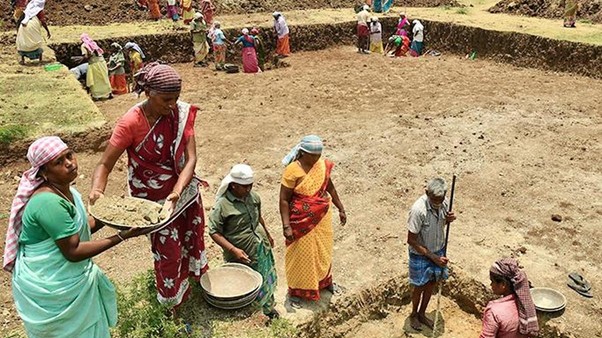
The replacement of MGNREGA with the Viksit Bharat Guarantee for Rozgar and Ajeevika Mission (Gramin) marks a major shift in India’s rural employment policy. While MGNREGA functioned as a universal, demand-driven and rights-based employment guarantee that supported vulnerable rural households, the new framework emphasises fiscal discipline, centralised planning and productivity-linked employment. The transition reflects the government’s intent to reform rural welfare delivery, but it also raises concerns about dilution of the right to work, increased burden on states, and potential exclusion of marginalised communities.
Copyright infringement not intended
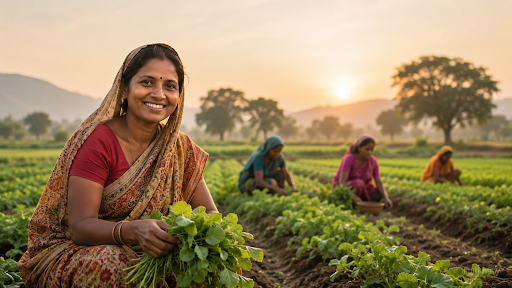
Picture Courtesy: The Hindu
On December 18, 2025, Parliament passed the Viksit Bharat Guarantee for Rozgar and Ajeevika Mission (Gramin) Bill (VB-G RAM G) to replace the Mahatma Gandhi National Rural Employment Guarantee Act (MGNREGA), 2005.
|
Must Read: NREGA | PUJYA BAPU GRAMIN ROZGAR YOJANA | |
|
Phases |
Key Developments |
Significance |
|
Early 2000s (pre-legislative phase) |
Grassroots movements and civil society campaigns demanded a legal right to work to address rural poverty and distress migration. |
Laid the ideological foundation for a rights-based employment guarantee. |
|
2004–05 (Conceptualisation & Law) |
NAC under UPA, with Aruna Roy and Jean Drèze, drafted the employment guarantee framework; Parliament passed the Act in 2005. |
India became the first country to legally guarantee rural employment. |
|
2006–08 (Phased Rollout) |
Scheme implemented initially in 200 backward districts and expanded nationwide by 2008. |
Ensured gradual administrative learning and universal rural coverage. |
|
2009 (Renaming) |
Act renamed as Mahatma Gandhi National Rural Employment Guarantee Act (MGNREGA). |
Linked the scheme to Gandhian ideals of dignity of labour and decentralisation. |
|
2010–14 (Institutional Strengthening) |
Introduction of job cards, social audits, Gram Sabha oversight, and MIS-based monitoring. |
Improved transparency, accountability, and community participation. |
|
Mid-2010s (Asset Focus) |
Emphasis on durable assets such as water conservation, land development, and drought-proofing. |
Shift from short-term relief to long-term rural resilience. |
|
2016–19 (Technology & Reforms) |
Aadhaar-based payments, DBT, and geo-tagging of assets expanded. |
Reduced leakages but raised concerns over exclusion errors. |
|
2020–21 (COVID-19 Phase) |
Massive expansion of MGNREGA employment to absorb reverse migrants and rural distress. |
Established MGNREGA as a critical economic shock absorber. |
|
Early–Mid 2020s (Policy Debate) |
Rising fiscal costs, payment delays, and allegations of misuse led to calls for restructuring. |
Triggered debate on sustainability versus social protection. |
|
December 2025 (Transition) |
MGNREGA repealed and replaced by VB-G RAM G. |
Marked a shift from a universal, demand-driven right to work to a centrally allocated, supply-driven rural employment framework. |
Social safety net for rural poor: MGNREGA acted as a guaranteed fallback source of income during agricultural lean seasons and economic distress, supporting around 12.6 crore active workers across rural India.
Poverty reduction and consumption stabilisation: By providing assured wage employment, MGNREGA helped smooth household consumption, with studies showing up to a 30% increase in lean-season consumption among Scheduled Caste and Scheduled Tribe households.
Women’s economic empowerment: The scheme significantly enhanced female labour force participation and financial autonomy, with women constituting nearly 58% of total MGNREGA workers, one of the highest shares globally in public employment programmes.
Social inclusion of marginalised communities: MGNREGA’s universal and non-discriminatory design ensured access for vulnerable groups, with SCs and STs accounting for about 35% of total beneficiaries, particularly in tribal and backward regions.
Reduction in distress migration: By providing employment within villages, MGNREGA reduced seasonal and distress migration, as evidenced in regions such as eastern Uttar Pradesh and Bundelkhand, where workers avoided migration to urban informal sectors.
Shock absorber during economic crises: MGNREGA functioned as an automatic stabiliser during crises, generating a record 389 crore person-days in 2020–21 to absorb reverse migration and rural distress during the COVID-19 pandemic.
Creation of durable rural assets: Beyond wage employment, the programme contributed to long-term rural development by creating assets in water conservation, land development, and drought-proofing, accounting for over 70% of total works.
|
Dimension |
MGNREGA (2005) |
New Rural Employment Bill (VB-G RAM G, 2025) |
|
Nature of Programme |
Rights-based legislation guaranteeing employment as a legal entitlement. |
Welfare scheme without a justiciable right to employment. |
|
Approach |
Demand-driven, where work had to be provided on demand by households. |
Supply-driven, with employment dependent on centrally approved allocations. |
|
Coverage |
Universal coverage across all rural areas of India. |
Applicable only to rural areas notified by the Central government. |
|
Guarantee of Work |
100 days of employment per household per year guaranteed by law. |
125 days mentioned, but subject to budgetary limits and allocations. |
|
Funding Pattern |
Centre bore 100% of labour cost and 75% of material cost (effective 90:10). |
Cost-sharing of 60:40 for most states and 90:10 for NE and Himalayan states. |
|
Fiscal Responsibility |
Greater fiscal responsibility on the Centre. |
Increased financial burden on states with reduced autonomy. |
|
Decision-Making Power |
Significant role for Gram Sabhas and state governments. |
Greater central control over allocations, coverage, and implementation. |
|
Targeting |
Open to all rural households without BPL or social category targeting. |
Selective and geographically targeted implementation. |
|
Labour Market Impact |
Provided employment even during peak agricultural seasons. |
Allows “blackout periods” during peak farming seasons. |
|
Transparency & Accountability |
Strong social audit framework and IT-based monitoring. |
Audit and monitoring framework yet to be clearly specified. |
|
Objective Orientation |
Focused on livelihood security and social protection. |
Emphasises productivity, efficiency, and fiscal discipline. |
|
Federalism Aspect |
Cooperative federalism with shared but predictable roles. |
Centralised decision-making with higher state financial responsibility. |
Dilution of the Right to Work: VB-G RAM G replaces the legally enforceable right to employment under MGNREGA with a discretionary, scheme-based approach, weakening citizens’ ability to demand work as an entitlement.
Shift from Demand-Driven to Supply-Driven Framework: By making employment contingent on centrally determined allocations, the new Bill reduces responsiveness to local unemployment and seasonal distress.
Loss of Universality and Risk of Exclusion: The provision allowing the Centre to notify specific rural areas may exclude needy households in non-notified regions, increasing regional and social inequities.
Increased Financial Burden on States: The revised 60:40 cost-sharing pattern places significant fiscal pressure on states, particularly poorer states with limited revenue capacity.
Centralisation at the Cost of Federalism: Greater control of the Centre over funding, coverage, and parameters undermines cooperative federalism and reduces state and Panchayat autonomy.
Gender Impact: Women, who formed nearly 58% of MGNREGA workers, may be disproportionately affected if work availability becomes irregular or distant from habitations.
Strengthening rural employment safety nets: Rural employment can be stabilised by ensuring adequate funding, timely wage payments, and effective implementation of employment programmes such as MGNREGA/VB-G RAM G, especially during agricultural lean seasons and economic shocks.
Enhancing agricultural productivity and farm incomes: Investments under PM Krishi Sinchai Yojana (PMKSY), Soil Health Card Scheme, and National Mission on Sustainable Agriculture (NMSA) can raise productivity, improve water-use efficiency, and create on-farm employment.
Promoting allied and livestock-based livelihoods: Schemes such as National Livestock Mission, Animal Husbandry Infrastructure Development Fund (AHIDF), and Pradhan Mantri Matsya Sampada Yojana (PMMSY) support dairy, fisheries, and poultry, generating year-round rural jobs.
Expanding rural non-farm employment and MSMEs: Initiatives like PM Formalisation of Micro Food Processing Enterprises (PMFME), SFURTI, and MUDRA Yojana encourage rural entrepreneurship and local manufacturing.
Skill development aligned to rural needs: Programmes such as Deen Dayal Upadhyaya Grameen Kaushalya Yojana (DDU-GKY) and Pradhan Mantri Kaushal Vikas Yojana (PMKVY) improve employability of rural youth in agriculture, construction, logistics, and services.
Strengthening rural infrastructure: Large-scale investments under PM Gram Sadak Yojana (PMGSY), BharatNet, Saubhagya, and Jal Jeevan Mission enhance connectivity, digital access, power supply, and water availability, stimulating rural economic activity.
Leveraging green and digital rural jobs: Initiatives like the National Bio-Energy Mission, Solar Pumps under PM-KUSUM, and Digital India create employment in renewable energy, maintenance, and digital service delivery.
The replacement of MGNREGA with the VB-G RAM G framework marks a significant shift in India’s rural employment policy from a rights-based, demand-driven approach to a centrally planned, fiscally constrained model. While the government aims to improve efficiency, accountability, and alignment with the Viksit Bharat vision, concerns remain regarding dilution of universality, increased burden on states, and potential exclusion of vulnerable rural households. The long-term success of the new framework will depend on balancing fiscal discipline with livelihood security, federal cooperation, and grassroots responsiveness.
Source: The Hindu
|
Practice Question “The replacement of MGNREGA with the Viksit Bharat Guarantee for Rozgar and Ajeevika Mission (Gramin) reflects a fundamental shift in the philosophy of rural employment policy in India.” |
MGNREGA was a rights-based law enacted in 2005 that guaranteed 100 days of wage employment per year to every rural household willing to do unskilled manual work.
It was the world’s largest and only legally enforceable rural employment guarantee programme, being universal, demand-driven, and free from BPL or caste-based targeting.
VB-G RAM G is the Viksit Bharat Guarantee for Rozgar and Ajeevika Mission (Gramin), a new rural employment framework introduced in 2025 to replace MGNREGA.



© 2026 iasgyan. All right reserved