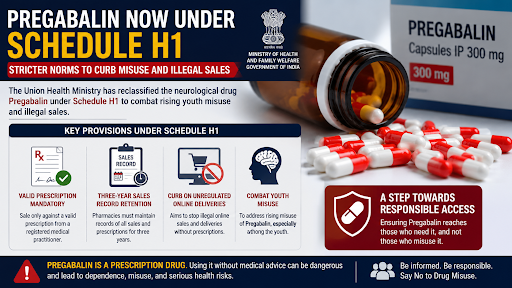
The Union Health Ministry has reclassified the neurological drug Pregabalin under Schedule H1 to combat rising youth misuse and illegal sales. This mandates valid prescriptions, three-year sales record retention, and aims to curb unregulated online deliveries.
Why In News?
The Union Health Ministry moved Pregabalin to Schedule H1 through the Drugs (Second Amendment) Rules, 2026, following reports of its use for sedative, euphoric, and dissociative effects.
What is Pregabalin?
Pregabalin is a gabapentinoid drug that acts as a Central Nervous System (CNS) depressant and a structural analog of gamma-aminobutyric acid (GABA).
Physicians prescribe it for neuropathic pain (diabetic peripheral neuropathy, post-herpetic neuralgia), fibromyalgia, epilepsy (partial-onset seizures), and Generalized Anxiety Disorder (GAD).
Side Effects: Common adverse effects include somnolence, dizziness, weight gain, and peripheral edema, while abrupt discontinuation can trigger withdrawal syndromes.
What are Schedule H1 Drugs?
The Union Government introduced Schedule H1 in 2013 via the Drugs (Fourth Amendment) Rules to combat drug abuse and Antimicrobial Resistance (AMR).
Legal Framework: This classification falls under the Drugs Rules, 1945, promulgated under the Drugs and Cosmetics Act, 1940.
Regulatory Status: It serves as a middle ground between ordinary prescription drugs (Schedule H) and heavily restricted narcotics (Schedule X).
Mandatory Compliance Features
Separate Register: Pharmacists must maintain a dedicated register recording the prescriber’s details, patient identity, drug name, and quantity supplied.
Record Retention: Sellers must preserve the registers for at least three years, making them available for audits by Drug Inspectors
Labeling Requirements: Packaging must feature a red "Rx" symbol on the top left corner and a red-bordered warning box stating it is dangerous to consume without medical advice.
Prescription Rule: The drug is only available through a fresh, valid prescription from a Registered Medical Practitioner (RMP); no "verbal orders" or repeat sales without new prescriptions are permitted.
Source: THEHINDUBUSINESSLINE
|
PRACTICE QUESTION Q. Consider the following statements regarding 'Schedule H1' of the Drugs and Cosmetics Rules, 1945:
Which of the statements given above is/are correct? A) 1 and 2 only B) 1 and 3 only C) 2 and 3 only D) 1, 2, and 3 Answer: B Explanation: Statement 1 is correct: Schedule H1 was introduced by the Ministry of Health and Family Welfare to curb the misuse, prevent over-the-counter sales of certain antibiotics, and combat rising antimicrobial resistance (AMR). Statement 2 is incorrect: Under the Drugs and Cosmetics Rules, 1945, pharmacists are required to maintain a separate register detailing the sale of Schedule H1 drugs for a minimum of three years, not five. Statement 3 is correct: Packaging for Schedule H1 drugs must conspicuously display the symbol "Rx" in red on the left top corner and prominently feature the required warning text inside a box with a red border. |
Pregabalin is a medicine to treat chronic neuropathic pain (such as diabetic peripheral neuropathy and post-herpetic neuralgia), fibromyalgia, partial-onset seizures (epilepsy), and generalized anxiety disorder.
The Health Ministry shifted it to Schedule H1 due to increasing reports from multiple states regarding its recreational misuse and abuse, particularly among young people, who consume it for its sedative, euphoric, and dissociative ("high"-inducing) effects.
It crosses the blood-brain barrier and binds to the alpha2-delta subunit of voltage-gated calcium channels. This diminishes calcium entrance at nerve terminals, thereby reducing the abnormal release of excitatory neurotransmitters like glutamate, norepinephrine, and substance P, leading to analgesic and anticonvulsant effects.






© 2026 iasgyan. All right reserved