The 2026 UN ESCAP report warns that West Asian conflicts drive "imported inflation" and "greenflation," slowing India's growth to 6.4%. To ensure resilience, India must expand petroleum reserves, implement fiscal measures, and accelerate inclusive renewable energy like PM-KUSUM.
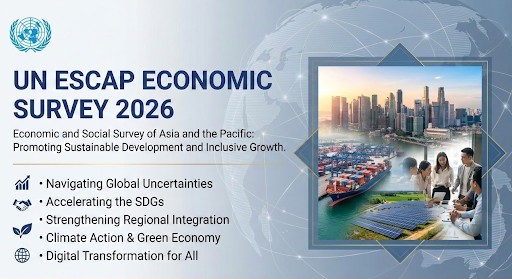
The United Nations Economic and Social Commission for Asia and the Pacific (UN ESCAP) released the "Economic and Social Survey of Asia and the Pacific 2026".
Surging Inflation & Slowing Growth: Regional inflation is expected to rise to 4.6% in 2026 (from 3.5% in 2025), while economic growth is projected to decelerate from 4.6% to 4.0%.
Energy & Input Price Shocks: The conflict has caused sharp increases in global commodity prices:
Logistical and Financial Volatility: The crisis has led to widespread market instability, including a 3% to 10% rise in freight rates, a 5% to 16% plunge in Asian stock markets, and a 0.4% to 1.5% depreciation of regional currencies.
Multiplier Effect on Global Output: High energy prices contract economic activity globally. A 10% increase in energy costs is estimated to reduce global GDP growth by 0.2% points.
|
Indicator |
2025 (Actual/Est.) |
2026 Projection |
Trend |
|
Asia-Pacific Growth |
4.6% |
4.0% |
Slowdown due to tight financial conditions and weak external demand. |
|
Regional Inflation |
3.5% |
4.6% |
Rising due to supply shocks from the West Asia conflict and currency depreciation. |
Impact on India’s Macroeconomic Stability
Vulnerability to Imported Inflation: India imports nearly 50% of its oil from West Asia.
Growth and Inflation Projections for India (2026)
|
Indicator |
2025 (Projection) |
2026 (Projected Impact) |
|
Real GDP Growth |
7.4% |
6.4% (Deceleration) |
|
Inflation (CPI) |
2.3% |
4.4% (Spike) |
Monetary Policy Constraints: The spike in inflation to 4.4% poses a challenge for the Reserve Bank of India (RBI).
Socio-Economic Impact on Vulnerable Populations: Macroeconomic shocks disproportionately harm low-income households, who spend a larger portion of their income on essential items like food and energy.
Expand Strategic Petroleum Reserves (SPR): India's current SPR capacity is 5.33 Million Metric Tonnes (MMT), covering only 9.5 days of national requirement.
Ensure Fiscal Prudence: The N.K. Singh Committee on FRBM recommended a general government debt-to-GDP ratio ceiling of 60%.
Shift the Growth Paradigm: The report advocates moving away from fragile export-led growth.
India needs a two-pronged approach to manage geopolitical risks. Short-term actions should prioritize calibrated monetary policy and fiscal support to cushion price shocks. Long-term stability requires building Strategic Petroleum Reserves, fostering internal growth, and transitioning to inclusive renewable energy.
Source: DOWNTOEARTH
|
PRACTICE QUESTION Q. The term "Greenflation" frequently seen in the news, is: A. Inflation caused by a surge in organic food prices B. Rising costs of materials and energy during the clean energy transition C. Deflationary trends in the renewable energy sector D. Government subsidies for environmental protection Answer: B Explanation: The term Greenflation refers to the rising costs of materials, energy, and labor during the transition to a clean energy economy. It occurs because the shift toward renewable energy sources and low-carbon technologies increases demand for critical minerals and metals (like copper, lithium, and nickel) faster than supply can keep up, leading to higher prices. |
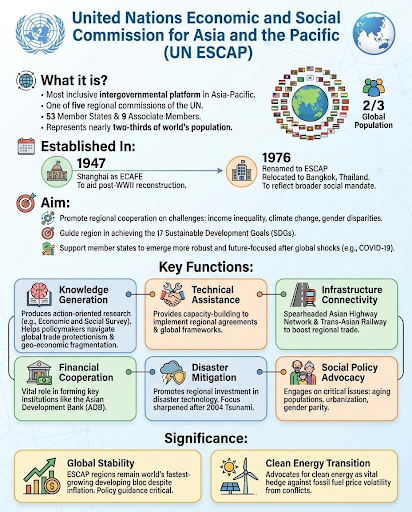
The 'Economic and Social Survey of Asia and the Pacific 2026' is a flagship report by the United Nations Economic and Social Commission for Asia and the Pacific. It analyzes regional macroeconomic trends, focusing on the impacts of West Asian conflicts, inflation, and the energy transition on economic growth.
Because India imports roughly 50% of its oil from West Asia, the conflict causes a spike in crude oil prices. This inflates India's import bill, weakens the Rupee, widens the Current Account Deficit (CAD), and triggers "imported inflation," which ultimately slows overall GDP growth to a projected 6.4% in 2026.
Imported inflation occurs when the prices of imported goods (like crude oil and fertilizers) rise, leading to a general increase in domestic prices. In India, a weakened Rupee makes importing these essential commodities more expensive, and these elevated costs are passed directly on to consumers.


© 2026 iasgyan. All right reserved