India’s SPRs face a 33% capacity gap, threatening energy security amid 90% import dependency. To meet IEA’s 90-day mandate, India must fast-track Phase-II expansion, leverage salt caverns, and secure commercial partnerships, building a resilient buffer against West Asian geopolitical volatility.
Copyright infringement not intended
Picture Courtesy: INDIANEXPRESS
Why In News?
The Ministry of Petroleum and Natural Gas informed Parliament that India’s Strategic Petroleum Reserves are currently only 64% full.
What are Strategic Petroleum Reserves (SPRs)?
SPRs are massive stockpiles of crude oil held by a government to handle unexpected supply disruptions (wars, natural disasters, global price spikes). They act as a nation's "energy emergency fund."
Objective: Since India imports over 85% of its crude oil requirement, any global disruption can paralyze the economy. SPRs ensure the country has enough fuel to run for a few weeks even if imports stop completely.
Global Standard: The International Energy Agency (IEA) mandates that its member countries must hold oil stocks equivalent to 90 days of net imports.
India’s SPR Architecture
The reserves are managed by Indian Strategic Petroleum Reserves Limited (ISPRL), a Special Purpose Vehicle (SPV) under the Ministry of Petroleum and Natural Gas.
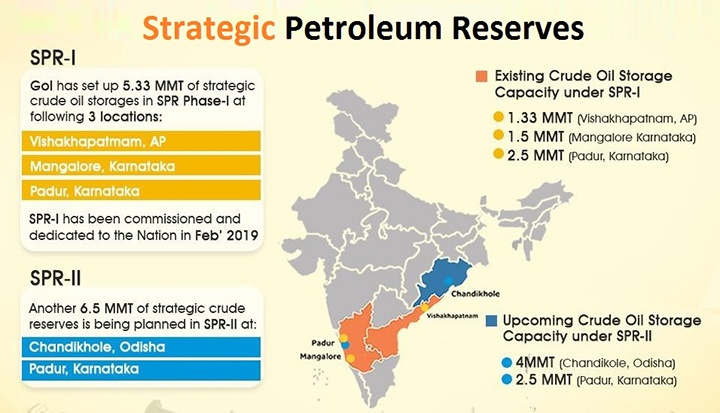
Phase I (Operational): India has built underground rock caverns at three locations with a total capacity of 5.33 Million Metric Tonnes (MMT).
Current Coverage: At full capacity, Phase I provides approx. 9.5 days of India’s crude oil requirement.
Total National Buffer: When combined with the commercial stocks held by Oil Marketing Companies (OMCs) in their refineries (approx. 64.5 days), India’s total coverage is around 74 days.
Phase II (Approved & Upcoming): To bridge the gap towards the 90-day target, the government has approved two commercial-cum-strategic facilities (Total 6.5 MMT):
"Commercial-cum-Strategic" Model
Building and maintaining reserves is expensive (dead capital). To make it financially viable, India adopted a unique model in Phase I (Mangaluru) and Phase II.
Rock Caverns vs Salt Caverns
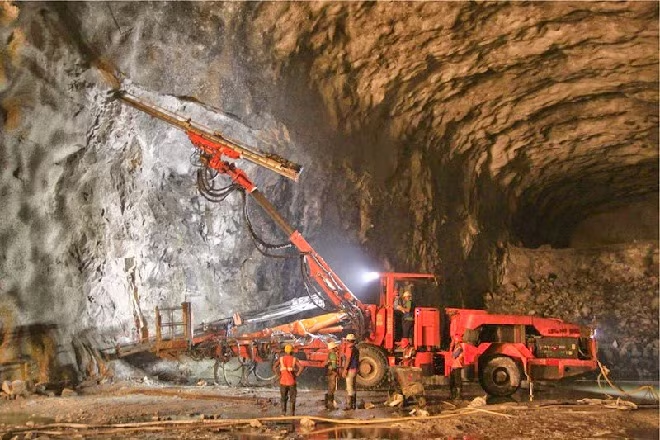
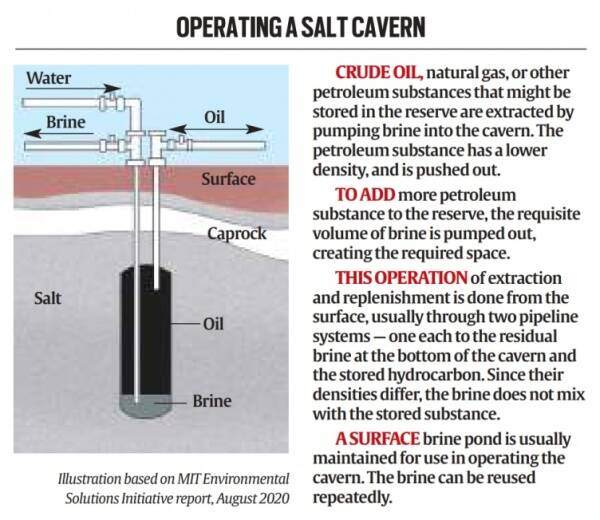
Currently, all Indian SPRs are in Rock Caverns, but the government is exploring Salt Caverns (in Bikaner, Rajasthan) for future expansion.
|
Rock Caverns (Current) |
Salt Caverns (Future Potential) |
|
|
Construction |
Excavated by drilling hard rock. |
Created by pumping water to dissolve salt (Solution Mining). |
|
Cost & Time |
Expensive and slow to build. |
Cheaper and faster to build. |
|
Efficiency |
Oil injection/withdrawal is slower. |
High oil injection/withdrawal rates (ideal for frequent trading). |
|
Sealing |
Needs water curtains to prevent leakage. |
Naturally well-sealed (salt is impermeable). |
Challenges
Low Utilization: With reserves at only 64%, India currently has effective emergency coverage of only 5 days from SPRs. Filling them now, when global prices are high due to West Asian wars, puts a massive burden on the exchequer.
Dead Capital: Storing oil locks up billions of dollars that yield no direct return unless there is a crisis or effective commercial trading.
Infrastructure Bottlenecks: Ensuring pipelines connect these caverns seamlessly to refineries across North India remains a logistical hurdle.
Way Forward
Diversification: Reduce dependency on the Strait of Hormuz (West Asia) by sourcing more from Russia, Africa, and the Americas.
Strategic Buying: ISPRL needs more autonomy to buy oil during global price crashes (like in 2020) rather than waiting for bureaucratic approvals.
Energy Transition: The ultimate long-term solution is reducing oil dependence entirely by shifting to Ethanol blending, Green Hydrogen, and EVs.
Source: INDIANEXPRESS
|
PRACTICE QUESTION Q. Consider the following statements about India's Strategic Petroleum Reserves (SPRs): 1. The International Energy Agency (IEA) mandates its member and associate countries to hold emergency oil stocks equivalent to at least 90 days of their net oil imports. 2. India's dedicated SPR capacity currently exceeds the 90-day IEA benchmark. 3. The proposed Phase-II expansion includes constructing underground rock caverns at Chandikhol and Padur. Which of the statements given above is/are correct? a) 1 and 2 only b) 2 and 3 only c) 1 and 3 only d) 1, 2, and 3 Answer: c Explanation: Statement 1 is correct: The International Energy Agency (IEA) requires its member countries to hold emergency oil stocks equivalent to at least 90 days of their net oil imports. While India is an Associate Member (and not a full member), it has committed to this benchmark as a goal for national energy security. Statement 2 is incorrect: India’s current dedicated SPR capacity (Phase I) managed by ISPRL is 5.33 MMT, which provides approximately 9.5 days of crude oil requirements. Even when combined with the commercial stocks held by Oil Marketing Companies (OMCs), the total coverage is around 74 days, which is still short of the 90-day IEA benchmark. Statement 3 is correct: Under Phase II of the SPR programme, the Government of India has approved the establishment of additional commercial-cum-strategic facilities. These include a 4 MMT facility at Chandikhol (Odisha) and an additional 2.5 MMT facility at Padur (Karnataka), both using underground rock cavern technology. |
SPRs are massive underground storage facilities for crude oil designed to act as an emergency buffer against sudden global supply shocks, geopolitical disruptions, and price spikes, ensuring a country's fuel security.
India's Phase-I SPRs, managed by ISPRL, are located in underground rock caverns at Visakhapatnam (Andhra Pradesh), Mangaluru (Karnataka), and Padur (Karnataka), with a total combined capacity of 5.33 million metric tonnes (MMT).
Salt caverns, such as those proposed for Bikaner (Rajasthan), naturally seal hydrocarbons, require less fresh water, and are faster and cheaper to construct compared to hard rock caverns. They are also highly adaptable and are being explored for storing natural gas and green hydrogen in the future.



© 2026 iasgyan. All right reserved