The UMEED Portal aims to digitise and secure Waqf properties through geo-tagging and layered verification, replacing WAMSI. It seeks transparency, curbs encroachment and unlocks welfare potential. Success depends on resolving data gaps, uneven state implementation and strengthening State Waqf Board capacity.
Copyright infringement not intended
Picture Courtesy: livelaw
Context
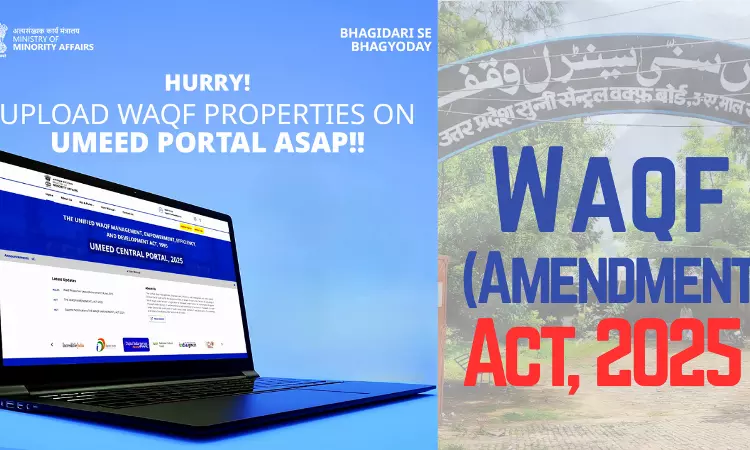
The Ministry of Minority Affairs launched the Unified Waqf Management, Empowerment, Efficiency and Development (UMEED) Portal to create a centralized, transparent, and efficient digital inventory of all Waqf properties across India.
|
Read all about: PARLIAMENT PASSES WAQF (AMENDMENT) BILL 2025 l WAQF ACT AMENDMENTS l WAQF ACT 2025 FACES LEGAL CHALLENGE l SUPREME COURT ON WAQF AMENDMENT ACT |
Waqf is the permanent, irrevocable dedication of property (movable or immovable) by a Muslim for a purpose recognized as pious, religious, or charitable under Muslim law.
Once a property is declared as Waqf, it is considered to be owned by God and cannot be sold, gifted, or mortgaged.
The person who creates the Waqf is known as the Waqif, and the property is managed by a caretaker called a Mutawalli.
The income generated from property is used for the welfare of the community, funding institutions like schools, hospitals, and mosques.
The Ministry of Minority Affairs launched nationwide mission to digitize all Waqf property records via two key portals.
Key Benefits of Waqf Property Digitization
As of December 2025, over 5.17 lakh Waqf properties were initiated for registration on the UMEED portal. (Source: PIB)
Source: livelaw
|
PRACTICE QUESTION Q. What is the primary purpose of the UMEED portal launched by the Government of India? A. To manage and digitize all Waqf properties for transparency. B. To provide direct financial aid to minority students for higher education. C. To facilitate the annual Haj pilgrimage for Indian Muslims. D. To create a grievance redressal system for all minority communities. Answer: A Explanation: The Ministry of Minority Affairs' UMEED portal (Unified Waqf Management, Empowerment, Efficiency and Development) is a centralized digital platform to register, geo-tag, verify, and monitor all Waqf properties nationwide. |
The UMEED (Unified Waqf Management, Empowerment, Efficiency and Development) Portal is a centralised digital platform launched by the Ministry of Minority Affairs to create a transparent, geo-tagged, and verified inventory of all Waqf properties across India.
Under Islamic law, a Waqf is a permanent charitable endowment of a property by an individual or group for religious, pious, or public welfare purposes. Once designated as Waqf, the property cannot be sold or transferred.
UMEED introduces mandatory features that WAMSI lacked, including precise geo-tagging of all properties and a "Maker-Checker-Approver" three-tier verification process to ensure data accuracy and prevent fraudulent entries.






© 2026 iasgyan. All right reserved