The US strike on Venezuela, framed as counter–narco-terrorism, undermines the UN Charter and reflects weakening international law. Economic interests, not drugs, appear central. For India, the episode reinforces the need for strategic autonomy through indigenous defence strength and calibrated multialignment in a fragile global order.
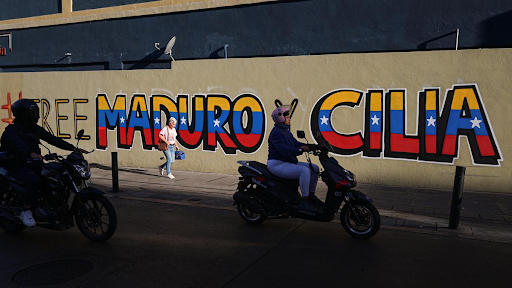
Copyright infringement not intended
Picture Courtesy: THEHINDU
The U.S. military action against Venezuela and the capture of its sitting President amounts to a direct violation of international law and reflects the dangers of a collapsed balance of power in a largely unipolar world dominated by the U.S.
|
Read all about: INDIA'S STRATEGY AGAINST US PRESSURE l US-CHINA RELATIONS IMPACT ON INDIA |
It refers to a foreign policy doctrine where the United States acts independently, prioritizing its own national interests and sovereign autonomy over international consensus or multilateral cooperation.
It is the polar opposite of multilateralism, which emphasizes working through alliances and international organizations like the United Nations (UN) or the World Trade Organization (WTO).
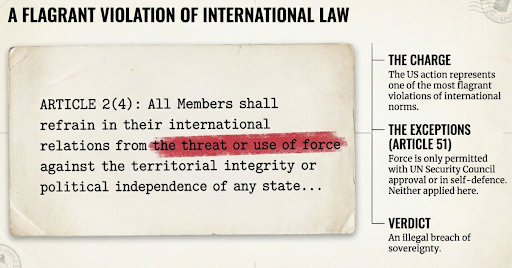
The foundation of modern international law, prohibiting the unilateral use of force by states, is established in the United Nations Charter.
|
Legal Principle |
Provision |
Explanation |
|
Prohibition of Force |
Article 2(4) |
Forbids member states from the threat or use of force against the "territorial integrity or political independence of any state." This is a fundamental rule designed to prevent aggression. |
|
Exceptions to the Rule |
Chapter VII Authority |
The UN Security Council (UNSC) can authorize collective action, including the use of force, to maintain or restore international peace and security. |
|
Right to Self-Defence |
Article 51 grants states an "inherent right" to individual or collective self-defence, but only "if an armed attack occurs" against them. Actions must be necessary and proportionate. |
Case Study: U.S. Policy Towards Venezuela
On January 3, 2026, the US conducted a military Operation “Absolute Resolve” in Caracas to capture President Nicolás Maduro and his wife, on charges of "narco-terrorism".
The U.S. accused the Venezuelan government of sponsoring drug trafficking.
Resource-Driven Motives: Critics argue that a key motivation for U.S. pressure is Venezuela's vast natural resources.
The Cold War Era: A Bipolar Check
During the Cold War, the U.S. and the USSR dominated a bipolar world, creating a tense but stable "balance of power" through the fear of mutual escalation, which deterred unilateral military action.
The Post-Cold War Era: Unipolar Dominance
The dissolution of the Soviet Union in 1991 left the U.S. as the world's sole superpower. This removed the primary check on U.S. power, leading to an increase in military interventions.
According to a U.S. Congressional Research Service report, the U.S. undertook 251 military interventions between 1991 and 2022, a sharp increase compared to the preceding period.
This period also saw the rise of doctrines like "pre-emptive war," which challenge the traditional interpretation of self-defence under Article 51 of the UN Charter.
China as a Long-Term Counter-Balance
China is increasingly viewed as the only realistic long-term counterweight to U.S. dominance.
Russia–China Alignment
The alignment between Moscow and Beijing has intensified as a strategic necessity, though it remains a "tactical" rather than formal military alliance.
Strategic autonomy is crucial for India to prioritize national interests in foreign policy and build comprehensive national power to transition from a balancing power to a leading power in the current geopolitical landscape.
Foreign Policy Implications
Strategic Autonomy and Multi-Alignment: India maintains independent stances on major global conflicts, such as the Russia-Ukraine and Israel-Palestine crises, while simultaneously engaging in diverse forums like the Quad, BRICS, and SCO.
Voice of the Global South: Following the 2023 G20 presidency, India has cemented its role as a leader for emerging economies, advocating for reforms in the UN Security Council and global financial institutions to reflect 21st-century realities.
Pragmatic Economic Diplomacy: India boosts economic resilience through diversified trade deals (UK, EFTA, Oman) and ensures energy security by continuing Russian oil imports despite Western pressure.
Shift to "Shaper" Role: Diplomacy has moved from "non-alignment" to being a "decider" or "shaper" of global rules, particularly in digital governance and climate equity.
National Security Implications
Strategic Deterrence against China: India responds through firm border deterrence, infrastructure development along the Line of Actual Control (LAC), and deepening Indo-Pacific partnerships.
Defense Indigenization: India is pursuing Aatmanirbhar Bharat in defense, with the 2025–26 budget allocating ₹6.81 lakh crore to boost indigenous production of platforms like Tejas aircraft and BrahMos missiles.
Technology as Security: National security now includes "digital strategic autonomy," focusing on securing semiconductor supply chains, AI ethics, and data sovereignty via the Digital Personal Data Protection Act.
Managing Regional Volatility: India faces structural instability in neighborhoods (eg.Bangladesh), the Russia-China-Pakistan nexus, requiring constant "managed escalation" strategies and a "Neighbourhood First" approach to maintain regional stability.
The erosion of a balanced international order leads to power politics overriding international law, weakening multilateralism, which requires India to focus more on self-reliance to maintain strategic autonomy and shape the multipolar world.
Source: THEHINDU
|
PRACTICE QUESTION Q. Critically analyze the impact of U.S. withdrawal from international organizations on the interests of developing nations like India. (150 Words) |
The action violates Article 2(4) of the UN Charter, which prohibits the use of force against the political independence of any state. The U.S. did not act in self-defence (Article 51) nor did it have authorization from the UN Security Council, which are the only two legally permissible exceptions.
'Balance of power' is a principle where states act to prevent any single state from becoming dominant. During the Cold War, the world was bipolar, with the US and the Soviet Union acting as checks on each other. Neither superpower could act with total impunity, as demonstrated by the Soviet counter-deployment during the 1971 India-Pakistan war and the superpower standoff during the 1973 Yom Kippur War.
The dissolution of the Soviet Union ended the bipolar balance of power, leading to a 'unipolar moment' with the U.S. as the sole superpower. This has enabled the U.S. to undertake unilateral military interventions, such as in Iraq (2003) and Libya (2011), without facing geopolitical counter-balance.

© 2026 iasgyan. All right reserved