Description
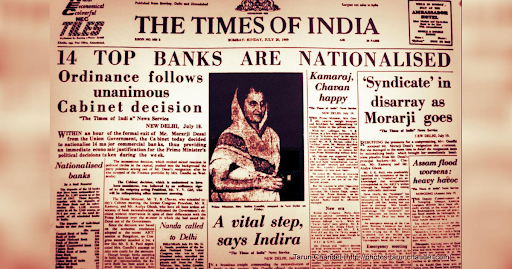
Prime Minister Indira Gandhi spearheaded the nationalisation of banks in India.
Why in News?
Recent discussions regarding the potential privatisation of several public sector banks have brought the 1969 nationalisation back into focus. Analysts and policymakers are re-examining whether the original objectives of financial inclusion and credit parity have been met.
Key Objectives of the 1969 Move
- Financial Inclusion: Before 1969, private banks were primarily concentrated in urban areas, serving large industrial houses. Nationalisation aimed to expand the banking network into rural and semi-urban regions.
- Sectoral Credit Allocation: The government sought to redirect credit toward neglected sectors such as agriculture and small-scale industries, which were vital for the Indian economy but ignored by profit-driven private lenders.
- Ending Class Banking: The policy intended to shift the focus from class banking to mass banking, ensuring that credit was accessible to the common man rather than a few privileged business groups.
- Economic Stability: By bringing major banks under state control, the government aimed to prevent bank failures and protect the savings of the general public.
Impact on the Indian Economy
- Branch Expansion: There was a massive surge in the number of bank branches across India. Rural branches increased significantly, helping to monetize the rural economy and encourage the habit of saving among farmers.
- Green Revolution Support: Nationalised banks provided the necessary credit to farmers to purchase high-yield variety seeds and fertilizers, which was a critical factor in the success of the Green Revolution.
- Priority Sector Lending: The introduction of Priority Sector Lending norms ensured that a fixed percentage of bank credit reached agriculture and small businesses, fostering more equitable growth.
- Public Trust: Government ownership provided a sovereign guarantee to depositors, leading to a massive increase in household savings being funneled into the formal financial system.
Current Challenges and Criticisms
- While nationalisation achieved social goals, it led to certain structural inefficiencies over time.
- Many public sector banks began to struggle with a high volume of non-performing assets, often attributed to political interference in lending decisions and a lack of modern risk assessment tools.
- The lack of competition for several decades also resulted in lower levels of customer service and slower technological adoption compared to the private banks that emerged after the 1991 reforms.
Way Forward
- The banking sector must now strike a balance between social responsibility and commercial viability. Strengthening the autonomy of public sector bank boards is essential to reduce political interference in credit decisions.
- The government should focus on the consolidation of smaller banks to create larger, more resilient entities capable of competing globally.
- Embracing digital banking and financial technology will be crucial for reaching the last mile without the high overhead costs of physical branches.
Conclusion
Bank nationalisation was a defining moment that democratized credit and laid the foundation for rural development in India. While it successfully transitioned the country from class banking to mass banking, the modern economy demands higher efficiency and capital agility.
Source: Indian Express
|
PRACTICE QUESTION
Q. Examine the primary economic objectives behind the nationalization of banks in 1969. To what extent did this move succeed in addressing the credit needs of the 'priority sectors' of the Indian economy? (250 words)
|
|
Key Insights
Public Sector Banks in India are financial institutions where the Union Government or other state-run organizations hold a majority stake of 51 percent or more. These entities play a critical role in achieving financial inclusion and implementing various social welfare schemes across the country. Following major consolidation drives, the number of these banks has been streamlined to improve operational efficiency and capital adequacy. They are regulated by the Reserve Bank of India under the Banking Regulation Act of 1949 and the Reserve Bank of India Act of 1934.
|