"Chips to Ships" diplomacy signals a shift toward high-tech integration, prioritizing semiconductors and maritime modernization. By merging India's "Act East Policy" with South Korea’s Indo-Pacific strategy, this partnership counters regional imbalances, though success requires structural reforms to overcome capital and talent hurdles.
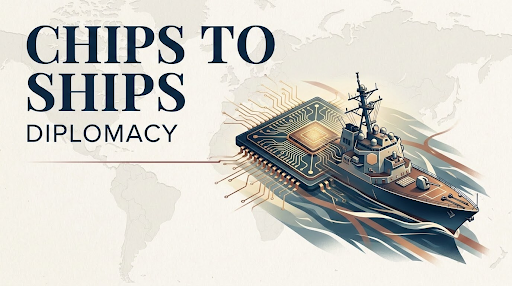
The "Chips to Ships" diplomacy, launched during South Korean President Lee Jae-myung's 2026 visit to India, creates a strategic partnership centered on semiconductor and maritime shipbuilding cooperation
|
Read all about: Growing India-South Korea ties |
"Chips to Ships" Diplomacy is a strategic bilateral framework established between India and South Korea during the state visit of South Korean President Lee Jae-myung to India in April 2026.
This initiative signals a shift in the relationship from a transactional trade partnership to a deep industrial and strategic alliance, focusing on two critical pillars: Semiconductors ("Chips") and Maritime Shipbuilding ("Ships").
South Korea, home to global leaders like Samsung and SK Hynix, is the ideal partner for the India Semiconductor Mission (ISM).
As India aims to become a top-10 global shipbuilder, South Korean expertise—traditionally the world's most advanced—is critical.
Countering Regional Hegemony: Both nations share concerns over maritime disruptions in the Indo-Pacific. Secure chips ensure secure naval hardware; secure ships ensure uninterrupted trade.
Economic De-risking: For South Korea, India offers a massive, stable market and a manufacturing alternative to China ("China Plus One" strategy). For India, Korea offers high-end technology without the political strings of Western powers.
Integrated Logistics: Diplomacy supports the India-Middle East-Europe Economic Corridor (IMEC), as modernized Indian ships will be required to ply these new trade routes.
Economic Security: Creating resilient supply chains for critical technologies that are immune to geopolitical shocks (like the West Asian crisis or tensions in the Taiwan Strait). The leaders set a goal to double bilateral trade to $50 billion by 2030.
"Chips to Ships" diplomacy proves India is evolving beyond service provision. Partnering with South Korea builds a Viksit Bharat focused on technological and maritime sovereignty through co-development and co-production.
Source: ANINEWS
|
PRACTICE QUESTION Q. Evaluate the role of the "China Plus One" strategy in driving South Korea’s recent technological pivots toward the Indian market. 150 words |
It is a bilateral agreement between India and South Korea focusing on joint semiconductor manufacturing (specifically memory chips) and the modernization of India’s commercial and naval shipbuilding infrastructure through technology transfers.
India currently imports over 90% of its semiconductor requirements. Developing a domestic manufacturing base is crucial to prevent massive foreign exchange drains, secure critical defense and electronic systems, and protect the economy from geopolitical shocks like China-Taiwan tensions.
The "China Plus One" strategy refers to the efforts of global companies and nations to diversify their supply chains away from China to avoid weaponization of trade. The India-South Korea partnership leverages South Korea's high-tech capital and India's vast demographics to create a reliable, democratic alternative in Asia.


© 2026 iasgyan. All right reserved