Description
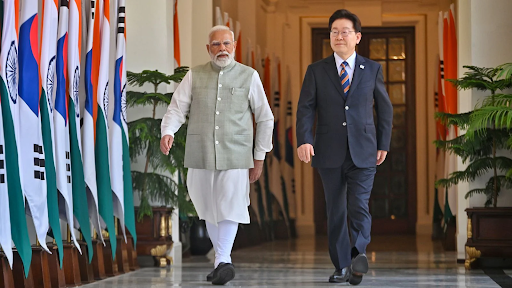
During a bilateral meeting on the sidelines of a regional summit, the leaders of India and South Korea emphasized the transition of their relationship into a more robust strategic partnership.
Why in News?
During a bilateral meeting on the sidelines of a regional summit, the leaders of India and South Korea emphasized the transition of their relationship into a more robust strategic partnership.
Key Areas of Cooperation
- The Digital Bridge: This initiative aims to integrate the digital ecosystems of both nations, focusing on artificial intelligence, 6G technology, and cross-border digital payments to boost the startup sectors in both Delhi and Seoul.
- Semiconductor Resilience: Given South Korea’s global leadership in electronics, both nations agreed to collaborate on building a resilient semiconductor supply chain, with potential South Korean investments in India’s growing chip manufacturing sector.
- Defense and Space: The leaders discussed the second phase of defense industrial cooperation, particularly the joint production of advanced military hardware and collaboration between ISRO and KARI on lunar exploration missions.
- Green Energy: Cooperation in the production of green hydrogen and the development of next-generation EV batteries was highlighted as a priority to meet mutual climate goals.
Strategic Significance of the Partnership
- Indo-Pacific Alignment: Both India and South Korea share a vision for a free, open, and inclusive Indo-Pacific. Their cooperation is vital for regional stability and maintaining a rules-based international order.
- Economic Diversification: For South Korea, India offers a massive market and a manufacturing hub under the Make in India initiative, while for India, South Korea is a critical source of high-end technology and Foreign Direct Investment.
- Supply Chain De-risking: The partnership is a strategic move to diversify global supply chains away from over-dependence on single geographies, ensuring economic security for both democracies.
Challenges in Bilateral Relations
- Trade Imbalance: India has consistently raised concerns regarding the widening trade deficit and has called for a review of the CEPA to allow better market access for Indian steel, rice, and IT services.
- Regulatory Hurdles: Complex administrative procedures and land acquisition issues in India have sometimes slowed down the pace of South Korean industrial projects.
- Geopolitical Pressures: Navigating the complex security dynamics of the Korean Peninsula and the broader competition between major global powers requires constant diplomatic coordination.
Way Forward
- CEPA Upgrade: Both nations must expedite the conclusion of the review of the Comprehensive Economic Partnership Agreement to make it more balanced and modern.
- Special Strategic Partnership: There is a need to move beyond buyer-seller relationships toward joint research, development, and co-production in high-tech industries.
- People-to-People Ties: Strengthening cultural exchanges and simplifying visa processes for students and professionals will build a stronger foundation for long-term cooperation.
Conclusion
The meeting between the leaders of India and South Korea signals a new era of technocratic and strategic synergy. By building a digital bridge and securing critical supply chains, the two nations are positioning themselves as central pillars of the Asian economy.
Source: Indian Express
|
PRACTICE QUESTION
Q. "The shift from 'Chips to Ships' signifies a broadening of the India-South Korea Special Strategic Partnership." Analyze the strategic importance of South Korea in India’s 'Act East Policy'. (250 Words)
|
|
Key Insights
The Act East Policy is a diplomatic initiative launched in 2014 to upgrade the previous Look East Policy by focusing on extended neighborhood relations in the Indo-Pacific region. It emphasizes the 4Cs—Culture, Commerce, Connectivity, and Capacity building—to strengthen ties with ASEAN, Japan, Australia, and South Korea. This strategy aims to promote economic cooperation and security through infrastructure projects like the India-Myanmar-Thailand Trilateral Highway while countering regional hegemony. It essentially transforms India's engagement from purely economic integration into a proactive strategic partnership involving deep military and political collaboration.
|