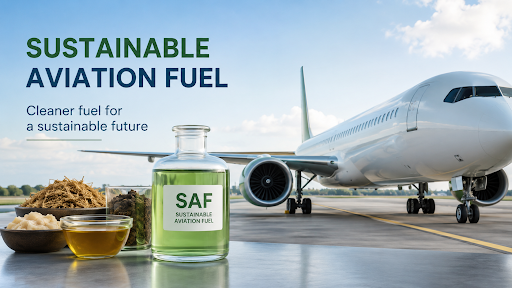
Sustainable Aviation Fuel (SAF) slashes aviation emissions by up to 80% without engine modifications. Leveraging low-cost solar and agricultural residues, India targets 5% blending by 2030, transforming pollution liabilities into a $30 billion export engine while advancing Net-Zero goals.
Why In News?
The Ministry of Petroleum and Natural Gas officially amends Aviation Turbine Fuel (ATF) regulations to enforce a mandatory Sustainable Aviation Fuel (SAF) blending target for international flights.
What is Sustainable Aviation Fuel (SAF)?
Definition: SAF, or aviation biofuel, serves as a replacement for conventional ATF, sharing identical chemical and physical characteristics. It allows airlines to reduce emissions without modifying existing aircraft engines or airport infrastructure.
Composition and Production: Producers utilize four primary chemical pathways:
Environmental Impact: SAF upcycles existing, above-ground carbon, cutting lifecycle greenhouse gas (GHG) emissions by up to 80% compared to fossil-based fuels. It also reduces particulate matter and soot, preventing the formation of polluting condensation trails.
Sources of SAF
Agricultural Residues: India generates 500 million tonnes (MT) of agricultural residue annually. The PBtL (Power-and-Biomass-to-Liquids) pathway gasifies rice straw, wheat straw, and cotton stalks to produce fuel without threatening food security.
Used Cooking Oil (UCO): The hospitality sector provides massive volumes of UCO, though export demand has spiked prices from ₹65/litre to ₹210/litre.
Municipal Solid Waste (MSW): Urban centers transform landfill waste into high-value aviation fuel via the GAS-FT pathway.
Algae-Based Feedstock: Refineries extract lipid-rich oils from algae for the HEFA pipeline.
Biomass Resources: The AtJ pathway leverages India’s sugar industry; utilizing just 4% of surplus crop residue by 2030 secures a 25% share of the global SAF market.
Significance of SAF
Reducing Aviation Emissions: The aviation sector contributes 2.5% of global GHG emissions. SAF decarbonizes flight operations to meet global mobility goals.
Achieving Net-Zero: Aggressive deployment operationalizes India’s 2070 net-zero commitment under the UNFCCC and the aviation sector’s Long-Term Aspirational Goal (LTAG) of net-zero by 2050.
Energy Security: Domestic production dilutes reliance on imported crude oil, shielding the economy from geopolitical price volatility.
Circular Economy: Utilizing agricultural waste for PBtL fuel eliminates stubble burning in northern India, potentially creating a $30 billion export industry.
India’s Advantages in SAF Production
Feedstock Availability: India possesses a theoretical foundation to produce 19 to 24 million tonnes of SAF annually, exceeding the 8-10 million tonnes required for a 50% blend by 2030.
Competitive Costs: India produces SAF at costs 40% lower than global benchmarks by leveraging cheap solar-powered green hydrogen and biomass waste.
Market Growth: As the world’s fastest-growing aviation market, India provides a captive consumption base for initial capital investments.
|
Global Initiatives CORSIA: The Carbon Offsetting and Reduction Scheme for International Aviation (CORSIA) compels airlines to purchase SAF to offset emission growth above the 2020 baseline. EU Mandates: The ReFuelEU Aviation mandate forces airlines to blend 2% SAF by 2025, rising to 70% by 2050. Corporate Action: Aerospace leaders like Airbus engineer aircraft to accept 100% SAF to bypass blending limits. |
Challenges in Scaling SAF
Feedstock Shortages: A lack of streamlined UCO collection infrastructure forces refiners to import high-priced Food Waste Oil (FWO).
High Costs: Capital and operational expenditures for SAF synthesis remain double the price of fossil ATF.
Infrastructure Gaps: India lacks commercial-scale AtJ or PtL facilities, risking a lag behind competitors like Brazil.
Certification Hurdles: The absence of final ASTM certifications for novel pathways stalls project financing.
Government Initiatives
Policy Framework: The National Policy on Biofuels (2018) establishes the legal foundation for advanced bio-ATF.
Technical Roadmaps: The MoPNG Bio-ATF Development Committee and DGCA facilitate demonstration flights, including a successful 25% SAF blend test on a SpiceJet aircraft.
Fiscal Incentives: NITI Aayog proposes slashing GST on SAF to 5% and waiving passenger development fees for green-fuel flights.
Global Biofuel Alliance: India spearheaded this alliance during its 2023 G20 Presidency to standardize certification and expedite technology transfers.
Way Forward
Incentivize Production: The government must deploy Viability Gap Funding (VGF) and green bonds to neutralize high capital costs.
Strengthen R&D: Policymakers must foster India-EU technological synergies to scale PtL architectures.
Public-Private Partnerships: The state must support mega-projects, such as the $110 million IOCL-M11 plant and the 800,000 t/yr Essar SAF facility.
Airport Microgrids: The sector should install localized solar-powered hydrogen microgrids at major hubs like Delhi and Mumbai to eliminate logistics costs.
Conclusion
By leveraging low-cost solar energy and agricultural residues through targeted policy frameworks, India positions itself to transition from a major crude importer to an undisputed global superpower in the Sustainable Aviation Fuel market.
Source: DOWNTOEARTH
|
PRACTICE QUESTION Q. Consider the following statements regarding the production pathways of Sustainable Aviation Fuel (SAF):
Which of the statements given above is/are correct? A) 1 and 2 only B) 1 and 3 only C) 2 and 3 only D) 1, 2, and 3 Answer: B Explanation: Statement 1 is correct: The Power-to-Liquid (PtL) pathway (often called e-fuel or e-jet) creates synthetic kerosene by combining green hydrogen (extracted from water via electrolysis using renewable energy) with captured carbon dioxide (via Direct Air Capture or industrial point sources). Statement 2 is incorrect: The Alcohol-to-Jet (AtJ) pathway relies on alcohols like ethanol, methanol, or isobutanol as its primary feedstocks, which are derived from starch, sugars, or cellulosic biomass (such as corn, sugarcane, or agricultural residues). It is the Hydroprocessed Esters and Fatty Acids (HEFA) pathway that primarily relies on Used Cooking Oil (UCO) and animal fats. Statement 3 is correct: SAF functions as a "drop-in" fuel. When blended with conventional jet fuel up to regulated limits (typically 50%), it matches the chemical and physical properties of fossil jet fuel. It can be utilized in modern aircraft without requiring any modifications to the existing engines, fueling systems, or airport delivery infrastructure. |
Sustainable Aviation Fuel (SAF) is an eco-friendly, drop-in alternative to conventional jet fuel produced from non-fossil waste feedstocks—such as used cooking oil, agricultural residues, animal fats, and municipal solid waste—that meets stringent aviation performance standards.
SAF is crucial because it can reduce lifecycle greenhouse gas emissions by up to 80% compared to traditional jet fuel, serving as the most viable decarbonisation pathway for the hard-to-abate aviation sector to reach net-zero goals.
India can achieve SAF leadership by leveraging its massive surplus of agricultural biomass and used cooking oil, establishing a clear domestic blending mandate, scaling up indigenous production technologies, and attracting green investments into commercial-scale biorefineries.
The primary hurdles include a severe shortage of consistent, high-quality organic feedstocks, high production costs that make SAF two to four times more expensive than fossil jet fuel, and a lack of dedicated refining infrastructure to match global supply demands.

© 2026 iasgyan. All right reserved