Sirpur in Chhattisgarh is a 5th–12th Century multi-religious archaeological landscape featuring Hindu, Buddhist and Jain monuments, including the renowned Lakshmana Temple and Surang Tila complex. As the early-medieval capital of Dakshina Kosala, it showcases advanced urban planning, monastic architecture and a unique riverine cultural setting along the Mahanadi. With well-preserved archaeological integrity and major government initiatives to improve conservation, accessibility and interpretation, Sirpur strongly meets UNESCO’s criteria of outstanding universal value and stands as a compelling candidate for World Heritage inscription.
Copyright infringement not intended
Picture Courtesy: Indian Express
Sirpur, is a 5th–12th Century multi-religious archaeological landscape featuring 34 Hindu, Buddhist and Jain monuments along the Mahanadi.
A UNESCO World Heritage Tag is an international recognition given to places of outstanding universal value in terms of cultural or natural significance. These sites are considered important for all of humanity, transcending national boundaries, and must be preserved for future generations.
Categories of World Heritage Sites
a) Cultural Heritage
Includes monuments, temples, archaeological sites, historic buildings, rock art, ancient towns and landscapes shaped by human creativity.
Example: Taj Mahal, Ajanta Caves, Hampi.
b) Natural Heritage
Includes national parks, forests, biodiversity hotspots, mountains, lakes and ecosystems with exceptional natural value. Example: Kaziranga, Sundarbans, Western Ghats.
c) Mixed Heritage
Sites that combine cultural and natural importance. Example: Khangchendzonga National Park.
India and UNESCO World Heritage Sites:
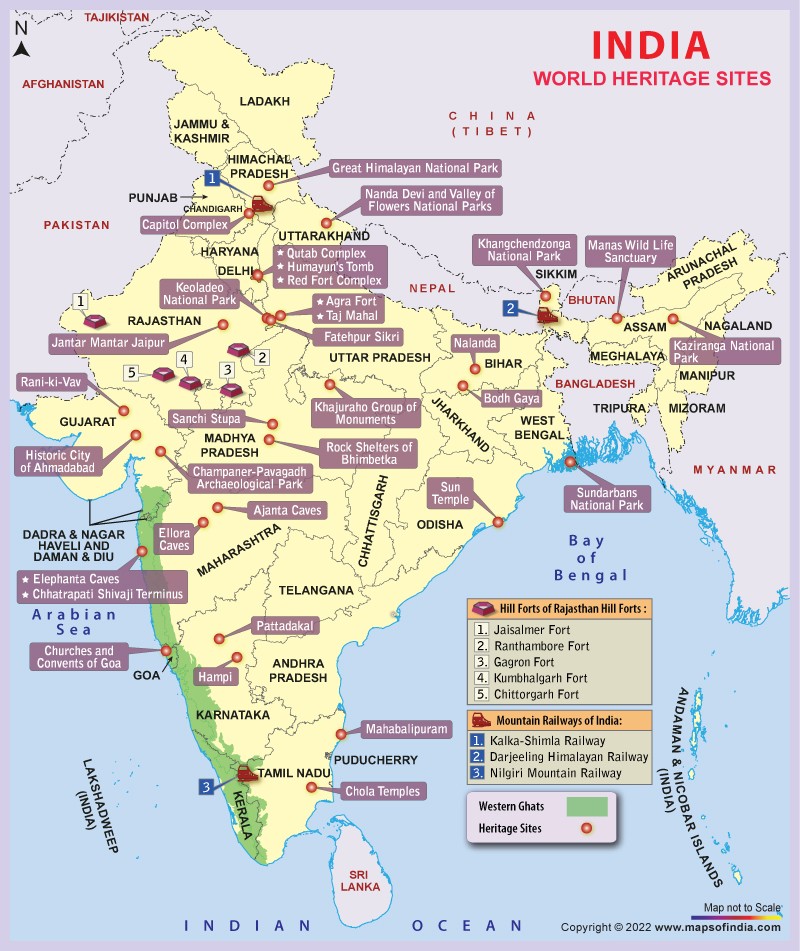
Picture Courtesy: Maps of India
Historical Significance
Flourishing capital of Dakshina Kosala: From the 5th to 12th Century CE, Sirpur (Shripur or Sripura) served as the thriving capital of Dakshina Kosala, ruled first by the Panduvanshi and later the Somavamshi kings. The city’s political prominence enabled major temple-building activity, monastic expansion and sophisticated urban development.
Early-medieval urban centre: Excavations have revealed palace complexes, market structures, residential quarters, warehouses, granaries, and an organised water management system. These point to Sirpur’s importance as a planned urban centre, blending administrative efficiency with ceremonial landscapes.
Rich archaeological Discoveries: Site excavations—initiated by Alexander Cunningham in 1882 and expanded in the 1950s, 1990s and early 2000s—have uncovered:
Excavated stupas, meditation cells, terracotta artefacts, inscriptions and coins
These finds trace the city’s evolution from the 5th Century onwards.
Hub of religious scholarship and trade: Sirpur’s strategic location along the Mahanadi river made it a centre for trade, pilgrimage and intellectual exchange, linking eastern and central India.
Cultural Significance
Multi-religious coexistence: Sirpur is one of India’s finest examples of religious pluralism in antiquity. Hindu, Buddhist and Jain traditions prospered simultaneously without conflict.
Strong Buddhist heritage: Sirpur was a major Buddhist monastic centre, attracting monks and scholars from across Asia. The Tivaradeva Mahavihara contains an important Buddha statue. Chinese traveller Xuanzang is believed to have referred to this region during his travels.
Sacred riverine cultural landscape: Situated on the banks of the Mahanadi, the site blends nature and spirituality through ghats, temple clusters, water channels and ritual pathways. This aligns with UNESCO’s concept of combined cultural and natural heritage.
Living cultural identity: Local art, crafts and festivals connected to Sirpur’s past continue to reinforce its significance in regional memory. The unique blend of tribal and classical traditions enriches the cultural profile of the region.
Architectural Significance
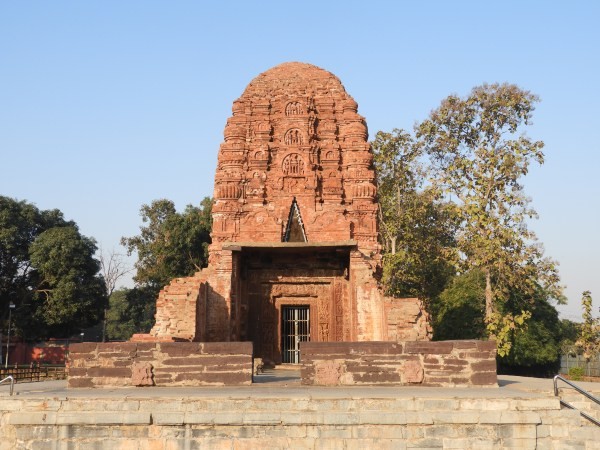
The Lakshmana Temple: Built in the 7th Century, the Lakshmana Temple is one of India’s earliest and best-preserved brick temples.
Key features:
Surang Tila (A monumental temple complex): Surang Tila stands on a high terrace accessed via 37 steep steps, creating dramatic visual impact. It contains multiple shrines arranged in the panchayatana format, showcasing:
Buddhist monastic complexes: The site’s Buddhist viharas and stupas display typical Buddhist architectural planning:
Structural harmony and urban layout: Sirpur’s architecture combines religious, civic and residential spaces in a unified plan. The coordinated placement of temples, markets, monasteries and administrative structures reveals an advanced urban design tradition in early-medieval central India.
Masonry, terracotta and sculptural art: The site preserves fine terracotta figurines, carved stone panels, inscriptions, moulded bricks and ornamental motifs representing Shaiva, Vaishnava, Shakta, Buddhist and Jain iconography.
Outstanding universal value (OUV) across religions: Sirpur is one of India’s rare archaeological landscapes where Hindu, Buddhist and Jain traditions flourished together from the 5th to 12th Century. The co-existence of 22 Shiva temples, five Vishnu temples, 10 Buddhist viharas and three Jain viharas demonstrates an unparalleled cultural synthesis—meeting UNESCO’s criteria of illustrating exceptional human interchange and spiritual coexistence.
Exceptional early-medieval urban planning: Sirpur offers an unusually well-preserved example of early-medieval urban design, with evidence of palace complexes, civic structures, markets, residential quarters and a sophisticated water management system. Few sites in central India display such clarity of urban organisation, administrative layout and settlement planning.
This aligns strongly with UNESCO’s cultural criteria related to unique architectural ensembles and historical urban landscapes.
Architectural masterpieces of the 5th–8th centuries: The Lakshmana Temple, one of India’s oldest surviving brick temples, showcases refined brick bonding, ornate carvings and a panchayatana layout. The dramatic Surang Tila complex, with its elevated plinth and 37 steep steps, represents advanced temple engineering and multi-shrine construction.
These monuments exemplify artistic achievement, structural innovation and architectural diversity, fulfilling UNESCO’s criterion of outstanding creative genius.
Riverine sacred cultural landscape: Located along the Mahanadi River, Sirpur integrates nature with religious architecture. The ghats, temple clusters, water channels and sacred pathways form a harmonious riverine cultural landscape. This combination of natural and cultural elements is a strong argument under UNESCO’s concept of “combined heritage,” strengthening authenticity and contextual integrity.
Sirpur’s unique blend of Hindu, Buddhist and Jain heritage, its exceptional early-medieval architecture, and its well-preserved urban and riverine cultural landscape make it a site of rare historical and artistic value. With strong archaeological integrity and renewed conservation efforts by the government, Sirpur clearly meets UNESCO’s criteria of outstanding universal value. Granting it World Heritage status would not only safeguard this remarkable legacy but also bring global recognition to one of India’s most significant early-medieval cultural centres.
Source: Indian Express
|
Practice Question Q. Sirpur in Chhattisgarh is increasingly viewed as a strong contender for UNESCO World Heritage status. Discuss (150 words) |
It served as the capital of Dakshina Kosala between the 5th and 12th centuries and reveals evidence of a major early-medieval urban centre with temples, monasteries, markets and palace complexes.
Sirpur represents harmonious coexistence of Hindu, Buddhist and Jain traditions, with 22 Shiva temples, five Vishnu temples, 10 Buddhist viharas and three Jain viharas found in the same landscape.
The Lakshmana Temple is one of India’s finest early brick temples, while the Surang Tila complex stands out for its elevated plinth, dramatic stairway and panchayatana design. Large Buddhist viharas and stupas add to its architectural diversity.


© 2026 iasgyan. All right reserved